
Choosing the Right Surface Additive: Silicone vs. Silicone-Free Leveling Agents in Modern Coatings

Formulators face a critical decision during paint development. Every liquid coating requires precise surface tension control to achieve a flawless finish. Without the right surface additive, your coating will suffer from orange peel, craters, or air entrapment.
The market offers two primary paths: silicone-based additives and silicone-free alternatives. Each chemistry has unique strengths and weaknesses depending on the resin matrix.
Understanding how these technologies interact with different coating systems allows you to optimize your formulas effectively. Let us break down the core science behind these additives and look at how to choose the right one for your specific system.
1. The Core Chemistry: Silicone, Acrylic, and Fluorocarbon Leveling Agents
To make the right choice, you must first understand the fundamental differences between the three main classes of leveling additives.
Silicone Leveling Agents
These additives typically consist of polyether-modified siloxanes. They possess an incredibly flexible silicone backbone that lowers the surface tension of liquid coatings dramatically. This sharp reduction allows the paint to wet out difficult substrates effortlessly. Modern types, like polyether siloxanecopolymers, combine this powerful surface action with highly compatible polyether segments.
Acrylic (Silicone-Free) Leveling Agents
These polymers usually rely on polyacrylates. They do not lower surface tension aggressively. Instead, they migrate to the surface to create a uniform, equalized surface tension layer. They excel at eliminating orange peel and long-wave waviness, but they cannot fix severe substrate wetting issues or craters.
Fluorocarbon Leveling Agents
Fluorocarbon additives are specialized surfactants that lower surface tension even more than silicones. They provide extreme wetting capabilities on highly contaminated or oily surfaces. However, they are expensive, face growing environmental regulations, and can cause severe foaming problems if misused.
2. Viscosity and Flow: Why High-Viscosity Systems Demand Silicone Copolymers
When you formulate low-VOC, high-solid, or solvent-free coatings, you lose the thinning benefits of volatile solvents. As a result, these modern coating systems maintain a very high application viscosity throughout the spraying and curing processes.
High viscosity acts like a physical cage for air. When you mix, pump, or spray thick coatings, you trap massive amounts of air into the wet film. Because the liquid matrix is dense, these tiny air bubbles cannot rise to the surface easily.
Silicone-free acrylic leveling agents lack the unique physical power to solve this issue. They only focus on surface flatting, leaving micro-foam trapped underneath the surface.
This severe limitation is exactly why high-viscosity systems prefer advanced silicone copolymers like S-1484 from DongGuan SailAdditive. S-1484 delivers a unique dual-action mechanism engineered for solvent-free and high-solid systems.
The silicone backbone lowers surface tension rapidly to ensure uniform flow. Simultaneously, the polyether modification actively destabilizes bubble walls. This action forces tiny micro-bubbles to merge into larger ones, helping them escape the thick resin matrix and pop cleanly before the coating crosslinks.
3. Surface Power: Deep Dive into Anti-Cratering and Slip Performance
A major advantage of using a high-quality silicone leveling agent is the secondary benefits it brings to the cured film. Acrylic leveling agents only improve flatness; they do not change the physical feel or resistance of the surface.
Active Anti-Cratering Protection
Craters happen when a high-surface-tension coating encounters a low-surface-tension contaminant, like a drop of machine oil or a particle of dust. The liquid paint naturally pulls away from the contaminant, leaving an ugly, bowl-shaped recess.
Because S-1484 contains a highly active polyether siloxanecopolymer structure, it lowers the overall surface tension of the paint immediately. This sharp reduction prevents the paint from pulling back, completely eliminating craters and fish-eyes.
Surface Slip and Scratch Resistance
The silicone segments of S-1484 orient themselves toward the coating-air interface. Once cured, they create a highly smooth, slippery top layer. This surface slip reduces the friction coefficient of the film significantly. When objects slide across the coating, they glide smoothly off the surface rather than digging into it, which improves the scratch and mar resistance of the coating dramatically.
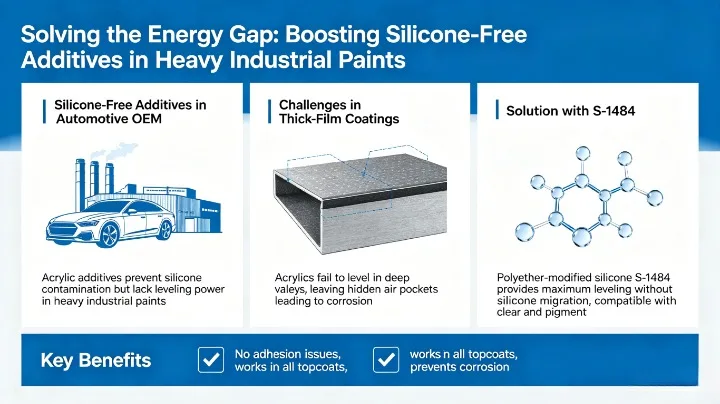
4. Solving the Energy Gap: Boosting Silicone-Free Additives in Heavy Industrial Paints
Silicone-free acrylic additives are popular in applications where formulators fear silicone contamination, such as automotive OEM lines. However, acrylics often lack the energy and drive to level out properly in heavy industrial paints. Thick-film epoxy or polyurethane coatings require a powerful force to spread smoothly over rough, blasted steel.
If you rely solely on a standard acrylic leveling agent in heavy industrial coatings, you will often find its leveling dynamics insufficient. The paint will fail to flow into the deep microscopic valleys of the substrate, leaving tiny, hidden air pockets beneath the paint film. These hidden gaps lead to premature corrosion and coating delamination.
To fix this energy gap without using pure silicone oils, you must upgrade your formula with a highly compatible, polyether-modified silicone leveling agent like S-1484. Unlike traditional silicone oils that migrate uncontrollably and destroy adhesion, S-1484 provides maximum leveling power without compromising inter-coat adhesion. It works cleanly in both transparent clear coats and highly pigmented topcoats.
In the global industrial market, TEGO® Glide 1484 by Evonik is a famous industry benchmark known for balancing flow and degassing in tough systems. If you want to check out other premium, globally recognized surface surfactants with similar leveling capabilities, you can review the BYK Additives Product Portfolio to explore their advanced silicone solutions.
If you want a highly efficient, cost-effective alternative that delivers an identical performance match to TEGO-1484, S-1484 is the perfect answer.
5. Matching Guide: Aligning Additives with Film Thickness and Curing Methods
Choosing between a silicone or silicone-free additive requires a careful analysis of your film thickness and curing setup. Follow this matching guide to optimize your system:
Thick-Film Systems (>100)
Thick-film industrial floor coatings and heavy-duty protective paints trap massive amounts of air. Acrylics cannot release these bubbles. You must use a powerful degassing silicone copolymer like S-1484 to achieve a high-gloss, bubble-free surface.
Ultra-Thin Clear Coats (<25)
For very thin wood finishes or plastic coatings, acrylics excel at removing fine orange peel. However, if your substrate contains micro-dust or oil, you should add a low-dosage silicone leveling agent like S-1484 to prevent craters.
UV-Cured and Fast-Curing Systems
UV coatings cure in fractions of a second. This incredibly fast chemical crosslinking leaves almost zero time for the liquid paint to flow out naturally. For UV systems, you need the rapid surface migration of a polyether siloxanecopolymer to flatten the surface instantly before the UV lamps lock the molecules into place.
Technical Data Sheet (TDS) Summary for S-1484
To help your lab team evaluate this product, here are the certified physical properties of S-1484 from its technical documentation:
| Property / Parameter | Value / Specification PDF | Practical Application Benefit |
| Chemical Structure | Polyether siloxanecopolymer | Delivers ideal balance of flow and active degassing. |
| Exterior / Appearance | Light yellow to amber transparent liquid | Guarantees zero yellowing or haziness in clear coats. |
| Viscosity ($25^\circ\text{C}$) | 300-500 | Provides easy blending into waterborne or high-solid bases. |
| Density ($25^\circ\text{C}$) | 1.440-1.450 | Allows accurate volumetric dosing during paint mixing. |
| Non-Volatile Matter | 120^ | Eco-friendly composition with zero volatile organic solvents. |
Factory Application Checklist
- Target Systems: Highly effective in floor coatings, protective coatings, general industrial coatings, and wood coatings.
- Recommended Dosage: Keep the addition level within the standard range of 0.05% to 0.5% of the total formula weight. Always start your testing at the lowest level.
- Proper Incorporation: Always add S-1484 during the paint mixing stage to ensure optimal, homogeneous distribution throughout the matrix.
- Commercial Packaging: S-1484 comes in flexible 25L barrels or large-scale 200L plastic/steel drums.
- Storage and Handling: Store the product in its original airtight container in a cool, dry place. It provides a stable shelf life of 24 months.
- Safe Logistics: You can transport S-1484 easily and safely as a non-hazardous chemical.
Do you want to optimize the surface performance and anti-cratering properties of your formulas? Contact the technical team at DongGuan SailAdditive to schedule an expert chemical consultation or request your evaluation sample of S-1484 today