
The R&D Masterclass: How Polyether Siloxanecopolymer Structure Dictates Leveling Performance

In the world of coating formulation, achieving a perfect, mirror-like surface finish is a precise science. Formulators often view additives as magic drops that instantly cure orange peel, craters, and pinholes. However, experienced R&D specialists know that surface performance depends entirely on molecular architecture.
The polyether siloxanecopolymer represents one of the most versatile backbones in surfactant chemistry. By tweaking its chemical segments, synthesis experts can radically alter how a coating behaves at the interface.
Understanding this relationship between structure and property allows formulators to choose the ultimate silicone leveling agent for their systems. Let us dissect the molecular physics behind these high-performance additives.
1. Tuning Surface Activity: The Balance of Silicone Backbones and Polyether Segments
To understand how a polyether siloxanecopolymer operates, you must look closely at its dual-nature chemical structure. The molecule consists of two primary components: a hydrophobic silicone backbone and hydrophilic polyether modification chains.
The Silicone Backbone
The dimethylsiloxane backbone provides an extremely low natural surface tension. This chemical structure provides the primary driving force for the additive, pushing it to migrate rapidly out of the bulk resin matrix toward the coating-air interface.
The Polyether Chain Segments
The attached polyether chains act as a compatibilizing anchor. They interact directly with the polar components of the resin system, preventing the silicone from separating into large, slick droplets.
By precisely adjusting the ratio of silicone to polyether, chemical engineers can tune the surfactant’s surface activity. A high silicone ratio drops surface tension aggressively to fix severe substrate wetting issues. Conversely, a higher polyether ratio prioritizes compatibility, making the additive safer for sensitive resin matrices.
2. Viscosity and Clarity: How Molecular Weight Drives Compatibility and Haze
When an R&D team designs a new silicone leveling agent, molecular weight distribution is a critical dial. The length of the polymer chains dictates how easily the additive disperses into a liquid paint matrix.
If the molecular weight is too high, the polymer chains become bulky and incompatible. When you mix a high-molecular-weight silicone into a clear varnish, the incompatible molecules aggregate into microscopic clusters. These clusters scatter incoming light waves, turning a beautiful transparent topcoat into a cloudy, hazy finish.
This critical balance is where S-1484 from DongGuan SailAdditive shines. It features an expertly optimized polyether siloxanecopolymer chain length. According to its technical documentation (TDS), it maintains a precise viscosity of 300 to 500 $mm^2/s$ at 25°C. This tightly controlled molecular size ensures excellent, homogeneous distribution throughout the paint matrix , providing high-gloss, bubble-free surfaces without risking optical haze or cloudiness.
3. The Dual-Action Secret: Balancing Fluid Leveling with Active Defoaming
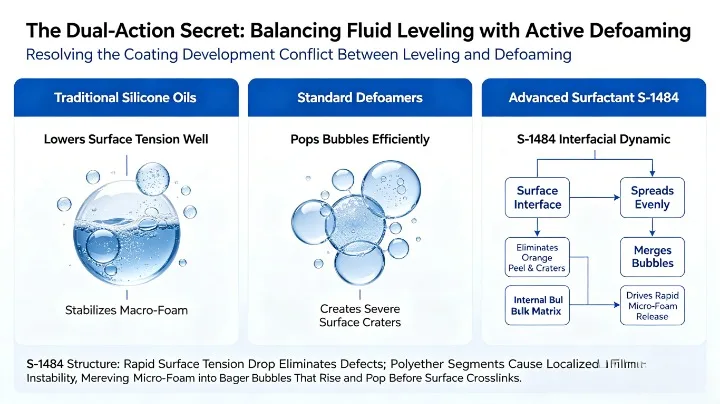
A major engineering challenge in coatings development is the historical conflict between leveling and defoaming. Traditional silicone oils lower surface tension well, but they stabilize macro-foam. Standard defoamers pop bubbles efficiently, but they create severe surface craters.
Advanced surfactants like S-1484 break this trade-off by combining excellent leveling and powerful degassing properties into a single molecule.
[S-1484 Interfacial Dynamic]
   │
   ├── Surface Interface ──> Spreads Evenly ────> Eliminates Orange Peel & Craters
   │
   └── Internal Bulk Matrix ──> Merges Bubbles ──> Drives Rapid Micro-Foam Release
The specific structure of S-1484 allows it to drop surface tension rapidly at the coating-air interface to eliminate orange peel and craters. Simultaneously, the polyether segments create localized film instability around internal bubbles. This action forces tiny, stubborn micro-foam bubbles to merge into larger ones. These larger bubbles gain enough physical buoyancy to rise quickly through thick-film formulations and pop cleanly before the surface crosslinks.
4. Formulation Trends: Custom Additive Architectures for Clear Coats vs. Pigmented Systems
Modern paint recipes are highly complex, driving a strong R&D trend toward custom additive selection. Clear topcoats and highly pigmented enamels require very different surface dynamics.
Clear Coat Requirements
Clear varnishes demand absolute optical transparency. The additive must dissolve perfectly into the resin phase to avoid scattering light. S-1484 features a light yellow to amber transparent liquid appearance that blends flawlessly into clear topcoats without causing discoloration.
Pigmented System Requirements
Pigmented coatings contain high concentrations of titanium dioxide, carbon black, or extenders. These solid particles alter the internal rheology and create rough surface patterns. For these formulas, you need an active surfactant that can wet out pigment surfaces while maintaining excellent surface flow. S-1484 serves as a highly versatile choice for both clear and pigmented topcoats.
In the global premium market, TEGO® Glide 1484 by Evonik is a famous industry benchmark known for its tailored molecular structure. If you want to check out other premium, globally recognized surface surfactants with similar leveling capabilities, you can review the BYK Additives Product Portfolio to explore their advanced silicone solutions.
For manufacturers seeking maximum cost-efficiency, S-1484 acts as a direct performance match to TEGO-1484, allowing a seamless replacement without sacrificing quality.
5. Advanced Verification: Proving Interfacial Alignment in the Lab
How do coating R&D experts prove that a silicone leveling agent has aligned correctly at the surface? Modern laboratories utilize advanced characterization tools to confirm this molecular orientation:
Dynamic Surface Tension (DST)
Chemists use bubble pressure tensiometers to measure how fast an additive drops surface tension over milliseconds. This test proves how quickly the polyether siloxanecopolymer molecules migrate from the bulk paint to a newly created surface.
GPC Viscosity Analysis
Using Gel Permeation Chromatography allows the lab to track the precise polymer backbone size. S-1484 maintains a stable density of 1.440 to 1.450 at 25°C, confirming its uniform synthesis and batch-to-batch repeatability.
Contact Angle Goniometry
By dropping water onto a cured coating film, researchers measure the contact angle. A high contact angle proves that the silicone backbone has successfully oriented itself outward, creating a smooth, slip-resistant, and scratch-resistant top layer.
Technical Specification Checklist for S-1484
To help your R&D team integrate this polyether siloxanecopolymer into your current lines, here is the certified technical data from the official TDS:
- Chemical Component: Polyether siloxanecopolymer
- Non-Volatile Matter Content: 100% (Tested at 120°C for 2 hours)
- Standard Dosage: Use 0.05% to 0.5% of the total formula weight.
- Incorporation Phase: Add S-1484 during the paint mixing stage to ensure optimal, homogeneous distribution.
- Target Applications: Floor coatings, industrial protective coatings, general industrial finishes, and high-solid wood coatings.
- Packaging & Logistics: Available in 25L barrels or 200L plastic/steel drums. It transports safely as a non-hazardous chemical.
- Storage Life: Keep in an airtight container for up to 24 months in a cool, dry place.
Are you ready to optimize your coating surfaces at a molecular level? Contact the technical engineering specialists at DongGuan SailAdditive to schedule a chemical consultation or request a free evaluation sample of S-1484 today.