
Mastering the Synergy: Flow Control and Pigment Anti-Floating in High-Performance Pigmented Coatings

Formulating high-performance pigmented coatings is a complex balancing act. Unlike clear varnishes, colored paints contain a heavy load of solid pigment particles. These particles introduce serious interfacial challenges.
Formulators frequently face a dual disaster: the coating surface develops a wavy, uneven texture, while the color splits into ugly streaks or patches. This separating of colors destroys both the visual beauty and the color consistency of the paint.
To solve these interconnected issues, you cannot treat flow control and pigment stability as separate problems. You must understand the deep synergy between your dispersing package and your silicone leveling agent. Let us explore how next-generation surface additives optimize colored topcoats completely.
1. The Color Split: How Poor Wetting Triggers Floating and Flooding
Floating and flooding are two of the most frustrating defects in pigmented enamels. They occur because different pigments in a blended paint matrix separate from one another during the drying process.
The Dynamics of Floating
Floating appears as a mottled, patchy, or streaky color distribution on the cured surface. For example, if you blend a green paint using phthalocyanine blue and chrome yellow pigments, poor wetting can cause the blue pigment to concentrate in certain areas while the yellow clusters in others. This defect ruins color uniformity completely.
The Root Cause
This separation happens because pigments vary widely in particle size, density, and surface chemistry. If the liquid resin matrix suffers from poor substrate wetting or high internal surface tension, the system cannot hold these diverse particles in a stable suspension. As the paint film moves and flows during application, the un-stabilized pigments drift apart, migrating to different zones of the wet layer and destroying the color profile.
2. Dynamic Teamwork: How Leveling Agents Assist Pigment Dispersants
To stabilize a high-concentration pigment paste, formulators always rely on wetting and dispersing additives. These dispersants wrap around raw pigment particles to provide steric hindrance or electrostatic repulsion. However, dispersants cannot do the job alone in thick-film or high-viscosity coatings.
Introducing a high-performance silicone leveling agent provides a massive boost to your dispersion stability. This chemical teamwork happens through a brilliant interfacial synergy:
Surface Energy Reduction
Advanced surfactants lower the overall surface tension of the liquid resin matrix aggressively. This drop allows the base resin to wet out the surfaces of raw pigment particles much more efficiently during the grind phase.
Improved Steric Freedom
By equalizing the surface tension throughout the system, the leveling agent prevents the formation of localized tension zones. This uniform environment allows dispersants to align correctly around each pigment particle without experiencing disruptive internal pulling forces.
By choosing a highly active polyether siloxanecopolymer like S-1484 from DongGuan SailAdditive, you gain a perfect balance of excellent leveling and powerful degassing properties. This dual-action chemistry ensures that your high-solid colored topcoats flow smoothly while maintaining flawless pigment distribution.
3. Banishing the Vortex: Eliminating Benard Cells and Surface Roughness
When a wet film cures, it experiences a hidden physical phenomenon known as Benard cell formation. This convective movement can completely destroy the mirror-like finish of your industrial paint.
The Physics of Benard Cells
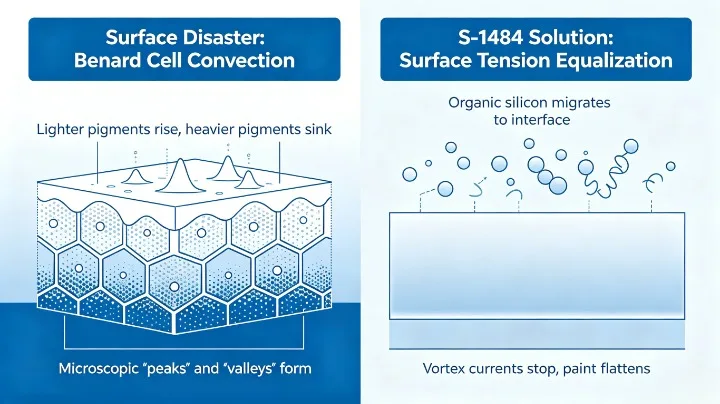
As solvents evaporate from a wet layer, or as chemical crosslinking generates heat, temperature and density gradients form within the film. Cooler, denser liquid at the top sinks down, while warmer, lighter liquid from the bottom rises to the top. This circular movement creates microscopic convection currents that arrange themselves into hexagonal vortex structures called Benard cells.
[Benard Cell Cross-Section]
    Surface:   ▼  Peak  ▲      ▲  Peak  ▼
               │        │      │        │
    Movement:  └──Sinks─┘      └──Rises─┘
The Surface Disaster
In a pigmented coating, these vortex currents carry smaller, lighter pigment particles up to the surface along the cell edges, while heavier pigments sink into the cell centers. This action causes a permanent hexagonal pattern of color separation. Even worse, the rising currents push up the wet film, creating microscopic “peaks” and “valleys” that lock into place as the coating cures, causing severe orange peel and surface roughness.
S-1484 eliminates this issue completely. The organic silicon backbone possesses incredibly low surface tension, forcing the molecules to migrate rapidly to the coating-air interface. Once there, it equalizes the surface tension across the entire liquid top layer, completely shutting down the surface tension gradients that drive Benard cell convection. The vortex currents stop instantly, allowing the paint to flatten into a perfectly uniform, smooth-as-glass layer.
4. Unlocking True Color: Maximizing Color Development and Final Gloss
A coating’s visual appeal depends entirely on how light interacts with its surface. If your pigmented topcoat suffers from micro-defects or microscopic pigment aggregation, it will scatter incoming light in random directions, leading to a dull, low-gloss finish with poor color depth.
Achieving maximum color development and a striking high-gloss finish requires perfect surface flatting and active air release. S-1484 is specifically engineered for solvent-free and high-solid systems, where high viscosity usually traps micro-foam.
The polyether modification in S-1484 forces tiny, stubborn micro-bubbles to merge into larger ones, allowing them to rise swiftly through dense pigment matrices and pop cleanly before the surface crosslinks. This active degassing prevents sub-surface voids. Combined with its excellent leveling power, it ensures that light reflects uniformly off the cured film, delivering an unblemished, deep, and brilliant color tone.
In the premium international market, TEGO® Glide 1484 by Evonik is a famous industry benchmark known for balancing flow and pigment stability in demanding clear and pigmented systems. If you want to check out other globally recognized options with similar high-performance surface capabilities, you can review the BYK Additives Product Catalog to examine their advanced silicone and leveling chemistry.
For manufacturers seeking a cost-effective solution without compromising quality, S-1484 serves as a direct, high-performance alternative to TEGO-1484. It matches the benchmark’s optical clarity, gloss performance, and pigment-stabilizing traits flawlessly.
5. The Complete Formula Strategy: Resolving Surface Defects in Multi-Component Enamels
To achieve a flawless finish in multi-component industrial enamels under real-world factory conditions, formulators should implement a structured, comprehensive additive strategy.
Technical Data Sheet (TDS) Summary for S-1484
To assist your formulation team during evaluation, here are the certified physical properties of S-1484 from its official technical documentation:
| Property / Parameter | Certified Value / Specification | Practical Benefit for Pigmented Paints |
| Chemical Structure | Polyether siloxanecopolymer | Delivers ideal balance of flow and active degassing. |
| Exterior / Appearance | Light yellow to amber transparent liquid | Ensures no discoloration or yellowing in light pastel shades. |
| Viscosity ($25^\circ\text{C}$) | 300-500 | Guarantees smooth blending and accurate volumetric pumpability. |
| Density ($25^\circ\text{C}$) | 1.440-1.450 | Critical for precise volumetric dosing during factory manufacturing. |
| Non-Volatile Matter | 120^ | Solvent-free composition, perfect for ultra-low VOC formulas. |
Practical Formulation Checklist
Follow these engineering guidelines to ensure seamless integration into your production lines:
- Target Applications: Highly effective in floor coatings, protective industrial coatings, general industrial finishes, and high-solid wood coatings. It acts as a versatile choice for both clear and pigmented topcoats.
- Strict Dosage Control: Keep the addition level within the standard recommended range of 0.05% to 0.5% of the total formula weight. Always run a ladder study to find the lowest optimal dosage for your specific pigment loading.
- Proper Incorporation Phase: Always add S-1484 during the paint mixing stage. This timing guarantees an optimal, homogeneous distribution throughout the high-viscosity resin system before the final milling or filtering.
- Inter-Coat Adhesion Safety: Unlike traditional silicone oils that migrate uncontrollably and leave a greasy residue, S-1484 provides a high-gloss, bubble-free surface without compromising inter-coat adhesion. You can safely apply subsequent multi-layer topcoats without risking peeling or delamination.
- Packaging and Storage: The product comes in convenient 25L barrels or large-scale 200L plastic/steel drums. Store it in its original airtight container for up to 24 months in a cool, dry place.
- Safe Logistics: You can transport S-1484 easily and safely as a non-hazardous chemical.
Reminder: The technical parameters provided in this documentation are typical values for reference only. Because factory usage conditions vary, users should always conduct relevant laboratory tests before full commercial adoption.
Do you want to eliminate Benard cells and unlock deep color consistency in your pigmented coatings? Contact the expert technical engineering team at DongGuan SailAdditive to schedule a chemical consultation or request your testing sample of S-1484 today