
How to Choose a High-Performance Alternative to BYK-323?

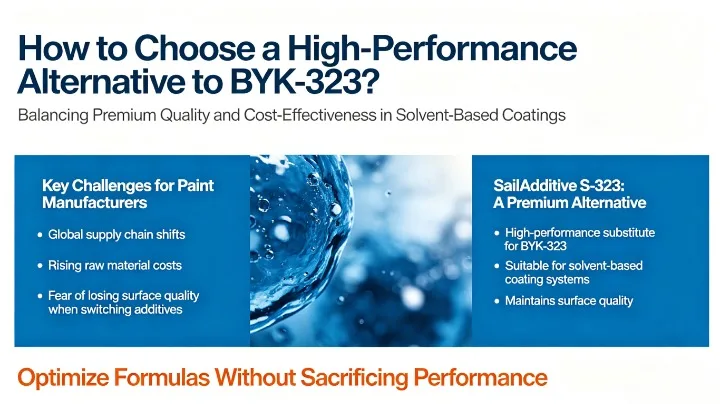
Finding the perfect balance between premium quality and cost-effectiveness remains a major challenge for paint manufacturers today. Global supply chain shifts and rising raw material costs constantly force procurement managers to look for smarter alternatives. However, shifting to a new additive can feel risky if you fear losing surface quality.
If you want to optimize your formulas without sacrificing performance, finding a reliable alternative to industry standards is the best step forward. In this guide, we will explore how SailAdditive S-323 serves as a premium, high-performance alternative to BYK-323 for solvent-based coating systems.
Understanding the Market Demand for Cost-Effective Coating Additives
The modern coating industry moves fast, and competition is fierce. Manufacturers must produce flawless coatings while keeping production costs low. High-end international additives often carry hefty price premiums, which directly eat into your profit margins.
Because of this pressure, technical teams actively search for local, dependable suppliers who offer identical performance. A cost-effective additive does not mean low quality. Instead, it represents smart engineering that delivers premium surface aesthetics at a highly competitive price point.
Chemical Structure Comparison: S-323 vs. Traditional Silicone Agents
To understand why a leveling agent works, we must look at its chemical molecular backbone. Traditional, unmodified silicone agents often cause heavy foam stabilization or compatibility issues in solvent-borne paints.
SailAdditive S-323 utilizes an advanced polyether-modified polydimethylsiloxane copolymer structure. This specific chemical modification allows the additive to reduce surface tension slightly and stabilize flow smoothly. Unlike raw silicone oils, this polyether modification ensures excellent system compatibility and delivers unique deaeration effects rather than trapping unwanted air.
How SailAdditive S-323 Matches the Exact Performance of BYK-323
When you evaluate a substitute, performance metrics must align perfectly with your standards. S-323 functions as a direct rival to premium market solutions. It provides exceptional thermal stability up to $250^C, making it a top choice for demanding furniture coatings and high-temperature wood paints.
Furthermore, S-323 shines brightly in matte systems by ensuring strong matting agent orientation. It also facilitates the precise, uniform alignment of aluminum pigments in metallic coatings.
If you currently source from global brands, you might be familiar with BYK-323, a well-known industry standard for solvent-borne systems. SailAdditive engineered S-323 to match these exact performance benchmarks, ensuring your film consistency remains flawless.
Cost Benefits of Switching to Premium Domestic Leveling Agents
Switching your supply chain to SailAdditive S-323 brings immediate financial and logistics advantages. First, you significantly reduce raw material procurement costs per kilogram. Second, our stable supply chain reduces your lead times, allowing you to maintain lower safety stocks in your warehouse.
Additionally, S-323 boasts a highly active content profile with non-volatile matter exceeding 97%. Since a standard dosage only requires 0.05% to 0.3% of the total formula, a single 25L or 200L barrel goes an incredibly long way in factory production
.
Step-by-Step Guide for Testing S-323 in Your Current Formulations
Ready to test S-323 in your laboratory? Follow these five simple steps to ensure a seamless evaluation process:
Analyze Your System: Ensure your target system is solvent-based, such as coil coatings, automotive paints, or industrial wood varnishes
.
Prepare the Control Sample: Keep a benchmark sample using your current leveling agent (like BYK-323) for a side-by-side surface comparison.
Incorporate Correctly: Add S-323 during the paint mixing stage to guarantee optimal, homogeneous distribution throughout the matrix.
Start with the Sweet Spot: We highly recommend a starting dosage of 0.1% based on the total formula weight.
Evaluate Key Metrics: Cure the coating under standard or high-temperature conditions (up to 250^C), then check for orange peel, cratering, pigment alignment, and foam behavior.
Do you want to shield your protective coatings from micro-foam failures and upgrade your substrate wetting? Contact the technical specialists at DongGuan SailAdditive to schedule an engineering consultation or request your testing sample today.