What Causes Surface Defects in Solvent-Based Industrial Coatings?

Every paint manufacturer wants a flawless finish. However, technical teams frequently face frustrating surface defects during the curing process.
These defects do not just ruin the visual appearance. In addition, they compromise the protective quality of the paint.
Therefore, formulators must understand the basic physics of liquid paint films. Let us analyze why these issues happen and how to fix them easily.
The Physics Behind Surface Tension and Coating Flow
Surface tension drives every single coating application. Specifically, wet paint naturally tries to minimize its surface area after spraying.
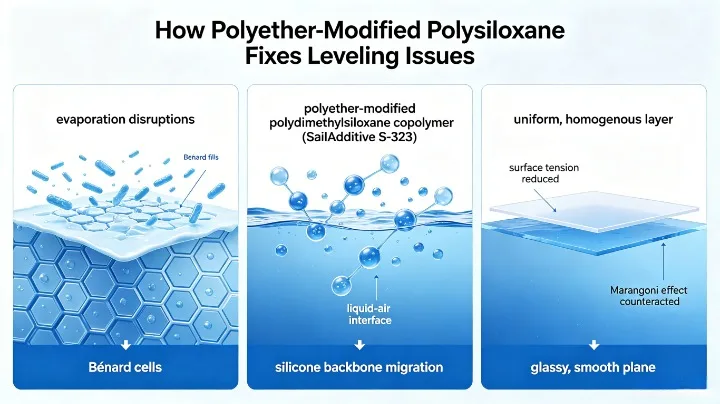
Consequently, liquid paint flows away from low-tension areas toward high-tension areas. Scientists call this movement the Marangoni effect.
This movement creates microscopic disruptions in the wet paint layer. Therefore, you must lower the surface tension to ensure a perfectly flat, uniform flow.
Common Defects: Orange Peel, Craters, and Fish Eyes
When surface tension forces go uncontrolled, several major defects appear on the cured surface:
- Orange Peel: The wet paint fails to level out smoothly. As a result, it leaves a bumpy texture like an orange skin.
- Craters: Small, bowl-shaped depressions form on the coating. Usually, localized dust or oil contaminants cause this issue.
- Fish Eyes: Severe circular marks appear on the surface. Consequently, these marks expose the underlying substrate completely.
Ultimately, these defects lead to immediate product rejections from your clients.
Why Solvent Evaporation Disrupts Surface Aesthetics
The drying phase is a highly critical window for solvent-based industrial coatings. During this stage, volatile organic solvents evaporate very rapidly from the wet film.
This rapid evaporation creates temperature differences within the paint layer. As a result, cold paint at the top sinks, while warm paint from the bottom rises.
This continuous motion creates microscopic circulation patterns called Bénard cells. If these cells become trapped as the paint dries, they leave permanent ridges and heavy orange peel.
How a Polyether-Modified Polysiloxane Fixes Leveling Issues
Fortunately, advanced additive technology solves these evaporation disruptions completely. A premium polyether-modified polydimethylsiloxane copolymer acts as a highly efficient surface tension regulator.
For instance, SailAdditive S-323 migrates rapidly to the liquid-air interface. This migration creates a perfectly uniform layer at the top of the paint film.
By evening out the tension gradients, it suppresses the formation of Bénard cells. Thus, the paint flows into a glassy, ultra-smooth plane.
Achieving a Flawless Finish with Minimal Additive Dosage
The best part about using a concentrated polyether-modified silicone agent is its extreme efficiency. S-323 features a non-volatile matter content greater than 97%. Therefore, you do not need to overload your paint system.
In fact, a tiny dosage of just 0.05% to 0.3% of the total formula provides full surface coverage. You only need to add this liquid during the standard paint mixing stage.
This minor addition guarantees a defect-free surface even under demanding baking conditions up to 250^C. Consequently, you gain ultimate control over your product’s final aesthetics.
Do you want to shield your protective coatings from micro-foam failures and upgrade your substrate wetting? Contact the technical specialists at DongGuan SailAdditive to schedule an engineering consultation or request your testing sample today.