
Defeating Corrosion: Resolving Bubble Retention and Substrate Wetting in Thick-Film Coatings

Heavy-duty anti-corrosion coatings shield vital infrastructure from destruction. Engineers rely on these robust formulas to protect marine vessels, chemical storage tanks, and structural steel from harsh environments. To provide reliable barrier protection, formulators design these coatings to form thick, dense protective layers.
However, applying thick-film systems introduces two severe, interconnected problems: entrapped air bubbles and poor substrate wetting. If you do not resolve these issues during formulation, your high-performance coating will fail prematurely.
Fortunately, integrating an advanced silicone leveling agent fixes both bugs simultaneously. Let us analyze why these defects happen and how next-generation surface chemistry solves them.
1. Why Heavy-Duty Thick-Film Coatings Trap Massive Amounts of Air
Applying a thick coating layer in a single pass saves enormous amounts of labor and time. However, this application method creates a perfect storm for air entrapment.
Heavy-duty protective coatings typically use high-solid or solvent-free epoxy matrices to maximize their physical barrier properties. Because these formulations lack volatile solvents to lower viscosity during application, they maintain a very dense, viscous state throughout the spraying process.
When workers apply these coatings using high-pressure airless spray equipment, the immense force shears the liquid paint. This mechanical action forces huge volumes of surrounding air directly into the wet film. In standard solvent-based paints, thin viscosity allows bubbles to rise and pop easily. In thick-film systems, the high-viscosity matrix locks the air in place, creating a dense layer of trapped air known as micro-foam.
2. How Micro-Foam Destroys the Permeation Resistance of Anti-Corrosion Films
Some operators think that tiny sub-surface bubbles only affect visual aesthetics. This assumption is a dangerous mistake. In heavy-duty anti-corrosion applications, internal micro-foam completely breaks down the coating’s protective abilities.
The primary function of an anti-corrosion coating is permeation resistance. It acts as a tight molecular wall that blocks water, oxygen, salt ions, and corrosive chemicals from reaching the metal substrate.
When micro-foam stays trapped inside the cured film, those tiny bubbles create permanent, hollow voids within the coating matrix. These voids act like a network of stepping stones for corrosive molecules. Instead of forcing water to struggle through a dense resin barrier, the voids give moisture an easy, accelerated pathway to penetrate the film.
Over time, moisture aggregates inside these internal pockets, causing osmotic blistering. This blistering detaches the paint from the metal and sparks aggressive rust under the film long before the coating’s expected service life ends.
3. Substrate Dynamics: How Polyether Siloxanecopolymers Wet Rough Steel
Before you can even worry about internal bubbles, your liquid paint must bond perfectly with the substrate. Industrial steel is rarely smooth. Metal prep teams use sandblasting or grit-blasting to clean the surface, leaving a highly irregular, jagged, and rough profile.
A high-viscosity coating naturally struggles to flow down into the microscopic peaks and valleys of a blasted steel surface. If the paint’s surface tension is too high, it will bridge across the top of the valleys, leaving micro-pockets of trapped air beneath the paint layer. These hidden air gaps prevent the coating from sticking, leading to catastrophic delamination under mechanical stress.
This is where polyether siloxanecopolymer chemistry provides an incredible advantage. S-1484 from DongGuan SailAdditive utilizes this exact advanced structure to control surface dynamics.
The organic silicon backbone possesses incredibly low natural surface tension. When you add S-1484 to your formula, it reduces the surface tension of the liquid paint dramatically. This sharp drop forces the thick, heavy-duty paint to spread rapidly and flow deep into the microscopic crevices of rough steel. It wets out the rough substrate completely, leaving zero air gaps and creating a rock-solid mechanical bond.
4. The Unified Strategy: Achieving Defoaming and Leveling in One Step
Historically, resolving both substrate wetting and micro-foam required mixing separate defoamers and leveling surfactants. This classic approach often backfires. Strong defoamers cause severe surface defects like craters, while standard leveling agents fail to push out stubborn bubbles.
Formulators need a unified, dual-action solution. S-1484 delivers this exact balance by combining excellent leveling with powerful degassing properties into a single additive molecule.
[S-1484 Dual-Action Mechanism]
   │
   ├──> Silicone Backbone ────> Lowers Surface Tension ──> Eliminates Craters & Wet-Out Gaps
   │
   └──> Polyether Segments ───> Merges Micro-Foam ─────> Forces Rapid Air Release
The silicone structure spreads across the coating surface to remove orange peel, craters, and pinholes. At the same time, the polyether modification destabilizes the walls of internal micro-foam. It forces tiny, microscopic bubbles to merge into larger bubbles. These larger bubbles gain enough physical buoyancy to overcome the thick viscosity of the film, rising swiftly to the top to pop cleanly before the coating crosslinks.
5. Optimizing Formula Tolerance for Extreme and Unpredictable Field Environments
Industrial coating applications rarely happen in a perfect laboratory. Shipyard workers and pipeline contractors must apply coatings in freezing coastal humidity, blazing desert heat, or windy outdoor fields. These harsh environments drastically alter paint viscosity and curing speeds, leaving a very low margin for error.
To survive these unpredictable field conditions, your formula needs a high degree of processing tolerance. S-1484 provides this robust flexibility. It operates exceptionally well across a wide range of challenging industrial applications, including floor coatings, protective coatings, and high-solid wood finishes.
In the global heavy-duty market, TEGO® Glide 1484 by Evonik is a highly respected industry benchmark for managing these tough coating environments. If you want to check out other premium, globally recognized options with similar high-performance surface properties, you can explore the BYK Additives Product Catalog to review their advanced silicone and leveling chemistry.
If you are looking to lower your overall raw material costs while keeping your formula tolerance high, S-1484 serves as a direct, high-performance alternative to TEGO-1484. It matches the benchmark’s performance perfectly but offers superior cost-efficiency.
Certified Technical Specifications of S-1484
To help your chemical engineering team review this product, here is the official data from the technical documentation (TDS):
| Property / Parameter | Certified Value / Specification |
| Chemical Structure | Polyether siloxanecopolymer |
| Exterior / Appearance | Light yellow to amber transparent liquid |
| Viscosity (25^) | 300-500^ |
| Density (25) | 1.440-1.450 |
| Non-Volatile Matter Content (120) | 100 (Solvent-Free) |
Practical Formulation Blueprint
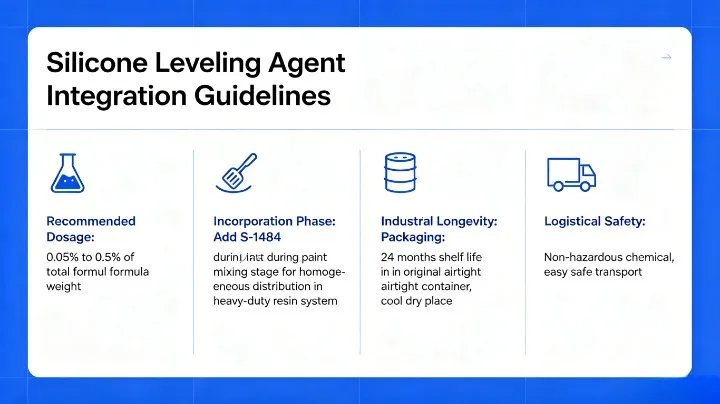
To integrate this silicone leveling agent into your protective coatings successfully, follow these standard guidelines:
- Recommended Dosage: Maintain a standard addition level of 0.05% to 0.5% of the total formula weight.
- Incorporation Phase: Always add S-1484 during the paint mixing stage. This guarantees a homogeneous, optimal distribution throughout the heavy-duty resin system before packaging.
- Industrial Packaging: The additive comes in convenient 25L barrels or large-scale 200L plastic/steel drums to match your manufacturing needs.
- Storage Longevity: Keep the product in its original airtight container in a cool, dry place. It provides an excellent, stable shelf life of 24 months.
- Logistical Safety: You can transport S-1484 easily and safely as a non-hazardous chemical.
Reminder: Because field application conditions vary greatly, always run standard laboratory panel tests to confirm the ideal dosage for your specific anti-corrosion formula.
Do you want to shield your protective coatings from micro-foam failures and upgrade your substrate wetting? Contact the technical specialists at DongGuan SailAdditive to schedule an engineering consultation or request your testing sample of S-1484 today.