
Mastering the Mirror Finish: Advanced Leveling Control in Automotive and Premium Industrial Coatings

First impressions matter immensely in consumer markets. When a person looks at a luxury car, a high-end smartphone, or premium industrial equipment, the quality of the exterior coating speaks volumes. Consumers immediately associate a deep, glass-like finish with superior product quality.
Achieving this perfect mirror look requires precise control over the liquid paint film during the application and curing stages. Even minor surface disturbances can break the illusion of luxury.
Formulators rely on advanced surface chemistry to prevent these issues. Choosing a specialized silicone leveling agent allows manufacturers to eliminate imperfections and deliver an unblemished, ultra-glossy surface.
1. The Pursuit of Perfection: Why the Mirror Look Matters to Consumers
In the automotive and high-end industrial sectors, coating aesthetics represent a critical selling point. Buyers demand a pristine surface that looks like liquid glass.
Any visible disruption on the coating surface degrades the value of the entire product. If a brand-new vehicle shows a wavy texture, buyers notice it instantly. This visual flaw alters how light reflects off the body panels, destroying the sharp, crisp reflections that designers intend to create.
Furthermore, premium industrial goods must maintain this pristine look under harsh environmental conditions. A bumpy or uneven topcoat does more than just look unprofessional. It leaves the product vulnerable to weathering, chemical exposure, and physical wear. Therefore, achieving an ultra-smooth finish is a functional necessity just as much as a visual requirement.
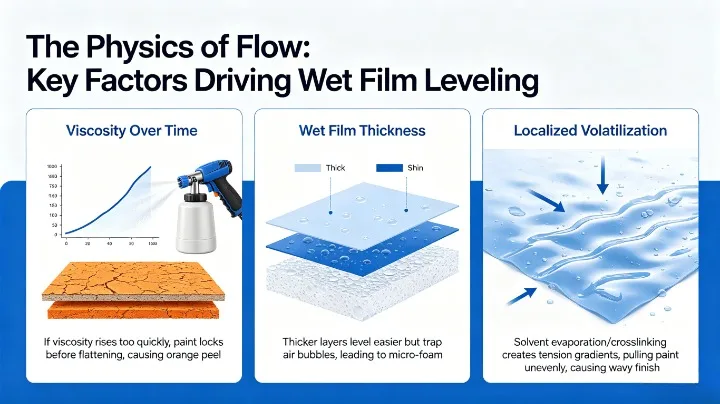
2. The Physics of Flow: Key Factors Driving Wet Film Leveling
To fix surface defects, we must understand the physical forces that control a wet coating layer immediately after spraying. Once the liquid paint hits the substrate, a complex race against time begins.
Viscosity Over Time
The wet film must stay fluid long enough to flow out and erase any ridges caused by the spray nozzle. If the viscosity rises too quickly, the paint locks into place before it can flatten completely, causing permanent orange peel.
Wet Film Thickness
Thicker coating layers generally level out more easily because they experience less resistance from the underlying substrate. However, thick coatings also tend to trap air bubbles, leading to micro-foam defects.
Localized Volatilization
As solvents evaporate or chemical crosslinking begins, different areas of the wet film change at different rates. These variations create localized surface tension gradients, which pull the liquid paint in unpredictable directions and create a wavy, uneven finish.
3. Surface Dynamics: How Silicone Additives Eliminate Defects
To counteract these physical forces, formulators introduce a high-performance silicone leveling agent to stabilize the wet film. These engineered molecules manage the surface tension of the liquid paint dynamically.
S-1484 from DongGuan SailAdditive utilizes an advanced polyether siloxanecopolymer structure to provide excellent leveling. It performs two critical functions simultaneously during the curing process:
- Rapid Surface Migration: The organic silicon backbone naturally possesses extremely low surface tension. This property forces the S-1484 molecules to migrate rapidly to the coating-air interface. PDF+ 1
- Surface Tension Equalization: Once the molecules cover the surface, they equalize the surface tension across the entire liquid film. This action eliminates the localized gradients that cause orange peel, craters, and fish-eyes, allowing the paint to settle into a flat, mirror-like layer. PDF+ 1
- Active Micro-Foam Release: At the same time, S-1484 provides powerful degassing properties. It helps trapped air bubbles merge together, allowing them to rise through thick-film formulations and pop cleanly before the surface hardens. PDF+ 1
4. Industry Benchmarks: High-Gloss Performance in Clear Coat Systems
Automotive clear coats represent the ultimate test for surface additives. The clear coat must remain completely transparent while reflecting light uniformly.
In the global automotive market, TEGO® Glide 1484 by Evonik serves as a famous industry benchmark. Formulators trust this chemistry for its exceptional gloss retention and compatibility in clear polyurethane and acrylic systems. If you want to check out other premium, globally recognized surface surfactants with similar leveling capabilities, you can review the BYK Additives Product Portfolio to explore their advanced silicone solutions.
For manufacturers seeking to optimize their production costs, S-1484 serves as a direct, high-performance alternative to TEGO-1484. It matches the benchmark’s optical clarity and gloss performance flawlessly.
Technical Data Comparison for S-1484
Here are the official physical properties of S-1484 according to its technical documentation (TDS):
| Technical Property | Value / Specification PDF | Practical Formulation Benefit |
|---|---|---|
| Chemical Structure | Polyether siloxanecopolymer PDF | Ensures ideal balance of flow and degassing. PDF |
| Exterior / Appearance | Light yellow to amber transparent liquid PDF | Guarantees zero yellowing or haziness in clear topcoats. PDF |
| Viscosity (25∘C) | 300–500 mm2/s PDF | Provides easy handling and smooth blending during production. |
| Density (25∘C) | 1.440–1.450 PDF | Allows accurate, reproducible volumetric dosing. |
| Non-Volatile Matter | 100% (120∘C/2h) PDF | Contains zero volatile solvents, making it perfect for green systems. PDF |
5. Crafting the Perfect Mirror: Blending Techniques and Addition Guide
Using a high-performance silicone leveling agent requires proper formulation strategies. To maximize the effectiveness of S-1484, follow these practical implementation guidelines:
1. Master the Dosage Window
A little goes a long way with highly active polyether siloxanecopolymers. The standard recommended dosage for S-1484 is 0.05% to 0.5% of the total formula weight. Adding too much can cause haziness, while adding too little will fail to eliminate orange peel. Always perform a ladder study to find the sweet spot for your specific resin system.
2. Proper Incorporation Stage
Always add S-1484 during the paint mixing stage. This timing guarantees that the additive distributes uniformly throughout the entire system before the final filtration and packaging.
3. Protect Inter-Coat Adhesion
Traditional silicone oils often migrate to the surface and create a slick barrier that ruins the adhesion of subsequent paint layers. S-1484 features specialized dual-action chemistry that ensures a high-gloss, bubble-free surface without compromising inter-coat adhesion. This makes it highly versatile for both clear and pigmented automotive topcoats
4. Handling and Factory Packaging
S-1484 comes in 25L barrels or 200L plastic/steel drums. Store it in its original airtight container in a cool, dry place. It has a stable shelf life of 24 months and transports safely as a non-hazardous chemical.
PDF+ 2
Are you ready to elevate your automotive clear coats and premium industrial finishes to a flawless mirror standard? Contact the technical team at DongGuan SailAdditive to schedule an expert consultation or request your evaluation sample of S-1484 today.