
Overcoming Surface Defects in Waterborne and High-Solid Wood Coatings

The woodworking and furniture industries are undergoing a massive environmental transformation. Tight green regulations force manufacturers away from traditional solvent-borne lacquers. Today, low-VOC alternatives like waterborne systems and high-solid coatings dominate the market.
However, switching to green wood coatings introduces stubborn application hurdles. Formulators frequently battle surface imperfections that ruin the luxurious feel of natural wood.
Achieving a flawless, smooth-to-the-touch surface requires the right surface chemistry. Integrating a specialized silicone leveling agent allows you to eliminate these defects completely. Let us examine how to conquer these wood coating challenges.
1. High Viscosity Hurdle: Flow Restrictions in High-Solid Wood Coatings
High-solid wood coatings are excellent for building a thick, luxurious protective film in fewer applications. They provide great body and excellent scratch resistance. However, this high resin concentration means you lose volatile solvents that traditionally lower paint viscosity during application.
Because high-solid wood coatings maintain high viscosity during spraying or brushing, the liquid paint struggles to move freely. A dense liquid matrix acts like a physical barrier, trapping air during mixing and application.
In traditional thin lacquers, air bubbles easily rise and pop. In high-solid systems, these tiny bubbles stay locked inside the wet layer. If the coating cures before these bubbles escape, they create deep micro-foam defects that destroy the strength and clarity of your finish.
2. The Wood Dilemma: Deep Pores, Grain Texture, and Substrate Wetting
Wood is not a uniform or predictable substrate like steel or plastic. It is a highly porous, organic material filled with natural grain variations, knots, and microscopic textures. This complex surface poses a double challenge for wetting and leveling.
The Wetting Challenge
When you apply a high-viscosity coating, the liquid must penetrate deep into the wood pores to create a strong anchor bond. If the paint has a high surface tension, it will bridge across the pores rather than sink into them. This poor wetting creates tiny, hidden pockets of trapped air underneath the coating.
The Leveling Challenge
Natural wood grains absorb liquid unevenly. Some sections of the wood pull moisture out of the coating rapidly, while denser grain sections reject it. This uneven absorption creates severe surface tension gradients across the wet film. The liquid paint naturally pulls away from low surface tension spots, creating an uneven, bumpy texture that completely ruins the smooth look of premium furniture.
3. Banishing Defects: Eliminating Brush Marks and Craters Permanently
To fix surface tension imbalances and poor pore penetration, formulators introduce highly active surface surfactants into their recipes.
S-1484 from DongGuan SailAdditive utilizes an advanced polyether siloxanecopolymer structure to solve these issues. When you blend it into a wood coating, it performs a highly efficient dual-action mechanism:
- Erasing Brush Marks: S-1484 migrates instantly to the coating-air interface to drop the surface tension dramatically. This action forces the viscous paint to flatten out evenly, erasing brush ridges and spray patterns before the resin locks into place.
- Defeating Craters and Fish-Eyes: Craters occur when external contaminants like dust or oil repel the liquid paint. S-1484 equalizes the surface tension across the entire wet film, preventing the paint from pulling back and leaving ugly circular recesses.
- Active Air Release: Simultaneously, the polyether segments interact with internal bubble walls. They force trapped micro-foam to merge into larger bubbles, allowing them to rise swiftly through thick wood finishes and pop cleanly at the surface.
4. Optical Clarity: The Secret to High-Gloss, Transparent Wood Varnishes
Clear wood varnishes must remain completely transparent to highlight the beautiful natural grain underneath. However, many standard silicone additives fail this test. If a silicone additive is incompatible with your resin system, it will aggregate inside the film, scattering light and turning a beautiful clear varnish into a cloudy, milky mess.
Achieving high gloss and pristine optical clarity requires a highly compatible additive. In the global premium wood coatings market, TEGO® Glide 1484 by Evonik is a highly respected industry benchmark. Formulators trust its specialized polyether modification to deliver maximum gloss without causing haziness. If you are exploring alternative high-end options with similar surface-active properties, you can review the BYK Additives Product Portfolio to examine their advanced silicone and leveling chemistry.
For manufacturers seeking to protect their profit margins, S-1484 serves as a direct, high-performance alternative to TEGO-1484. It matches the benchmark’s clarity and surface leveling flawlessly , ensuring a high-gloss, bubble-free surface every time.
5. Selection Standards: Choosing Eco-Friendly Siloxane Additives
Green wood coatings require strict raw material standards. Formulators must evaluate additives based on three eco-friendly and practical performance criteria:
1. 100% Solvent-Free Composition
Eco-friendly coatings cannot use additives that introduce hidden VOCs. According to its technical documentation (TDS), S-1484 contains 100% non-volatile matter (120^). It contains zero carrier solvents, making it completely safe for zero-VOC waterborne and high-solid formulas.
2. Protection of Inter-Coat Adhesion
Furniture finishing usually requires multiple coats of sealer and topcoat. Traditional silicone oils leave a greasy film on the surface that prevents the next layer of paint from sticking. S-1484 provides exceptional surface flow without compromising inter-coat adhesion. You can apply subsequent layers safely without worrying about peeling or delamination.
3. High Efficiency at Low Dosage
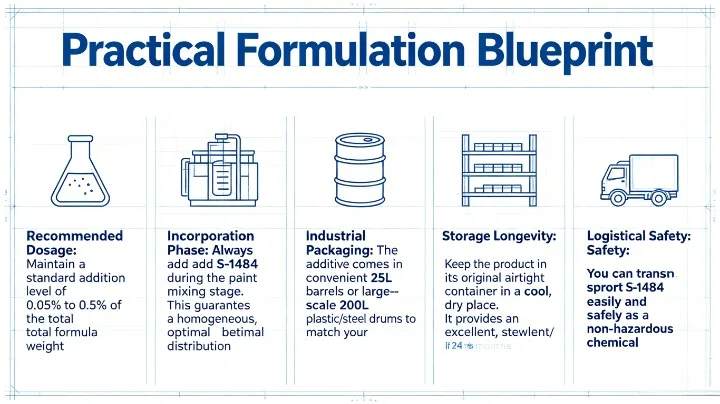
A high-quality silicone leveling agent must work powerfully at minimal concentrations to prevent formula over-saturation. S-1484 delivers maximum results at a standard recommended dosage of just 0.05% to 0.5% of the total formula weight.
Technical Data Sheet (TDS) Summary for S-1484
| Physical Property | Certified Specification Value | Practical Value for Wood Coatings |
| Chemical Structure | Polyether siloxanecopolymer | Delivers ideal balance of flow and active degassing. |
| Exterior / Appearance | Light yellow to amber transparent liquid | Ensures no discoloration in premium clear topcoats. |
| Viscosity (25^) | 300-500 | Provides easy blending into waterborne or high-solid bases. |
| Density (25) | 1.440-1.450 | Allows accurate volumetric dosing during paint mixing. |
| Non-Volatile Matter | 100 (120^) | Eco-friendly composition with zero volatile organic solvents. |
Application and Manufacturing Guidelines
- Target Systems: Highly effective in eco-friendly wood coatings, industrial floor coatings, protective finishes, and general industrial topcoats.
- Incorporation Stage: Always add S-1484 during the paint mixing stage to guarantee an optimal, homogeneous distribution throughout the matrix.
- Commercial Packaging: S-1484 comes in flexible 25L barrels or large-scale 200L plastic/steel drums.
- Storage Longevity: Keep the product in its original airtight container in a cool, dry place. It provides an excellent, stable shelf life of 24 months.
- Logistical Safety: You can transport S-1484 easily and safely as a non-hazardous chemical.
Do you want to eliminate brush marks and unlock flawless optical clarity in your green wood coatings? Contact the expert technical team at DongGuan SailAdditive to schedule a chemical consultation or request your testing sample of S-1484 today.