
Mastering Industrial Floor Coatings: How to Eliminate Craters, Pinholes, and Surface Defects

Applying industrial floor coatings requires high precision. Contractors and formulators constantly battle surface defects that ruin the final look and weaken the floor’s durability. In thick-film epoxy or polyurethane floors, even a tiny flaw can lead to catastrophic failure under heavy forklift traffic or chemical spills.
Achieving a flawless, high-gloss surface requires more than just good installation technique. It demands the right surface chemistry.
By understanding the root causes of common coating defects, you can choose the right silicone leveling agent to solve these issues. Let us explore the main challenges in industrial flooring and how to fix them permanently.
1. Why Craters and Pinholes Ruin Your Floor Paint
Craters and pinholes are the two most frustrating defects in floor construction. They look ugly, but their structural impact is much worse.
The Origin of Craters
Craters are small, bowl-shaped depressions that appear during the curing process. They usually occur because a low surface tension contaminant sits on the substrate. Common culprits include:
- Droplets of oil or grease from machinery.
- Leftover silicone lubricants on the concrete.
- Dust or moisture particles in the air.
When the liquid paint flows over these contaminated spots, it pulls away from them. This movement leaves a small circular recess in the middle of the coating film.
The Mystery of Pinholes
Pinholes look like tiny needle punctures that pierce deeply into the coating layer. These occur because of entrapped air or gas.
When you mix a thick two-component floor coating, you trap a massive amount of air into the system. As the coating cures, these micro-bubbles try to rise to the top. However, thick-film floor coatings have a high application viscosity. The bubbles move slowly. If the surface dries too fast while a bubble is still rising, the bubble bursts and leaves a tiny, open tube that never closes back up.
2. How Surface Tension Imbalances Destroy the Mirror-Like Finish
Every liquid paint has a property called surface tension. For a floor coating to level out perfectly and create a smooth, mirror-like finish, its surface tension must be perfectly uniform across the entire floor.
Unfortunately, surface tension imbalances happen easily during application. Localized temperature changes, uneven solvent evaporation, or variations in film thickness create areas with different surface tension values.
When this happens, a phenomenon known as Marangoni flow occurs. Liquid paint naturally flows away from areas of low surface tension toward areas of high surface tension. This internal movement causes serious surface roughness, resulting in an unpleasant orange peel texture or severe floating lines. If you want a smooth, high-gloss floor, you must control and equalize this surface tension across the entire liquid matrix.
3. The Flow Mechanism of Polyether Siloxanecopolymer in Thick-Film Flooring
To fix these surface tension imbalances, formulators rely on advanced surfactant chemistry. Traditional silicone oils can cause severe cratering if you misuse them. Therefore, modern floor coatings utilize polyether siloxanecopolymer technology.
How S-1484 Works in Thick-Film Systems
S-1484 from DongGuan SailAdditive uses this precise polyether siloxanecopolymer structure. When you add it to a floor coating formula, the molecule performs a brilliant dual-action mechanism:
- Rapid Migration: The silicone backbone has an extremely low natural surface tension. It migrates rapidly to the coating-air interface.
- Surface Equalization: Once it reaches the top, it spreads out evenly across the entire surface. This action instantly equalizes the surface tension of the liquid paint, removing orange peel, craters, and surface irregularities.
- Active Degassing: At the same time, the polyether segments interact with the internal bubble walls. They force tiny micro-bubbles to merge into larger bubbles. These larger bubbles gain more buoyancy, allowing them to rise quickly through thick-film layers and pop cleanly before the surface skins over.
4. Maximizing Flow While Protecting Multi-Coat Interlayer Adhesion
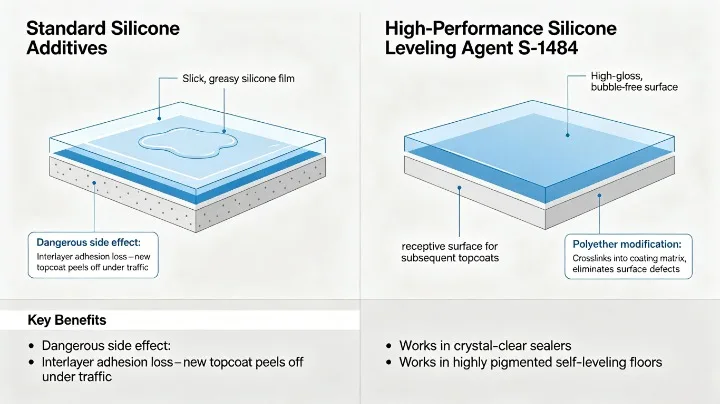
Many standard silicone additives provide excellent flow, but they carry a dangerous side effect. They leave a slick, greasy silicone film on top of the cured layer.
If you need to apply a second topcoat or a clear protective sealer over that layer, the new coat cannot stick to the slick surface. It will peel off later under heavy traffic. This loss of interlayer adhesion is a nightmare for industrial flooring projects that require multiple coats.
This is where a high-performance silicone leveling agent like S-1484 shows its true value. SailAdditive designed S-1484 specifically to achieve a high-gloss, bubble-free surface without hurting inter-coat adhesion. The polyether modification ensures the additive crosslinks or integrates cleanly into the coating matrix. It eliminates surface defects completely while leaving a receptive surface for subsequent topcoats. It works reliably in both crystal-clear sealers and highly pigmented self-leveling floors.
5. Guide to Choosing Additives to Optimize Total Flooring Costs
In today’s highly competitive industrial flooring market, formulators must balance performance with raw material costs. Using expensive international brands for every project can quickly erase your profit margins.
Global industry leaders often use premium benchmarks like TEGO® Glide 1484 by Evonik to solve flow issues in demanding systems. If you are exploring alternative high-end options with similar surface-active properties, you can review the BYK Additives Product Portfolio to examine their advanced silicone and leveling solutions.
However, if you want a seamless, cost-effective replacement without sacrificing quality, S-1484 provides the perfect balance. It acts as a direct performance match to TEGO-1484 but reduces your formula expenses significantly.
Technical Specifications of S-1484
To help your technical team evaluate this product, here are the official specifications from the technical documentation (TDS):
| Property / Parameter | Value / Specification PDF |
| Chemical Component | Polyether siloxanecopolymer |
| Exterior / Appearance | Light yellow to amber transparent liquid |
| Viscosity ($25^\circ\text{C}$) | $300\text{–}500\text{ mm}^2/\text{s}$ |
| Density ($25^\circ\text{C}$) | $1.440\text{–}1.450$ |
| Non-Volatile Matter Content ($120^\circ\text{C}/2\text{h}$) | $100\%$ (Solvent-Free) |
Practical Formulation Guide
To integrate this silicone leveling agent into your current system seamlessly, follow these application parameters:
- Target Applications: S-1484 is highly effective in heavy-duty epoxy floor coatings, industrial protective coatings, general industrial finishes, and wood coatings.
- Recommended Dosage: Use a standard addition level of 0.05% to 0.5% based on the total formula weight.
- Incorporation Method: Always add S-1484 during the paint mixing stage. This ensures optimal, homogeneous distribution throughout the high-viscosity resin system.
- Packaging and Logistics: The product comes in practical 25L barrels or large 200L plastic/steel drums. It is classified as non-hazardous for transportation, making shipping easy and safe.
- Storage Life: Keep it in its original airtight container in a cool, dry place. It maintains a stable shelf life of 24 months.
Note: Formulators should always conduct independent laboratory tests before large-scale production to verify performance in their specific resin blends.
Are you ready to eliminate surface defects and optimize your floor coating costs? Contact the technical team at DongGuan SailAdditive to request a free sample of S-1484 today.