
Mastering High-Solid Coatings: How to Eliminate Micro-Foam and Orange Peel for a Flawless Finish

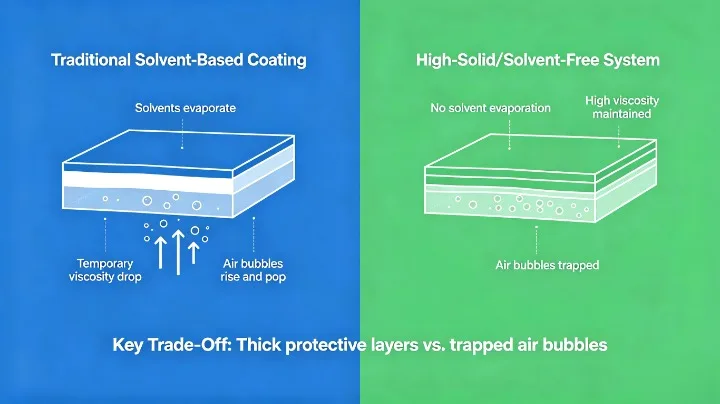
Industrial formulators face a constant battle today. Environmental regulations push coatings toward higher solid content and solvent-free formulations. While this shift reduces volatile organic compounds (VOCs), it introduces brutal application challenges.
Two main issues plague high-solid coatings: entrapped micro-foam and surface orange peel. These defects ruin the visual appeal of a coating. Even worse, they degrade the protective lifespan of the film.
Fortunately, choosing the right silicone leveling agent can solve both problems simultaneously. Let us explore why these defects happen and how next-generation additives fix them.
Why High-Solid Coatings Trap Micro-Foam
Formulators love high-solid and solvent-free systems because they deliver thick, protective layers in fewer coats. However, this benefit comes with a hidden cost: high application viscosity.
When you apply a traditional solvent-based coating, solvents evaporate and lower the viscosity temporarily. This temporary drop allows air bubbles to rise and pop easily. In contrast, high-solid systems maintain high viscosity throughout the curing process.
Air enters the system during manufacturing, mixing, or spraying. Because the matrix is thick, these tiny air bubbles cannot escape. They stay trapped inside the film as micro-foam. As the coating cures, these micro-bubbles weaken the physical structure of the layer.
The Fatal Impact of Orange Peel on Industrial Coating Lifespan
Surface aesthetics matter, but industrial coatings serve a more critical purpose: protection. Orange peel is not just an ugly, bumpy texture. It represents a serious threat to the longevity of industrial anti-corrosion coatings.
Orange peel occurs when a coating fails to flow out smoothly across the substrate. This poor leveling creates an uneven film thickness. The “valleys” of the orange peel texture are significantly thinner than the “peaks.”
These thin areas become the weakest links in your armor. Corrosive elements like moisture, salt, and chemicals easily penetrate these thin sections. Consequently, premature rust and coating failure begin in the valleys of the orange peel long before the rest of the coating degrades. A perfectly smooth, mirror-like finish is essential to ensure long-term, uniform corrosion protection.
The Dual-Action Solution: How One Additive Solves Flow and Degassing
Traditionally, formulators had to use two different additives to solve these issues. They added a silicone leveling agent to improve surface flow and a separate defoamer to eliminate bubbles. However, these two additives often fight each other, causing compatibility issues like cratering or haziness.
Modern chemistry solves this with polyether siloxanecopolymer technology. This advanced molecule provides a unique dual-action mechanism:
1. Rapid Surface Tension Reduction
The silicone backbone migrates quickly to the coating-air interface. It lowers the surface tension dramatically. This action forces the liquid paint to spread evenly, eliminating orange peel and craters.
2. Active Defoaming and Air Release
Simultaneously, the polyether segments promote the rapid coalescence of tiny micro-bubbles into larger bubbles. These larger bubbles gain enough buoyancy to overcome high viscosity and break through the surface smoothly.
By combining these two functions into a single product like S-1484, you achieve a flawless finish without risking incompatibility.
Market Benchmark: Classic Applications of TEGO-1484
For years, international formulators have relied on premium additives to handle tough coating systems. In the global market, TEGO® Glide 1484 by Evonik stands out as a highly respected industry benchmark.
Many high-end industrial projects use this additive to achieve perfect clarity and surface smoothness. For example, severe marine environments require thick-film epoxy coatings. Formulators rely on this technology to prevent micro-foam during high-pressure airless spraying.
If you are looking for other globally recognized options with similar high-performance surface properties, you can also explore premium solutions from the BYK Additives Catalog, which features advanced silicone and leveling chemistry for industrial applications.
The Smart Strategy: Seamless Replacement with Cost-Effective Alternatives
While global benchmarks deliver excellent results, supply chain volatility and rising material costs force manufacturers to look for smart alternatives.
DongGuan SailAdditive engineered S-1484 as a direct, high-performance alternative to TEGO-1484. It matches the performance of the industry standard perfectly but offers superior cost-efficiency.
| Feature / Property | S-1484 Silicone Leveling Agent PDF |
| Chemical Structure | Polyether siloxanecopolymer |
| Active Matter Content | 100% (Non-volatile matter) |
| Appearance | Light yellow to amber transparent liquid |
| Viscosity (25°C) | 300-500 $mm^2/s$ |
| Density (25°C) | 1.440 – 1.450 |
Key Benefits of S-1484
- Zero Compromise on Adhesion: Unlike traditional silicone oils, S-1484 delivers high-gloss, bubble-free surfaces without hurting inter-coat adhesion.
- Versatility: It works beautifully in both clear and highly pigmented topcoats.
- Broad Applications: It is highly effective in floor coatings, protective coatings, general industrial coatings, and wood finishes.
Application Guidelines
To get the best results from this silicone leveling agent, follow these simple guidelines:
- Recommended Dosage: Add between 0.05% to 0.5% of the total formula weight.
- Incorporation Stage: Always add S-1484 during the paint mixing stage. This timing ensures the additive distributes optimally throughout the system.
- Storage and Handling: Store it in a cool, dry place in an airtight container. The shelf life is 24 months, and you can transport it safely as a non-hazardous chemical.
By switching to localized, high-performance alternatives like S-1484, industrial coating manufacturers can protect their profit margins without sacrificing surface quality or long-term durability.
Do you want to optimize your high-solid coating formula? Contact SailAdditive or conduct a sample test today to see the dual-action performance firsthand.