
Cracking the Code: Balancing Flow and Degassing in Solvent-Free Coating Systems

The global chemical industry is undergoing a massive shift. Environmental regulations and strict green mandates push paint and coating manufacturers away from traditional systems. Today, sustainability drives innovation, making solvent-free and high-solid coatings the new standard.
However, removing volatile organic compounds (VOCs) introduces severe chemical and physical challenges. Formulators frequently face a frustrating paradox: how do you eliminate trapped air without ruining surface smoothness?
Achieving this balance requires an advanced, high-performance silicone leveling agent. In this article, we will unpack the science behind solvent-free systems and explore how to achieve a flawless finish every time.
1. The Green Dilemma: Formulation Challenges in Solvent-Free Systems
Solvent-free systems offer incredible environmental benefits, but they completely change how paint behaves during application. When you remove volatile solvents, you lose a critical tool for viscosity control.
Solvent-based paints rely on evaporation to adjust flow. As solvents escape, the viscosity changes dynamically. Solvent-free systems, however, maintain a very high application viscosity from the moment they leave the spray gun until they cure.
This thick liquid matrix creates a major physical roadblock. Air enters the paint effortlessly during mixing, pumping, and spraying. Because the coating is dense and viscous, these tiny air bubbles cannot rise to the surface. Instead, they remain trapped inside the curing film as micro-foam. This micro-foam ruins the clarity of clear coats and significantly weakens the physical protection of the cured film.
2. The Danger of Traditional Defoamers: Why Craters Appear
When formulators notice micro-foam, their first instinct is to add a strong, traditional defoamer. While this step might pop the bubbles, it often triggers a completely new surface disaster: severe cratering.
Traditional defoamers rely on extreme incompatibility to break bubble walls. They have a lower surface tension than the surrounding resin matrix. When a defoamer droplet spreads over a contaminated area or a rising bubble, it drops the localized surface tension dramatically.
Because liquid paint naturally flows away from areas of low surface tension toward areas of high surface tension, the resin pulls away from the defoamer droplet. This rapid movement leaves small, bowl-shaped depressions across the surface. These ugly circular recesses, known as craters or fish-eyes, expose the substrate and completely ruin the visual appearance of the floor, wood, or metal finish.
3. The Core Chemistry: Balancing Powerful Degassing with Flawless Flow
To prevent this destructive tug-of-war between degassing and leveling, formulators must move away from simple additives. Instead, they need a single, sophisticated molecule that handles both jobs simultaneously. This is the exact core technology behind polyether siloxanecopolymer chemistry.
S-1484 from DongGuan SailAdditive utilizes this precise polyether-modified silicone structure to achieve a perfect dual-action mechanism:
Instant Surface Leveling
The silicone backbone provides incredibly low surface tension. Once applied, the S-1484 molecules migrate rapidly to the coating-air interface. This rapid movement equalizes the surface tension across the entire liquid film, instantly erasing orange peel, craters, and minor surface defects.
Active Air Release
Simultaneously, the polyether segments act on the internal bubble structures. They force tiny, stubborn micro-bubbles to merge into larger bubbles. These larger bubbles gain enough physical buoyancy to push through the thick, solvent-free resin matrix and pop cleanly at the surface before the coating crosslinks.
By integrating both properties into one engineered molecule, you get high-gloss, bubble-free surfaces without risking compatibility issues.
4. Lab Methods: Evaluating Leveling Agents in Solvent-Free Wood Coatings
When testing a new silicone leveling agent in a solvent-free wood coating or industrial clear coat, you must use structured laboratory evaluations. You can measure performance accurately using three reliable methods:
1. The Drawdown Test
Apply the solvent-free wood coating onto a clean glass plate or a dark contrast chart using a calibrated applicator blade. Observe the liquid film under a strong light source. Watch how fast the surface irregularities smooth out. Look closely for any signs of immediate cratering or surface tension pulling.
2. The Airless Spray Test
Airless spraying injects massive amounts of air into high-viscosity coatings. Spray a thick-film layer onto a wooden panel. Let it cure completely, and then inspect the cross-section under a microscope. Count the number of trapped micro-bubbles to measure the degassing efficiency of your additive.
3. Gloss and Clarity Measurement
Use a standard gloss meter at a 20^ or 60^ angle to check surface reflectivity. Additionally, look through the clear coat against a black background to check for any hidden haze or turbidity.
5. Preventing Haziness: Overcoming Over-Dosage Risks
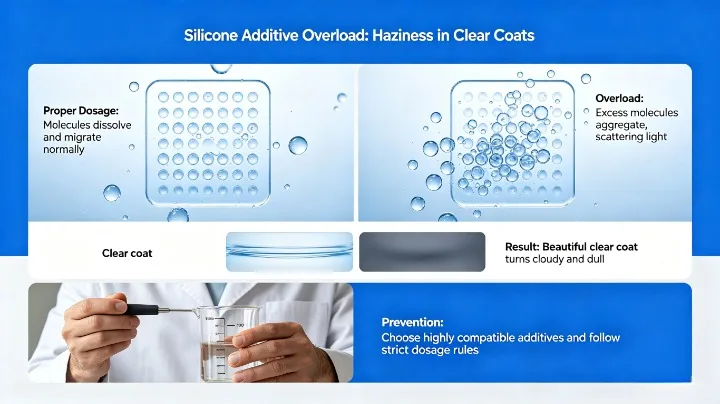
While silicone additives are incredibly powerful, adding too much can cause a serious defect known as haziness or milkiness. If you overload a system with silicone, the excess molecules cannot dissolve or migrate properly. They aggregate within the resin matrix, scattering light and turning a beautiful clear coat into a cloudy, dull finish.
To avoid this issue altogether, formulators must choose highly compatible additives and follow strict dosage rules.
In the global market, TEGO® Glide 1484 by Evonik is a famous industry benchmark known for its excellent compatibility and performance. If you want to check out other premium, globally recognized surface surfactants with similar leveling capabilities, you can view the BYK Additives Product Guide to explore their advanced silicone solutions.
If you are looking for a highly efficient, cost-effective alternative that delivers an identical performance match to TEGO-1484, S-1484 is the perfect answer. It offers a wide compatibility window, allowing you to achieve a mirror-like finish without risking haziness.
Technical Data of S-1484
Here are the certified physical properties of S-1484 from its technical documentation (TDS):
| Parameter / Property | Value / Specification PDF |
| Chemical Structure | Polyether siloxanecopolymer |
| Exterior / Appearance | Light yellow to amber transparent liquid |
| Viscosity ($25^\circ\text{C}$) | $300\text{–}500\text{ mm}^2/\text{s}$ |
| Density ($25^\circ\text{C}$) | $1.440\text{–}1.450$ |
| Non-Volatile Matter Content ($120^\circ\text{C}/2\text{h}$) | $100\%$ (Solvent-Free) |
Practical Formulation Checklist
To achieve the best results and avoid over-dosage issues, follow these practical steps in your lab:
- Target Systems: S-1484 works exceptionally well in solvent-free floor coatings, protective industrial coatings, and high-solid wood coatings.
- Dosage Control: Keep the addition level within the recommended standard range of 0.05% to 0.5% of the total formula weight. Always start testing at the lowest level.
- Proper Incorporation: Always add S-1484 during the paint mixing stage. This ensures optimal, homogeneous distribution throughout the high-viscosity base resin.
- Packaging and Storage: The product comes in 25L barrels or 200L steel/plastic drums. Store it in its original airtight container in a cool, dry place. It has a stable shelf life of 24 months.
- Safe Logistics: You can transport S-1484 easily as a non-hazardous chemical.
Do you want to eliminate micro-foam and upgrade the optical clarity of your green formulations? Contact the DongGuan SailAdditive technical team to schedule a technical consultation or order a free sample of S-1484 today.