
The Science of Steric Hindrance: Selecting Polyphosphate Dispersants for High-Solids Coatings

In high-performance industrial coatings, pigment dispersion physics dictates the lifespan, color depth, and gloss of the final film. R&D experts and formulation scientists understand that breaking raw pigment agglomerates down is only half the battle. The true engineering milestone is keeping those primary particles separated during storage and curing.
Without advanced stabilization, attractive molecular forces will pull particles back together. This re-agglomeration creates costly defects like flooding, floating, and micro-haze.
Learning how to select a premium polyphosphate dispersing additive is essential to mastering complex fluid dynamics. This technical blog explores the physical chemistry of steric hindrance, the behavior of polyphosphate chains in polar matrices, and how specifying solvent-free polymers future-proofs industrial formulas.
1. Electrostatic vs. Steric Stabilization: A Guide for R&D Experts
Formulation scientists rely on two primary chemical mechanisms to keep pigments deflocculated: electrostatic stabilization and steric stabilization. Understanding the limits of each approach is critical for successful product development.
Electrostatic Stabilization
Electrostatic stabilization works by generating identical electrical charges on the surface of neighboring pigment particles. These matching charges create a repulsive Coulombic force that pushes the particles apart.
While highly effective in traditional water-borne systems with high dielectric constants, electrostatic defense fails in solvent-borne, high-solids, and solvent-free formulations. Organic solvents lack the electrical conductivity needed to maintain a strong charge barrier, leaving pigment particles unprotected against attractive forces.
Steric Stabilization
Steric stabilization avoids electrical charges completely, relying instead on space-directed physical repulsion. This mechanism utilizes high-molecular-weight polymers that possess a dual-action structure. Highly polar anchoring groups bind tightly to the pigment core, while solvated polymer arms extend outward into the surrounding resin matrix.
When two stabilized particles approach one another, their extending polymer chains compress and overlap. This overlap causes a sharp reduction in local molecular entropy and triggers a spike in osmotic pressure.
The resulting physical force pushes the particles apart before they can touch. For non-aqueous, high-solids, and UV-curable industrial systems, steric hindrance serves as the only dependable method to ensure complete pigment deflocculation.
2. Why Polyphosphate Solutions Excel in Polar Solvent Matrices
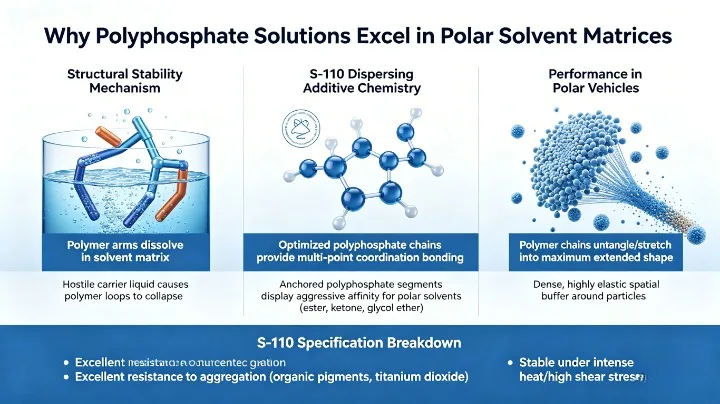
The structural stability of your steric barrier depends heavily on how well the dispersant’s polymer arms dissolve in your solvent matrix. If the carrier liquid is too hostile, the polymer loops will collapse flat against the pigment surface, destroying the protective spatial barrier.
S-110 Dispersing Additive uses advanced polyphosphate solution chemistry to solve this problem. The chemical backbone of S-110 features optimized polyphosphate chains that provide multi-point coordination bonding across pigment surfaces.
Once anchored, these polyphosphate segments display an aggressive affinity for polar and medium-polarity solvent matrices, including ester, ketone, and glycol ether blends.
In a polar vehicle, the polyphosphate arms absorb solvent molecules eagerly, causing the polymer chains to untangle and stretch outward into their maximum extended shape. This open configuration creates a dense, highly elastic spatial buffer around each particle.
Whether you are dispersing demanding organic pigments or heavy titanium dioxide, S-110’s extended structure ensures excellent resistance to aggregation, even under intense heat or high shear stress.
3. S-110 Specification Breakdown: What 100% Active Matter Means for You
When evaluating technical data sheets (TDS) for new raw materials, R&D chemists must scrutinize the physical specifications of an additive to ensure compatibility with existing factory equipment. A detailed review of the S-110 specifications highlights its extreme purity and efficient handling properties:
- 100% Active Matter Content: S-110 delivers a pure, solvent-free composition with a non-volatile matter content of >97%. Traditional commercial dispersants are frequently diluted up to 50% with xylene or acetates to save on production costs. S-110 introduces zero carrier solvents. R&D teams can design high-solids or solvent-free coatings with total precision, without needing to deduct hidden solvent volumes from their total formula calculations.
- Low Delivery Viscosity: Despite its 100% active profile, S-110 maintains a fluid, easily processable delivery viscosity of 30–80 $mm^2/s$ at $25^{\circ}C$. It pumps smoothly through automated liquid lines, pours cleanly without leaving thick residue, and incorporates rapidly during the pre-mix stage.
- Optical Neutrality: S-110 presents as a clear, light yellow to amber transparent liquid. It dissolves fully within industrial polyurethane, epoxy, and composite varnishes, guaranteeing zero haze or cloudiness in high-end clear coats.
4. How Leading Laboratories Standardize on Chemical Dispersants
During raw material evaluation, industrial laboratories often benchmark their formulas against established polymer science standards. For example, Croda’s Zephrym™ series is frequently used in research labs as a reference standard for investigating complex polymer dispersion and stabilizing challenging particulate networks.
However, moving a product from the laboratory bench to large-scale industrial manufacturing requires balancing performance with sourcing agility. SailAdditive’s S-110 provides an exceptional peer-performing alternative, specifically optimized for heavy-duty industrial anti-corrosion paints and high-gloss wood lacquers.
While universal laboratory standards are excellent for general research, S-110 targets the practical needs of the industrial paint shop. It matches international baselines by providing strong anti-settling insurance and active rheology control.
S-110 maintains a highly fluid mill base even at maximum pigment loading, giving your production facility a cost-effective alternative that integrates seamlessly into existing workflows.
5. Future-Proofing Coatings: Relying on High-Performance, Solvent-Free Chemistry
The global coating industry faces a clear mandate: reduce environmental impact without sacrificing performance. Regulatory agencies continue to lower allowable volatile organic compound (VOC) levels, steering the market toward high-solids, solvent-free epoxy, and fast-curing UV systems.
Relying on traditional, solvent-diluted dispersants places your product line at risk of regulatory non-compliance and introduces structural weaknesses like trapped solvent vapor and reduced film hardness. Specifying a 100% active polyphosphate dispersant like S-110 future-proofs your formulations.
S-110 introduces zero VOCs, prevents hard caking during extended warehouse storage, and allows your binders to reach their full cross-linking potential. It gives R&D experts a powerful tool to build durable, sustainable, and completely defect-free industrial coatings.
Expert Application Guidelines
For optimal performance, always introduce S-110 into your resin and solvent blend during the pre-mix stage before you add any dry pigment powders. This sequence ensures the active polymer chains cover the particle surfaces evenly during the grinding process.
Calculate your S-110 dosage based on total pigment weight, typically adding 1% to 4% for inorganic fillers and 10% to 50% for organic pigments and carbon blacks.
Conclusion: Leverage Advanced Surface Science
Mastering the physical chemistry of steric hindrance is the key to creating durable industrial finishes. By integrating a 100% active polyphosphate solution like S-110 into your mill base, you eliminate micro-haze, secure low mill-base viscosity, and insulate your paints from storage settling.
Stop fighting viscosity shifts and regulatory complications. Upgrade your additive matrix and ensure total formula stability with precision engineering.
Ready to leverage advanced steric science and optimize your formulation costs? Visit SailAdditive.com to browse our complete raw material catalog, or connect directly with our technical application team at 86-13713141735 to request a sample of S-110 today.