
Eliminating Sedimentation and Hard Caking in Tinting Pastes: The Storage Solution

For industrial colorant manufacturers, formulating a high-density tinting paste is a true test of quality control. You can achieve a perfect color match in the laboratory, but the real challenge begins during storage. If your heavy pigments separate and pack together at the bottom of the container, your product becomes useless to the end-user.
Learning how to prevent hard caking in paint systems and universal color pastes is a critical milestone for factory throughput. This professional guide breaks down the physical mechanics behind pigment settling, compares temporary wetting with permanent stabilization, and outlines a troubleshooting routine to salvage storage-damaged batches.
1. The Storage Nightmare: Why High-Density Fillers Form Hard Cake
The production of industrial tinting pastes relies on heavy inorganic pigments and dense functional fillers. Materials like titanium dioxide ($TiO_2$), iron oxides, and barium sulfate are essential for providing hiding power and structural weight. However, these minerals possess a high specific gravity, meaning gravity is constantly pulling them downward.
When a tinting paste sits on a warehouse shelf for weeks or months, these heavy particles naturally sink. In a poorly stabilized fluid, the falling particles pack tightly together at the bottom of the bucket. This intense packing forces out the liquid resin from between the particles, creating a dense, rock-hard layer known as a “hard cake.”
For paint factories, this is a total nightmare. The hard sediment sticks so firmly to the container that industrial mixers cannot break it apart, leading to severe pigment loss, altered color values, and angry customer complaints.
2. Shifting from Temporary Flocculation to Permanent Dispersion
Many formulators try to fix settling issues by adding cheap, low-molecular-weight wetting agents. While these surfactants reduce initial surface tension and speed up the grinding process, they only provide temporary relief.
Low-molecular-weight agents lack long polymer chains. They cannot stop particles from entering the attractive Van der Waals zone under the continuous pressure of gravity, which allows controlled flocculation to turn into hard caking over time.
S-110 Dispersing Additive solves this problem by providing a permanent physical barrier through high-performance polymer science. As a specialized polyphosphate solution, S-110 uses powerful polar groups to form an unbreakable link with the inorganic filler surface.
Long, active polymer segments extend outward into the solvent matrix, creating a reliable state of steric hindrance (spatial repulsion). Because S-110 features a 100% active non-volatile matter content, every single molecule works to push the particles apart. This continuous spatial barrier stops particles from packing closely together, transforming a dangerous hard-caking environment into a safe, easily manageable system.
3. Enhancing the Fluidity and Pourability of Industrial Tinting Pastes
A premium tinting paste must remain easy to handle throughout its entire shelf life. If a paste turns into a thick, paste-like gel during storage, operators cannot pour it accurately or pump it through automated dispensing equipment.
   Untreated Paste (Thixotropic Breakdown)     S-110 Stabilized Paste (Newtonian Fluid)
      ___________________________                ___________________________
     |   \   /   \   /   \   /   |              |  .  .  .  .  .  .  .  .   |
     |     Clumpy Gel Matrix     |              |   Free-Flowing Particles  |
     |___________________________|              |___________________________|
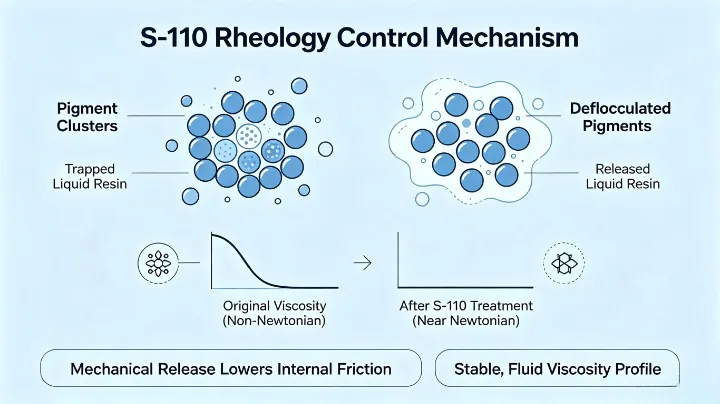
S-110 provides exceptional rheology control for concentrated color systems. By deflocculating the high-density pigments completely, it releases the liquid resin trapped within particle clusters.
This mechanical release lowers internal friction, allowing the tinting paste to maintain a stable, fluid viscosity profile (close to Newtonian flow behavior). Your industrial pastes stay highly fluid, pour cleanly without leaving thick residue on the container walls, and pump smoothly through processing lines even after long periods of storage.
4. How Global Manufacturers Maintain Long-Term Storage Stability
When engineers evaluate storage additives for color concentrates, they often look to premium international standards. For instance, Clariant’s Dispersogen® additives are highly regarded across the global chemical market for their wetting efficiency and ability to preserve stability in high-end tinting systems.
However, operating in today’s industrial landscape requires sourcing flexibility and competitive pricing. SailAdditive’s S-110 serves as an exceptional peer-performing alternative, specifically optimized for solvent-borne and high-solids industrial tinting pastes.
While traditional standards excel in universal water-borne lines, S-110 focuses heavily on demanding solvent systems through its pure polyphosphate backbone. S-110 features an active delivery viscosity of 30–80 $mm^2/s$ at $25^{\circ}C$, matching the performance profile of multinational alternatives. It anchors tightly to mineral surfaces, providing elite anti-settling insurance while reducing raw material costs for your purchasing department.
5. Troubleshooting Guide: Re-dispersing Settled Fillers with Minimal Shear
Even with advanced stabilizers, slight particle settling can happen over extended storage periods. The critical difference lies in the type of sediment formed. A system treated with S-110 creates a soft sediment (or soft cake) rather than a hard, rock-like layer.
Because S-110’s steric hindrance keeps a microscopic layer of resin between the resting particles, they can never truly fuse together. If you encounter a batch with light settling, you can restore its original uniform state using this simple low-shear troubleshooting routine:
- Inspect the Sediment: Insert a flat spatula to the bottom of the container. A soft sediment will feel like a loose, jelly-like paste, not a solid wall.
- Apply Low-Shear Agitation: Place the container under a standard paddle mixer or slow-speed dissolver. You do not need a high-speed bead mill or intense shear forces to fix this.
- Stir at Moderate Speed: Run the mixer at 300 to 500 RPM for 10 minutes. The low mechanical energy will easily break the loose spatial networks apart.
- Verify Uniformity: Check the fluid consistency. The soft sediment will rapidly redistribute back into the resin matrix, restoring the original grind fineness, color value, and fluid mobility with zero loss of active raw materials.
Conclusion: Protect Your Storage Quality
Pigment sedimentation and hard caking can lead to costly batch rejections and damage your brand’s reputation. By integrating a 100% active polyphosphate dispersant like S-110 into your mill base, you insulate your heavy fillers from gravity-driven packing, secure long-term pourability, and make storage failures a thing of the past.
Stop worrying about shelf life limitations and thick, clogged pumps. Upgrade your tinting paste dynamics and ensure lasting product consistency with precision surface chemistry.
Ready to eliminate hard caking and optimize your formulation costs? Visit SailAdditive.com to browse our complete raw material line, or contact our technical engineers directly at 86-13713141735 to secure your samples of S-110 today.