Master the Balance of Leveling and Degassing in High-Solid Coatings: The Ultimate Guide to Silicone Leveling Agent S-1484

Introduction
Formulating modern coatings involves a continuous battle against surface defects. Coating engineers often face a frustrating dilemma when working with environmentally friendly systems. They must achieve a flawless, mirror-like finish while eliminating stubborn micro-foam. Many traditional additives solve one problem but worsen the other. For instance, strong defoamers frequently cause craters, while aggressive leveling agents can trap air inside thick chemical films.
If you formulate high-solid or solvent-free coatings, you know this challenge very well. High-viscosity systems naturally resist the rapid release of air. This creates surface irregularities that ruin both appearance and protection. Fortunately, advanced additive chemistry now offers a dual-action solution. In this comprehensive guide, we will explore how a single, high-performance silicone leveling agent can help you achieve perfectly smooth, bubble-free surfaces without rising costs.
1. The Chemistry Behind Surface Defects in Industrial Coatings
To eliminate coating flaws, you must first understand why they occur. When you apply a coating, surface tension gradients develop across the wet film. These imbalances drive the movement of the liquid paint, which often creates an unwanted “orange peel” effect. At the same time, the application process forces air into the liquid matrix, which generates micro-foam.
In low-solid, solvent-borne systems, thin viscosities allow air bubbles to rise and pop easily. However, high-solid and solvent-free coatings behave differently. Their high density and quick-setting nature trap air below the surface. Standard acrylic leveling agents lack the power to decrease surface tension enough to flatten these tough systems. Therefore, you need a specialized molecular structure that acts simultaneously on the liquid-air interface and the bulk coating.
2. Introducing Polyether Siloxane Copolymer: The Dual-Action Mechanism
The secret to solving these combined issues lies in the unique structure of the polyether siloxane copolymer. This advanced molecule consists of two main parts: a silicone backbone and polyether side chains.
The silicone backbone provides an incredibly low surface energy. This property allows the additive to migrate rapidly to the coating’s surface, where it flattens surface tension variations and eliminates craters. Meanwhile, the polyether segments ensure excellent compatibility with the surrounding resin matrix. This perfect compatibility prevents haziness or loss of gloss.
More importantly, this specific copolymer structure destabilizes the cell walls of entrapped micro-foam. It forces tiny air bubbles to coalesce into larger ones, which then rise and escape before the film cures. This dual-action chemistry delivers a smooth, mirror-like finish even in thick-film coatings or highly viscous formulations.
3. SailAdditive S-1484: The Perfect Alternative to TEGO 1484
For years, multinational brands have dominated the premium additive market. Formulators frequently rely on standard products like Evonik’s TEGO® Flow 1484 to handle difficult applications. While these products deliver great results, procurement managers face increasing budget pressures and long supply chain lead times.
To help you optimize your production costs without losing quality, DongGuan SailAdditive developed S-1484 Silicone Leveling Agent. Engineered as a direct, high-performance alternative to TEGO-1484, S-1484 matches the benchmark’s leveling and degassing performance perfectly. It drastically reduces surface tension to eliminate orange peel, while actively promoting the rapid release of micro-foam during application.
By switching to S-1484, coating manufacturers can secure a reliable local supply chain, achieve identical surface performance, and significantly lower their total raw material costs.
4. Technical Specifications and Performance Profiles of S-1484
When looking for a reliable chemical alternative, chemical purity and parameter consistency matter most to R&D experts. S-1484 undergoes strict quality control to ensure stable batch-to-batch performance.
The Technical Data Sheet (TDS) highlights the following typical properties of this premium additive:
| Property | Typical Value |
| Exterior | Light yellow to amber transparent liquid |
| Viscosity (25°C, $mm^2/s$) | 300 – 500 |
| Density (25°C) | 1.440 – 1.450 |
| Non-volatile matter content (120°C/2h, %) | 100 |
Because S-1484 features a 100% active matter content, it contains no volatile organic solvents. This makes it perfectly compatible with your strictest eco-friendly product developments. It integrates smoothly into your current resin matrices without changing the final solids content or VOC calculations of your paint.
5. Key Application Areas: Where S-1484 Excels
The unique properties of the S-1484 silicone leveling agent make it highly versatile across several demanding industries:
- Industrial Floor Coatings: Heavy-duty epoxy and polyurethane floors require thick coats. S-1484 prevents pinholes and craters, ensuring a continuous, flawless protective barrier.
- High-Solid Wood Finishes: Clear and pigmented wood topcoats need high gloss and deep clarity. S-1484 eliminates brush marks and surface defects while keeping the clear coat perfectly transparent.
- Protective & Marine Coatings: Industrial structures require robust anti-corrosion barriers. S-1484 ensures excellent substrate wetting over rough steel, preventing weak spots where rust could start.
- General Industrial Coatings: Whether you use spray, roller, or curtain coating methods, S-1484 adapts to your application machinery to maintain consistent surface quality.
6. How to Implement S-1484 in Your Paint Formulation
Achieving excellent results with S-1484 requires proper dosing and incorporation techniques. Because this organic silicon surface additive is highly active, you only need a very small amount to see a dramatic difference.
Recommended Dosage
The standard recommended dosage ranges from 0.05% to 0.5% of the total formulation weight. We highly recommend conducting a ladder study starting at 0.1% to find the ideal balance for your specific resin and pigment load.
Incorporation Method
For optimal distribution, always add S-1484 during the paint mixing stage. High-shear mixing ensures that the polyether siloxane copolymer disperses evenly throughout the entire matrix. This complete distribution prevents localized concentration drops, which could cause surface haziness.
7. Overcoming the Inter-Coat Adhesion Dilemma
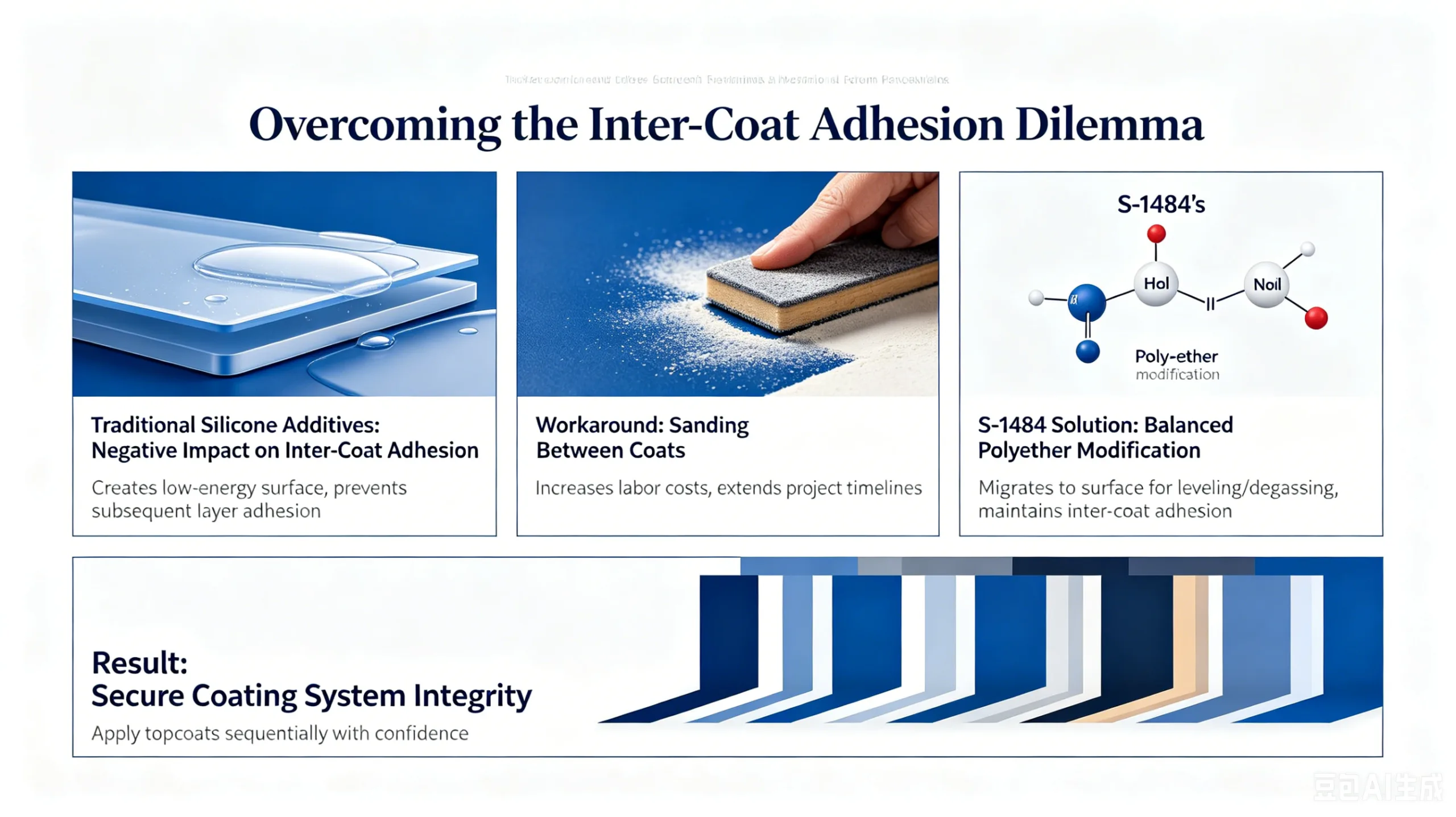
A common drawback of many traditional silicone additives is their negative impact on inter-coat adhesion. Strong silicones often create a slippery, low-energy surface that prevents subsequent paint layers from sticking. This forces workers to sand the surface between coats, which increases labor costs and extends project timelines.
Fortunately, S-1484 addresses this critical issue through precise molecular engineering. Its balanced polyether modification allows it to migrate to the surface to provide excellent leveling and degassing, but it does not compromise inter-coat adhesion. This means you can apply multiple layers of clear or pigmented topcoats sequentially with total confidence, knowing that the structural integrity of your coating system remains completely secure.
8. Storage, Packaging, and Safe Logistics
SailAdditive provides flexible packaging options to support both pilot-scale trials and large-scale industrial manufacturing. The product comes in 25L barrels or 200L plastic/steel barrels.
To maintain maximum performance, store S-1484 in its original, airtight container in a cool, dry place. When stored correctly, the product offers a long shelf life of 24 months. From a logistics perspective, S-1484 classifies as a non-hazardous chemical, which simplifies transport requirements and lowers your international shipping fees.
Conclusion
Choosing the right silicone leveling agent can completely transform your coating product line. It turns a sensitive, defect-prone formula into a robust, premium product that your customers will love. SailAdditive’s S-1484 provides an exceptional combination of powerful degassing and flawless leveling. It serves as an ideal alternative to expensive imported additives, allowing you to improve surface aesthetics while protecting your profit margins.
Don’t let surface defects or rising material costs slow your business growth. Contact our technical team today to request a sample of S-1484 and optimize your coating formulations for a brighter, more profitable future!
- Website: SailAdditive Official Website
- Technical Support Contact: +86-13713141735
Special Note: The technical parameters provided in this document are typical values for reference only and are not intended as product acceptance standards. Users should conduct relevant tests or consult our technical staff before using the product.