
Improving Aluminum Pigment Orientation in Metallic Baking Paints: Unlocking Flawless Flip Effects

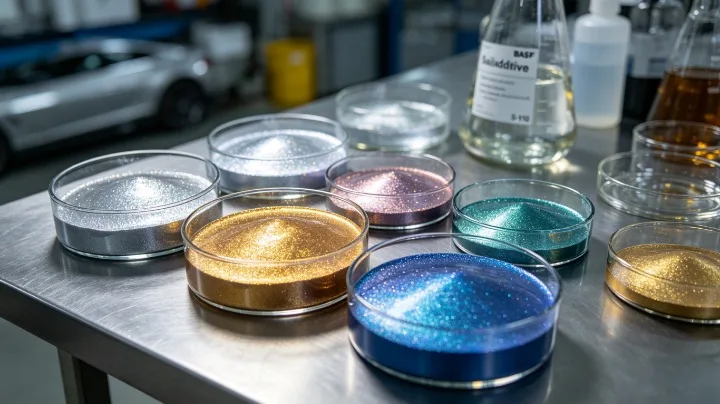
Metallic coatings bring a striking premium look to modern consumer goods, architectural panels, and transport equipment. However, formulation experts know that managing effect pigments—such as aluminum flakes and pearlescent powders—requires strict technical control. If these microscopic metallic flakes do not align correctly, your final coating will suffer from deep visual defects.
If you want your metallic coatings to stand out, learning how to improve aluminum pigment orientation paint lines is essential. This technical blog explores the physics of flake alignment, structural stabilization under intense heat, and how the right dispersing additives secure the perfect “flop” effect without ruining paint adhesion.
1. The Challenge of Preventing Flaking and Mottling in Metallic Finishes
In the industrial coil coating and automotive baking paint sectors, creating a uniform metallic finish is a constant struggle. The primary headache for shop floor engineers is a visual defect known as mottling or “clouding.” This problem appears as uneven, dark and light patches across the cured paint film.
Mottling happens when aluminum flakes distribute unevenly or tilt at random angles instead of lying flat. If the metal flakes tilt vertically or group into irregular clusters, they reflect light in chaotic directions.
This chaotic reflection destroys the coating’s optical consistency. Instead of a smooth, liquid-metal shine, you get a patchy, irregular finish. Additionally, poor stabilization can cause heavy metallic flakes to settle quickly in the wet film, leading to severe color shifting and patchiness during industrial processing.
2. How Surface Deflocculation Affects Metallic Flake Alignment
To understand how to keep metallic flakes parallel, you must look at the micro-rheology of the wet paint film. As solvents evaporate during the initial drying phase, internal fluid currents push through the wet layer. If your formulation suffers from pigment flocculation, the clustered particles create local areas of high friction and uneven fluid stress.
Advanced dispersing agents solve this problem through surface deflocculation. By wrapping individual pigment particles in a protective polymer shield, a high-performance dispersant eliminates attractive physical forces.
This total deflocculation removes local fluid stresses within the resin matrix. When you eliminate these internal friction spikes, the liquid base can flow uniformly as it shrinks vertically during drying. This uniform shrinkage applies a smooth, downward force that gently coaxes the aluminum flakes to flip and lie flat, parallel to the substrate surface.
3. S-110: Ensuring Uniform Spatial Hindrance in Industrial Baking Ovens
Industrial baking systems subject coatings to intense thermal stress. As a wet paint film enters a high-temperature baking oven, its viscosity drops sharply before the cross-linking reaction begins. This sudden thinning makes it incredibly easy for heavy aluminum flakes to sink, cluster, or tilt.
S-110 Dispersing Additive is engineered specifically to withstand these high-temperature environments. S-110 uses powerful polyphosphate anchoring groups that lock tightly onto particle surfaces. This multi-point anchoring remains completely stable from room temperature up to intense baking thresholds.
Long, solvated polymer tails extend outward from the pigment into the resin matrix, providing dependable steric hindrance (spatial repulsion). Every drop of S-110 features 100% active non-volatile matter content, meaning it introduces zero volatile solvents that might flash off and disturb the orienting flakes.
This continuous spatial barrier prevents aluminum flakes from clustering or sinking during the critical liquid-to-solid (leveling) stage, securing an absolute uniform finish under intense heat.
4. How Industry Benchmarks Stabilize Effect Pigments
When evaluating effect pigment stabilizers, automotive and industrial chemists frequently look to premium global standards. For example, BASF’s Efka® PB series is highly regarded across the industrial coatings market for its ability to manage effect pigments and control optical behavior in demanding paint formulations.
However, modern manufacturing plants must carefully manage raw material costs and avoid single-supplier bottlenecks. SailAdditive’s S-110 provides an exceptional peer-performing alternative. It is tailored specifically to provide elite aluminum flake control in solvent-borne baking systems.
While global standards are effective, they often come with high corporate markups and rigid shipping timelines. S-110 matches these international baselines by delivering excellent anti-settling protection and powerful deflocculation.
With a low delivery viscosity of 30–80 $mm^2/s$ at $25^{\circ}C$, S-110 incorporates quickly into industrial varnishes. S-110’s specific polyphosphate structure ensures a brilliant “flop” effect—where the paint changes brightness perfectly based on the viewing angle—at a highly competitive cost.
5. Balancing Dispersant Dosage to Avoid Interlayer Adhesion Failure
While maximizing metallic flake alignment is crucial, R&D chemists must always protect the coating’s mechanical limits. Adding too much standard surfactant can create a migratory layer that floats to the surface, causing severe interlayer adhesion failure during multi-coat processes.
S-110 solves this engineering challenge through its unique (polarity) control. It anchors so aggressively to the pigment surfaces that it resists migrating into the inter-coat zones. However, engineers must still calculate dosages carefully to maintain a perfect formula balance.
For optimal aluminum pigment orientation, use a tiered approach based on the total weight of your effect pigments:
- Aluminum Flakes & Pearlescent Powders: Use 1% to 4% of S-110 based on the total pigment weight.
- Co-Dispersing Fine Inorganic Colorants: If your metallic paint includes background pigments like titanium dioxide, use 1.5% to 3% based on that pigment’s weight to prevent vertical separation.
- Mixing Sequence: Always incorporate S-110 into your solvent and resin blend during the pre-mix phase before you introduce the effect pigments. This sequencing guarantees that the active polymer chains cover the metallic surfaces evenly without damaging the delicate flake shapes.
Conclusion: Capture the Perfect Metallic Sheen
Mottling and metallic flake settling are expensive defects, but you can control them completely through precise surface engineering. By utilizing S-110, you give your industrial baking paints a 100% active, high-temperature stabilization partner that eliminates clouding and maximizes visual color depth.
Stop struggling with inconsistent color changes and patchy finishes. Upgrade your metallic formulations and capture a true, uniform liquid shine with precision chemistry.
Ready to upgrade your metallic paint performance and optimize your raw material costs? Visit SailAdditive.com to check out our complete additive catalog, or connect directly with our technical support team at 86-13713141735 to request a sample of S-110 today.