
Choosing Dispersants for High-Solids and Solvent-Free Epoxy Systems: A Formulator’s Guide to Defect-Free Floors

Industrial flooring and heavy-duty anti-corrosion coatings demand the highest levels of structural durability and chemical resistance. To meet modern environmental laws, paint manufacturers continue to move away from traditional solvent-borne formulas. Instead, they favor high-solids and completely solvent-free epoxy resin matrices.
However, removing volatile organic compounds (VOCs) completely changes the physical behavior of the liquid coating. For research and development (R&D) experts and flooring engineers, this transition introduces a major production obstacle.
Without conventional thinners, raw pigments and functional fillers become incredibly difficult to handle. Selecting a specialized dispersant for solvent-free epoxy is essential to ensure a smooth, defect-free installation.
This comprehensive guide explores the unique wetting challenges of eco-friendly flooring formulations. We will analyze why additive solids content matters and detail how advanced wetting and dispersing agents protect thick coatings from pigment settling and structural sagging.
1. The Strict Wetting Challenges in Low-VOC Flooring Formulations
For flooring engineers, working with solvent-free epoxy resins is a constant battle against high viscosity. Standard bisphenol A/F epoxy resins possess a naturally thick molecular structure. When you eliminate organic solvents from the recipe, the liquid vehicle stays extremely sluggish and dense.
This high baseline viscosity creates a severe wetting problem during the manufacturing stage. Raw pigments (such as titanium dioxide or phthalocyanine green) and heavy structural fillers (like quartz powder, silica sand, and barium sulfate) have high surface energies. They naturally exist as tightly packed clusters.
A dense, unassisted epoxy resin cannot penetrate these dry clusters easily. Because the liquid cannot displace the air trapped between the pigment particles, several severe formulation problems occur:
Poor Pigment Wetting
The thick resin merely wraps around the outside of large pigment chunks rather than coating individual particles. This incomplete wetting causes dry, unseparated aggregates to remain in the mill base, leading to a gritty surface texture on the finished floor.
Severe Viscosity Spikes
Unwetted pigments quickly absorb a portion of the limited liquid vehicle onto their surfaces. This absorption robs the system of free resin, causing the mill base’s viscosity to climb to unmanageable levels during the grinding phase, slowing down production machinery.
Surface Craters and Pinholes
When workers apply the thick epoxy floor paint, trapped air pockets around the unwetted pigments slowly try to escape. Because the high-viscosity film cures quickly, these bubbles become trapped near the surface. They pop late in the drying cycle, leaving behind permanent craters, pinholes, and “fish-eyes” that ruin the smooth look of the floor.
2. Why 100% Solid Content Additives are Essential for Low-VOC Paint
To overcome these wetting barriers, procurement managers and R&D teams often look for chemical additives to break surface tension. However, using standard commercial dispersants can create a hidden trap. Most traditional dispersing agents are diluted with carrier solvents—like xylene, butyl acetate, or PM acetate—to keep the additive fluid in its delivery container.
In high-solids or solvent-free epoxy floor coatings, using a diluted additive defeats the entire purpose of a low-VOC design. This scenario explains why choosing an additive with 100% solid content (non-volatile matter) is essential for modern chemical compliance and paint performance.
Eliminating Trapped Solvent Vapor
If you introduce a diluted dispersant into a solvent-free epoxy floor paint, those low-boiling carrier solvents will stay trapped inside the thick layer after application. Epoxy floors are applied at a high film thickness (often 1 to 3 millimeters deep). As the epoxy cross-links, it seals the surface. The trapped solvent molecules cannot evaporate, forming micro-voids and vapor pockets that weaken the mechanical strength of the floor.
Protecting Film Hardness and Chemical Resistance
Trapped carrier solvents act as plasticizers within the cured epoxy matrix, making the floor softer than intended. A soft epoxy floor will scratch easily under heavy forklift traffic and succumb quickly to chemical spills or industrial cleaners. A 100% solids dispersant introduces zero volatile compounds, allowing the epoxy network to reach its full cross-linking potential and mechanical hardness.
Meeting Strict Environmental Codes
Industrial projects increasingly demand green building certifications, such as LEED or regional low-VOC compliance. Using a 100% active matter dispersant ensures that your final formulation remains completely solvent-free, simplifying the product regulatory approval process and giving your brand a distinct market advantage.
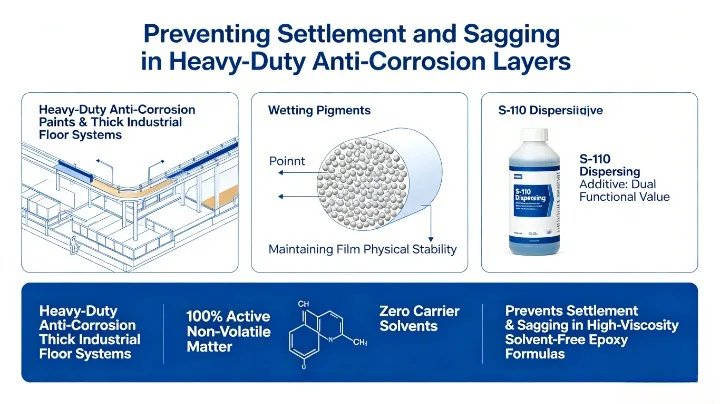
3. Preventing Settlement and Sagging in Heavy-Duty Anti-Corrosion Layers
In heavy-duty anti-corrosion paints and thick industrial floor systems, a dispersant must do more than just wet the pigments; it must also maintain the physical stability of the applied film. This area highlights the dual functional value of S-110 Dispersing Additive.
S-110 is a specialized polyphosphate solution that features a 100% active non-volatile matter content. It contains zero carrier solvents, making it a perfect match for high-viscosity, solvent-free epoxy formulas. Beyond its primary role as a wetting agent, S-110 provides an essential secondary benefit: preventing settlement and sagging.
   Flocculated System (Hard Caking)          S-110 Stabilized System (Anti-Settling)
      ___________________________              ___________________________
     |                           |            |  .   .   .   .   .   .   .  |
     |                           |            |  .   .   .   .   .   .   .  |
     |___________________________|            |___________________________|
     [======= HARD CAKE =======]              [..... SOFT SEDIMENT .....]
Defeating Hard Caking
Heavy inorganic pigments like iron oxides and barium sulfate have a high specific gravity. Over weeks of shelf storage, these heavy particles naturally want to sink to the bottom of the paint can. In an untreated paint system, they pack tightly into an impenetrable layer known as a “hard cake.” This rock-hard sediment is nearly impossible for a painter to remix.
S-110 uses powerful steric stabilization (spatial repulsion) to keep pigment particles perfectly separated. Because the particles can never touch or agglomerate, any natural settling results in a loose, “soft sediment” that easily disperses back into a uniform liquid with minimal mechanical stirring.
Controlling Film Sagging
When applying heavy-duty anti-corrosion coatings onto vertical surfaces (such as marine vessels or steel bridges), gravity pulls the thick wet paint downward, causing ugly “sagging” or runs. S-110 provides precise rheological control.
By deflocculating the pigments cleanly, it allows the wet paint to flow out smoothly to eliminate brush marks immediately after application. Then, it helps establish a controlled micro-structure that locks the pigments in place, preventing the wet film from sagging or running before the epoxy resin cross-links.
4. How Leading Formulators Tackle Low-VOC Resin Wetting
When evaluating new raw materials for thick industrial paints, development chemists often benchmark their formulas against established market standards. For example, Elementis’s Nuosperse® additives are widely recognized for their ability to modify the wetting behavior and adjust the flow profile of high-viscosity, heavy-duty protective coatings.
However, in modern low-VOC resin manufacturing, sourcing agility and raw material costs are critical factors for business success. SailAdditive’s S-110 serves as an elite peer-performing alternative, specifically optimized for solvent-free and high-solids epoxy environments.
While traditional thick-film additives often rely on solvent blends to aid wetting, S-110 handles dense resin matrices through its pure polyphosphate architecture. S-110 features an active viscosity of 30–80 $mm^2/s$ ($25^{\circ}C$), allowing it to pour easily and mix directly into heavy liquid epoxy without requiring any pre-thinning.
By choosing S-110, your R&D lab achieves the same elite level of pigment wetting, anti-settling protection, and gloss uniformity as legacy global brands. Concurrently, your purchasing department secures a highly competitive cost structure and a reliable supply line that helps insulate your business from multinational supply chain disruptions.
5. Calculating the Precise Dosage for Industrial Floor Coatings
To achieve a flawless, crater-free floor finish, you must apply S-110 using calculated, tiered dosage strategies. Because an industrial floor paint contains a complex mix of fine organic color pigments and coarse inorganic functional fillers, a single dosage rate rarely fits all raw materials.
Wetting and dispersing additives must always be introduced into the resin during the pre-mix stage, before adding any dry powders. This ensures the polyphosphate anchoring groups dissolve fully and coat the raw particles immediately as they enter the fluid.
Formulators should calculate the ideal S-110 dosage based on the total weight of the specific pigment or filler type:
- Coarse Functional Fillers (Quartz, Barium Sulfate, Silica Sand): 0.2% – 1.0% of the filler weight. (These heavy minerals have a low surface area and require less active polymer to achieve stabilization).
- Inorganic Pigments (Titanium Dioxide, Iron Oxides): 1% – 4% of the pigment weight.
- Organic Color Pigments (Phthalo Green, Phthalo Blue, Organic Yellows): 10% – 30% of the pigment weight. (These light powders feature immense surface area and require a higher concentration of active anchors).
- Carbon Blacks (For Deep Jetness or Conductive Flooring): 30% – 50% of the pigment weight.
The Step-by-Step Production Sequence:
- Load the Base Liquid: Add your liquid epoxy resin and any necessary reactive diluents into the mixing vessel.
- Incorporate S-110: Add the precise dose of S-110 directly into the resin matrix. Mix at medium speed for 5 to 10 minutes to ensure a completely homogenous active phase.
- Feed the Powders: Under continuous mechanical agitation, slowly add your pigments and heavy fillers. The active S-110 molecules will instantly wet the particle surfaces as they hit the liquid, preventing the formation of dry clumps.
- High-Speed Dispersion: Increase the mixer speed to create a strong shear vortex for 15 to 20 minutes, allowing the polyphosphate groups to anchor firmly across the particle surfaces.
- Final Grinding: Pass the fluid mixture through your horizontal bead mill or three-roller mill to achieve the final target particle size quickly and efficiently.
Conclusion: Formulate with Confidence
Thick resin viscosity and pigment settling are expensive obstacles, but you can control them completely through smart surface chemistry. By utilizing S-110, you give your solvent-free epoxy floor coatings a 100% active, solvent-free wetting partner that eliminates craters, prevents hard caking, and ensures a flawless, industrial-grade finish.
Stop fighting viscosity and pigment settling. Upgrade your low-VOC paint formulations and maximize your factory throughput with precision engineering.
Ready to enhance your flooring performance and optimize your production costs? Visit SailAdditive.com to explore our complete raw material catalog, or connect directly with our technical application team at 86-13713141735 to request a sample of S-110 today.