
What is the Ideal Dosage and Incorporation Method for Silicone Leveling Agents?

Formulating a premium coating requires high-quality ingredients, but adding them incorrectly can ruin an entire batch. Even the most advanced surface additives require precise handling to deliver their full benefits.
Introduction: Moving from a lab formulation to full-scale factory production requires strict attention to operational details. In this practical guide, we focus on the factory floor and the laboratory bench. We will guide factory operators and formulators on how to correctly calculate, introduce, and blend Силиконовый Выравнивающий агент S-323 at the critical 0.05% to 0.3% dosage range. Following these best practices ensures that your solvent-based coatings cure into flawless, defect-free films every time.
The Risks of Over-Dosing vs. Under-Dosing Silicone Additives
Silicone leveling agents are incredibly potent chemicals. They modify surface properties at very low concentrations because they migrate rapidly to the air-liquid interface. However, this high activity means that even a small weighing error can cause significant surface issues.
The Consequences of Under-Dosing
If you do not add enough leveling agent, the coating cannot overcome internal surface tension gradients.
- Bénard Cells: Vortex-like currents form unchecked as solvents evaporate, leading to orange peel and severe unevenness.
- Poor Pigment Alignment: In matte systems, matting agents settle randomly instead of orienting uniformly.
- No Defoaming Support: The formulation loses the necessary deaeration effect, which allows micro-foam to remain trapped in the cured film.
The Dangers of Over-Dosing
More is not better when it comes to silicones. Over-dosing creates an excess of silicone molecules that cannot integrate cleanly into the polymer matrix.
- Severe Cratering: Free silicone can aggregate into droplets on the surface, repelling the wet paint and forming deep craters.
- Intercoat Adhesion Failure: The excess silicone creates a slick, low-energy top surface. If you try to apply a second coat of paint, the new layer cannot stick to the first one, causing it to peel or crawl.
- Surface Hazing: It can cause a greasy film or cloudiness on high-gloss finishes.
Calculating the 0.05% to 0.3% Sweet Spot for S-323
To avoid these risks, you must strictly follow the technical datasheet guidelines. Силиконовый Выравнивающий агент S-323 features a polyether-modified polydimethylsiloxane copolymer structure with a high active content (>97% non-volatile matter). Because it is highly concentrated, the standard recommended dosage is a tiny 0.05% to 0.3% of the total formula weight.
                  [ Total Formula Weight ]
                             |
         +-------------------+-------------------+
         |                                       |
         v                                       v
   [ 0.05% Minimum ]                       [ 0.3% Maximum ]
(For high-polarity systems)             (For low-polarity/heavy coats)
Step-by-Step Production Calculation
Operators must calculate the weight of S-323 based on the absolute total weight of the batch, including all resins, solvents, pigments, and extenders.
Let us look at a practical math example for a standard 1,000 kg batch of industrial wood paint:
- To achieve a minimum 0.05% dosage
- To achieve a standard mid-range 0.1% dosage
- To achieve the maximum 0.3% dosage
Finding Your Target
Always start your laboratory trials right in the middle at 0.1%. If you are formulating high-polarity coatings like certain polyurethane or industrial baking systems, a lower dosage often suffices because S-323 is highly active. For thick curtain coatings or heavy-duty industrial paints, you may need to increase the dosage toward 0.3% to maintain a stable liquid curtain and ensure excellent deaeration.
Why You Must Introduce S-323 During the Paint Mixing Stage
Timing is everything in chemical processing. You cannot simply dump an advanced silicone additive into a finished paint tank right before packaging and expect flawless results.
The Correct Operational Window
The technical documentation states clearly that you must incorporate S-323 during the paint mixing stage. This means you should introduce it during the let-down phase, after the heavy pigment grinding process but while the main mixing blade is actively agitating the resin matrix.
[ Pigment Grinding Stage ] ---> [ Paint Mixing Stage (ADD S-323 HERE) ] ---> [ Final Filtration & Packaging ]
Why Post-Adding Fails
If you add S-323 at the very end of production without sufficient shear force, the additive cannot dissolve evenly into the system. The high-viscosity liquid will form highly concentrated “pockets” or droplets. These isolated pockets float through the batch, leading to local surface tension imbalances and causing craters during spray or curtain applications.
For premium wood finishes, formulation experts often rely on Silco Flw 3230 to drive surface slip and anti-cratering effects in high-end systems. However, whether using competitor products or S-323, proper mechanical integration during the mixing stage remains the vital industry standard to guarantee maximum performance.
Ensuring Homogeneous Distribution to Avoid Cratering
To get a smooth, defect-free finish, factory operators must follow a specific mixing protocol to achieve perfect homogeneity.
High-Shear Blending Protocols
- Check the Agitation Speed: Set the let-down tank mixer to a moderate-to-high speed. The liquid should form a clear, active vortex without sucking excess air into the system.
- Pour Slowly: Do not dump the calculated weight of S-323 into the tank all at once. Pour it in a slow, steady stream directly into the center of the vortex. This splits the additive instantly into micro-droplets.
- Maintain Blend Time: After adding S-323, keep the mixer running for at least 15 to 20 minutes. This gives the polyether chains on the silicone copolymer backbone enough time to align and bond with the surrounding resin system.
[ Active Vortex Cooking ] + [ Slow Stream Influx ] + [ 20 Min Extended Shear ] = Homogeneous Batch
Proper blending ensures that the additive slightly reduces surface tension uniformly across the entire batch, allowing curtain coatings to flow perfectly without tearing or breaking.
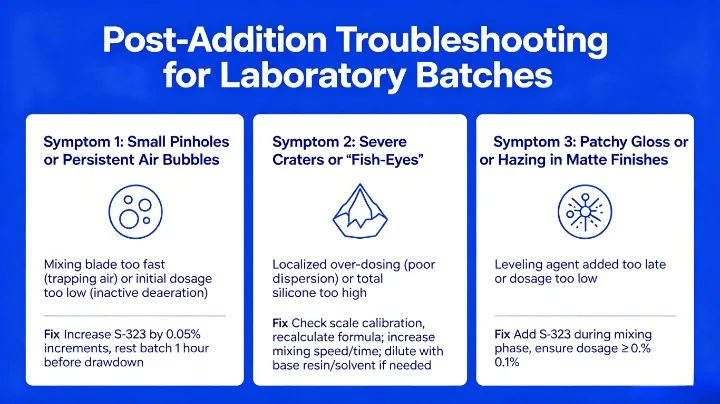
Post-Addition Troubleshooting for Laboratory Batches
If your lab drawdowns or test panels show surface defects after adding S-323, use this quick troubleshooting matrix to adjust your process.
Symptom 1: Small Pinholes or Persistent Air Bubbles
- The Cause: The mixing blade ran too fast, trapping air, or the initial dosage was too low to activate the deaeration effect.
- The Fix: S-323 provides a unique deaeration effect that prevents foam stabilization. Try increasing the dosage by 0.05% increments to help break the micro-foam, and allow the lab batch to rest for 1 hour before making another drawdown.
Symptom 2: Severe Craters or “Fish-Eyes”
- The Cause: This is a classic sign of localized over-dosing due to poor dispersion, or the total silicone percentage is too high for the resin system.
- The Fix: Check your scale calibration and recalculate the formula. If the weight is correct, increase your mixing speed and extend the blending time. If craters persist, you must dilute the batch by adding more base resin and solvent to lower the total silicone concentration.
Symptom 3: Patchy Gloss or Hazing in Matte Finishes
- The Cause: The leveling agent was added too late, or the dosage is too low to drive uniform matting agent orientation.
- The Fix: Ensure S-323 is present during the mixing phase so it can stabilize the silica particles before the film dries. Verify that your dosage is at least 0.1%.
Technical Specifications for Laboratory Control
Keep these official product constants handy on your laboratory wall for rapid verification during testing:
| Parameter | Laboratory Control Standard |
| Appearance | Light yellow to amber transparent liquid |
| Chemical Structure | Polyether-modified polydimethylsiloxane copolymer |
| Viscosity (25°C) | 500-1000 mm^2 s |
| Density (25°C) | 1.440-1.450 |
| Non-Volatile Matter Content | >97 (120^C/2h) |
| Thermal Resistance | Up to $250^C |
Storage Assurance
Always seal lab samples and production barrels tightly after weighing. S-323 has an excellent shelf life of 24 months when stored in an airtight container in a cool, dry place. It transports as a non-hazardous chemical, making it convenient to handle on the factory floor.
Conclusion: Precision Leads to Perfection
Using a high-performance additive like S-323 is the easiest way to optimize surface aesthetics and film consistency. However, you must treat the chemistry with respect. By calculating your dosage carefully between 0.05% and 0.3%, and incorporating it thoroughly during the paint mixing stage, you eliminate surface defects and unlock a flawless, industrial-grade finish.
Do you need technical support to optimize your production mixing line? Visit SailAdditive to download full data sheets or request a complimentary lab sample of S-323 for your evaluation trials.