
Master industrial curtain coating stability. Learn how the S-323 silicone leveling agent controls dynamic surface tension to prevent curtain breakages and micro-foam.

Achieving a flawless finish at high production speeds is the ultimate goal in modern industrial coating lines. Among various application methods, curtain coating stands out for its efficiency. However, maintaining a perfectly stable liquid curtain requires precise control over coating chemistry.
Introduction: Industrial curtain coating processes demand absolute precision to prevent costly line stoppages and surface defects. In high-speed coating lines, the slightest physical or chemical imbalance can rupture the liquid curtain, leading to uneven application or skipped spots. In this guide, we deep dive into the mechanics of industrial curtain coating. We will explore how the Силиконовый Выравнивающий агент S-323 optimizes dynamic surface tension and provides the deaeration effects necessary to maintain a flawless, unbroken liquid curtain.
Mechanics of the Curtain Coating Delivery System
To solve flow instability, we must first understand how a curtain coating system functions. This process relies on a continuous, gravity-driven sheet of liquid falling onto a substrate moving rapidly beneath it.
   [ Coating Reservoir / Die ]
               |
               |  <-- Falling Liquid Sheet (The Curtain)
               v
   ==============================> [ Moving Substrate / Panel ]
The Delivery Process
The coating material pumps into a specialized distribution header, often called a weir or slot die. The liquid overflows or exits the slot at a controlled rate, forming a vertical falling film. As the substrate passes through this falling “curtain,” it receives a uniform, high-speed application of paint or lacquer.
The Precision Balance
The success of this system relies entirely on the integrity of the falling sheet. The liquid film must remain perfectly continuous across its entire width. It must also maintain a uniform thickness before it hits the substrate. Because the film is incredibly thin and moves rapidly, it is highly sensitive to external vibrations, airflow, and internal chemical forces. Any disruption in the delivery system directly translates into visible surface defects.
Why Dynamic Surface Tension Causes Curtain Breakages
The primary hidden enemy of a stable liquid curtain is uncontrolled surface tension, specifically dynamic surface tension.
Static vs. Dynamic Surface Tension
Static surface tension measures a liquid at rest. In contrast, dynamic surface tension measures how fast surfactant molecules migrate to newly created interfaces. In curtain coating, the system creates massive amounts of new liquid surface area every second as the paint drops from the die.
The Mechanism of Rupture
If the surfactant molecules move too slowly, the surface tension of the falling sheet becomes uneven. High-surface-tension zones pull harder than low-surface-tension zones. This imbalance creates localized thinning in the liquid sheet. Eventually, the film reaches a critical point and snaps.
[Slow Surfactant Migration] ---> [Uneven Surface Tension] ---> [Localized Thinning] ---> [Curtain Breakage]
These curtain breakages cause immediate production disasters:
- Skipped areas: Uncoated patches on the substrate.
- Edge pullback: The liquid sheet retracts inward, leaving edges bare.
- Varying film weight: Rough, unpredictable coat weights across the batch.
To stop this, formulators introduce highly active surface additives that stabilize these rapid surface changes.
Deaeration and Micro-Foam Prevention with S-323
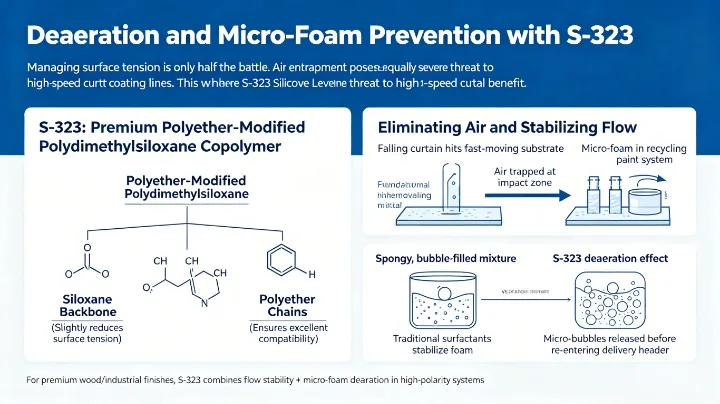
Managing surface tension is only half the battle. Air entrapment poses an equally severe threat to high-speed curtain coating lines. This is where Силиконовый Выравнивающий агент S-323 delivers a powerful dual benefit.
S-323 is a premium polyether-modified polydimethylsiloxane copolymer. It serves as a high-performance alternative to industry standards like BYK-323.
                +---------------------------------------+
                |  Polyether-Modified Polydimethylsiloxane |
                +---------------------------------------+
                                    |
            +-----------------------+-----------------------+
            |                                               |
            v                                               v
[Siloxane Backbone]                                [Polyether Chains]
(Slightly reduces surface tension)            (Ensures excellent compatibility)
Eliminating Air and Stabilizing Flow
As a falling curtain hits a fast-moving substrate, air easily gets trapped at the impact zone. This creates micro-foam within the recycling paint system. Traditional surfactants often stabilize this foam, turning the liquid into a spongy, bubble-filled mixture. Bubbles passing through the slot die cause instant curtain ruptures.
S-323 functions by slightly reducing surface tension to stabilize the flow of curtain coatings. Crucially, it provides a unique deaeration effect that actively prevents foam stabilization. Instead of trapping micro-bubbles, S-323 forces them to release quickly before the liquid re-enters the delivery header.
For premium wood and industrial finishes, formulation experts often rely on Silco Flw 3230 to drive surface slip and anti-cratering effects in high-end systems. However, S-323 provides an exceptionally balanced solution by combining excellent flow stability with targeted micro-foam deaeration in high-polarity systems.
Maintaining Constant Film Thickness Across Wide Substrates
In large-scale industrial lines—such as coil coatings, container coatings, or wide furniture panels—maintaining consistent film thickness across the entire substrate width is extremely difficult.
Preventing the “Edge Effect”
Liquids naturally want to minimize their surface area. At the outer left and right edges of a falling curtain, the paint tends to thickens or pull inward due to surface tension forces. This causes heavy edges and thin centers on the final product.
The S-323 Solution
By incorporating S-323 into the solvent-based formula, you optimize the internal consistency of the coating material.
- Uniform Alignment: It assists in the precise, uniform alignment of pigments and matting agents across wide spans.
- Even Leveling: It ensures the wet film levels out perfectly smooth from edge to edge before entering the curing phase.
- Thermal Insurance: If your line utilizes high-temperature curing, S-323 offers exceptional thermal stability up to 250°C. It prevents film defects or surface degradation even under demanding industrial baking conditions.
Troubleshooting Common Defects in High-Speed Coating Lines
When running high-speed lines, operators must quickly identify and resolve film defects. Here is a handy guide to troubleshooting common curtain coating issues using S-323.
1. Pinholes and Craters
- The Cause: Silicones or contaminants on the substrate repel the wet paint, or trapped micro-bubbles pop during the flash-off phase.
- The Fix: Ensure proper cleaning of the substrate. Add 0.05% to 0.3% S-323 during the paint mixing stage to achieve optimal distribution and drive out micro-bubbles.
2. Line Lines / Wet Streaks
- The Cause: A particle or dried paint bit gets lodged in the slot die, splitting the falling curtain.
- The Fix: Clean the die assembly. S-323’s high non-volatile matter content (>97%) ensures excellent system compatibility, reducing the risk of additive-induced precipitation or gelling in the nozzle.
3. Fluctuating Gloss and Texture
- The Cause: Poor orientation of matting agents or metallic pigments due to turbulent flow inside the curtain.
- The Fix: S-323 is particularly effective in matte systems and baking-type metallic paints. It ensures strong matting agent orientation and uniform aluminum pigment alignment for a consistent finish.
Technical Properties of S-323
For technical directors and lab chemists, here are the key parameters of S-323 for formulation adjustments:
| Technical Parameter | Typical Value / Specification |
| Appearance | Light yellow to amber transparent liquid |
| Chemical Type | Polyether-modified polydimethylsiloxane copolymer |
| Viscosity (25°C) | 500–1000 mm^2/s |
| Density (25°C) | 1.440–1.450 |
| Non-Volatile Content | >97% (120°C/2h) |
| Thermal Stability | Up to 250°C |
Packaging and Handling
SailAdditive offers S-323 in 25L barrels или 200L plastic/steel barrels to match industrial scale needs. The product transports safely as a non-hazardous chemical and provides a 24-month shelf life when stored in airtight containers.
Conclusion: Achieve Unbroken Production Efficiency
A stable curtain coating line requires a delicate balance of mechanical setup and surface chemistry. By choosing a high-performance additive like S-323, you actively eliminate dynamic surface tension issues and micro-foam failures. You gain a reliable, defect-free finish with high thermal resistance.
Ready to eliminate curtain breakages on your production line? Visit SailAdditive to explore our complete chemical portfolio. Contact our technical team today to request product samples or schedule a formulation trial.