
What is a Wetting Agent? Understanding Surface Tension for Perfect Coatings and High-Efficiency Agriculture

In industries ranging from coatings and printing to modern agriculture, the ability of a liquid to spread perfectly across a surface is a critical performance factor. The key to achieving this is the use of Wetting Agents.
Whether you are seeking a flawless “mirror” finish on a car or ensuring a pesticide covers every leaf of a crop, wetting agents are the invisible force that makes it possible.
What Are Wetting Agents?
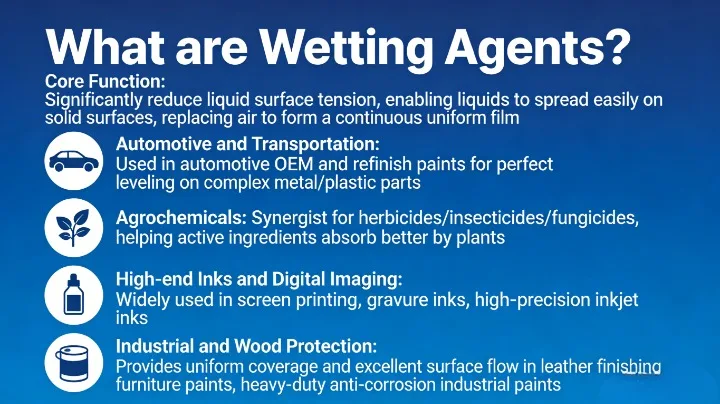
Wetting agents are chemical additives designed to significantly reduce the surface tension of a liquid. Their primary role is to allow the liquid to spread easily over a solid substrate, replacing air on the surface to form a continuous, uniform film.
The core mechanisms of wetting agents include:
- Surface Tension Reduction: By aligning at the liquid/air interface, they break the cohesive forces of the liquid, allowing droplets to flatten and spread.
- Enhanced Penetration: High-performance wetting agents facilitate the entry of active ingredients into surfaces, such as plant stomata in agricultural applications.
- Defect Elimination: In coatings, they prevent surface defects such as craters, fish-eyes, and shrinkage cavities caused by poor substrate wetting.
Core Applications: Products and Industrial Fields
Based on the technical standards of DongGuan SailAdditive, different chemical structures serve distinct professional sectors.
1. Core Systems and Product Categories
- The Substrate Wetting Expert (S-270): A high-performance alternative to TEGO 270, S-270 is a polyether-modified polymer designed for water-borne, solvent-based, and UV systems. It offers superior compatibility and is the go-to choice for defect-free coating applications.
- Agricultural Super-Spreader (S-608): S-608 is a polyether-modified polydimethylsiloxane copolymer similar to Momentive Silwet-408. It provides “super-spreading” in agricultural sprays, drastically increasing coverage area and enhancing rainfastness.
- High-Stability Trisiloxane (S-6081): Specifically formulated for demanding chemical environments, S-6081 offers exceptional hydrolysis resistance and remains stable across a wide pH range. It ensures stable wetting in high-pH inks and heavy-duty industrial paints.
2. Key Manufacturing Processes
- Pigment Dispersion and Mixing: Wetting agents are typically added during the paint mixing stage to ensure optimal distribution throughout the system.
- High-Speed Printing: In packaging and printing, specialized agents ensure that inks instantly wet the substrate even during high-speed application.
- Precision Spraying: In agriculture, using products like S-608 allows for reduced spray volumes, lowering costs while improving biological efficacy.
3. Broad Industrial Fields
- Automotive and Transportation: Used in OEM and repair coatings to ensure the paint film flows perfectly over complex metal or plastic parts.
- Modern Agriculture: Acts as an intensifier for herbicides, insecticides, and fungicides, helping active ingredients be absorbed more efficiently by plants.
- High-End Inks and Digital Media: Widely applied in screen, gravure, and flexo inks, as well as high-precision inkjet inks.
- Industrial and Wood Protection: Provides uniform coverage and excellent surface flow in leather finishes, furniture paints, and heavy-duty anti-corrosion coatings.
Expert Usage Tips for Optimal Wetting
To achieve the best results, the recommended dosage for wetting agents is typically very low:
- Industrial Coatings and Inks: Generally, between 0.1% – 1% of the total formula.
- Agricultural Sprays: Dosages for super-spreaders like S-608 can be as low as 0.01% – 0.5%.
Many formulators compare these results to international benchmarks like the BYK Additives collection, finding that SailAdditive provides a reliable, high-performance alternative for global resin systems.
Would you like a specialized compatibility guide for S-270 and S-6081 to help you choose the best wetting agent for your specific resin system?