
Solving High-Jetness Carbon Black Flocculation and Re-Coarsening: The Steric Hindrance Mechanism of S-4010

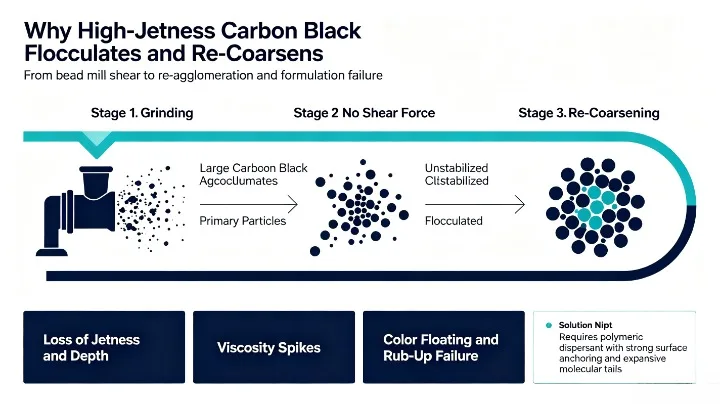
Formulating high-jetness black coatings poses severe challenges for technical laboratories. High-surface-area carbon black pigments possess extreme surface energies and strong van der Waals attractions. Consequently, carbon black particles tend to aggregate, flocculate, and re-coarsen shortly after high-shear bead milling. Flocculation causes severe paint defects, including loss of jetness, surface haze, viscosity spikes, and rapid pigment settling.
Traditional low-molecular wetting agents fail to prevent re-agglomeration because they lack sufficient spatial volume. To secure deep blackness and long-term shelf stability, formulators must establish a robust steric hindrance layer around each pigment particle.
To solve these tough stabilization issues, SailAdditive developed S-4010 Dispersing Agent, a 100% active content, high-performance modified polyurethane polymer designed for solvent-based, water-based, and UV coating systems.
In this technical guide, we break down why carbon black flocculates, explain the steric hindrance mechanism of S-4010, and demonstrate how you can achieve deep jetness and stable viscosity in industrial coatings.
Why High-Jetness Carbon Black Flocculates and Re-Coarsens
Carbon black pigments feature extremely small primary particle sizes and exceptionally high oil absorption values. During the initial grinding phase, bead mills break large agglomerates apart into primary particles. However, once shear forces stop, un-stabilized particles collide and clump back together—a process known as re-coarsening or flocculation.
This re-agglomeration creates three major formulation problems:
- Loss of Jetness and Depth: Flocculated particles scatter light irregularly, turning deep black tones into dull, brownish-gray shades.
- Viscosity Spikes: Uncovered carbon black particles build strong particle-particle networks, causing millbases to gel or thicken rapidly.
- Color Floating and Rub-Up Failure: In mixed pigment systems (such as carbon black mixed with titanium dioxide), flocculated carbon black separates easily, causing severe floating streaks during spray application.
Consequently, formulators need a polymeric dispersant with strong surface anchoring and expansive molecular tails.
Market Landscape: S-4010 vs. Leading Industry Alternatives
Evaluating established market additives helps technical teams benchmark polymer performance and formulation fit across global suppliers.
The industrial coatings market features several prominent polyurethane dispersants:
- BASF manufactures EFKA 4010, a widely recognized modified polyurethane dispersant used in high-performance automotive and industrial coatings.
- BYK produces BYK-161, a high-molecular-weight wetting and dispersing additive engineered to deflocculate organic pigments and carbon black in solvent-borne systems.
- Evonik supplies TEGO Dispers 655, which excels at viscosity reduction in demanding high-solids solvent-borne formulations.
While these legacy brands deliver high technical performance, S-4010 Dispersing Agent offers a 100% active polyurethane structure with broad system compatibility, providing exceptional formulation flexibility and lower raw material costs.
Technical Data Overview
| Specification / Property | S-4010 Dispersing Agent PDF | EFKA 4010 (Benchmark) PDF |
| Chemical Foundation | Modified Polyurethane Polymer | Modified Polyurethane Polymer |
| Active Non-Volatile Content | 100% (120°C / 2h) | ~50% (Solvent Cut) |
| Viscosity Range (25°C, | 1000 – 2000 | 300 – 700 |
| Exterior | Yellow Transparent Liquid | Clear Yellow Liquid |
| Target Pigments | Titanium Dioxide, Organics | Inorganic & Organic Pigments |
| System Compatibility | Solvent-based, Water-based, UV, Inks | Solvent-Borne Industrial Systems |
How S-4010 Prevents Flocculation via Steric Hindrance
Modified polyurethane dispersants stabilize difficult carbon black particles through a two-step molecular interaction:
[Dense Amine Anchoring] ➔ [Polymer Chain Expansion] ➔ [Steric Hindrance Barrier] ➔ [Maximum Jetness & Zero Flocculation]
1. Densely Spaced Anchor Groups
S-4010 features multiple basic amine and polar functional groups distributed along its polyurethane backbone. These anchor sites form strong, multi-point attachments onto acidic or neutral carbon black surfaces. Multi-point attachment prevents the polymer from desorbing under high shear or high temperature during bead milling.
2. Expansive Steric Hindrance Chains
Once the anchor groups attach firmly to the particle, flexible polyurethane loops and tails stretch outward into the surrounding liquid solvent phase. These extended polymer chains create a physical volume barrier around each carbon black particle.
When two dispersed particles approach each other, the overlapping polymer chains compress, generating a strong repulsive force. This steric hindrance barrier keeps carbon black particles separated permanently, preventing re-coarsening and locking in primary particle size.
Technical Benefits of S-4010 in Carbon Black & Filler Dispersions
Deploying S-4010 Dispersing Agent yields immediate processing and performance improvements across industrial paint formulas:
1. Superior Viscosity Reduction and Shorter Milling Times
By preventing particle-particle networking, S-4010 slashes millbase viscosity dramatically. This viscosity-reducing power allows paint plants to increase carbon black loading in bead mills, shorten grinding cycles, and cut energy consumption per ton.
2. Dual Performance on Inorganic Fillers ($\text{TiO}_2$, $\text{CaCO}_3$)
Besides carbon black, S-4010 is specifically optimized for inorganic fillers and pigments—such as titanium dioxide and calcium carbonate. It ensures a stable, uniform grind, while its robust anti-settling properties prevent heavy inorganic fillers from forming hard sediments during storage.
3. Elimination of Floating, Flooding, and Mottling
In mixed pigment systems, unequal particle movement causes color floating and mottling. S-4010 locks carbon black and inorganic pigments into a cohesive, non-separating matrix. Consequently, it effectively prevents floating, flooding, and mottling in floor coatings, coil coatings, and automotive finishes.
4. Matting Powder Control and Boosted Surface Gloss
In low-gloss industrial coatings, S-4010 optimizes the spatial orientation of silica matting powders. Conversely, in high-gloss carbon black topcoats, it boosts surface gloss and clarity, delivering flawless, high-brilliance black finishes.
Recommended Dosage and Incorporation Sequence
Achieving optimal stabilization requires applying correct addition levels and following proper laboratory incorporation procedures.
SailAdditive recommends the following practical dosage guidelines based on total formula mass or pigment weight:
- Standard Industrial Coating Formulations: 0.1% to 5.0% of total formulation weight.
- UV-Curable & Water-Based Formulations: 0.3% to 1.0% of total formulation weight.
- Titanium Dioxide & Inorganic Fillers: 1.0% to 3.0% calculated on dry pigment weight.
- Carbon Black & Organic Pigments: 10% to 30% calculated on dry pigment weight.
Proper Incorporation Sequence
Always incorporate S-4010 Dispersing Agent during the paint mixing stage before introducing dry pigment powders. Stir the liquid resin and solvent mixture thoroughly to dissolve S-4010 evenly. This pre-mixing sequence guarantees optimal additive distribution before high-shear bead milling begins.
Versatile Industrial Application Fields
Because S-4010 functions as a highly versatile, universal dispersant, technical teams can deploy it across diverse coating sectors:
- Automotive Coatings: Delivers high brilliance, deep black jetness, and zero haze in OEM and refinish topcoats.
- ਕੁਆਇਲ Coatings: Withstands high-temperature baking cycles while maintaining film flexibility and gloss stability.
- Floor & Epoxy Coatings: Prevents heavy filler settling and eliminates surface mottling in thick films.
- Wood & Plastic Coatings: Improves pigment clarity, color development, and matting agent orientation.
Packaging, Storage, and Safe Handling Specifications
SailAdditive supports commercial manufacturing with flexible packaging options and clear storage guidelines:
- Packaging Options: Supplied in standard 25L drums or 200L plastic/steel barrels.
- Storage Conditions: Store in airtight containers in a cool, dry place. S-4010 maintains a 24-month shelf life under proper storage conditions.
- Transportation Safety: Transport S-4010 safely as a non-hazardous chemical product.
Eliminate Carbon Black Flocculation with S-4010 Today
Mastering steric hindrance allows paint manufacturers to eliminate carbon black re-coarsening, maximize jetness, and prevent costly film defects. By choosing S-4010 Dispersing Agent, formulators secure 100% active polyurethane chemistry that optimizes pigment dispersion across solvent, water, and UV systems.
The technical specialists at SailAdditive stand ready to assist your lab with carbon black dispersion trials, dosage calculations, and free laboratory evaluation samples.
Ready to solve carbon black flocculation and boost your coating jetness? Contact SailAdditive today to request your free S-4010 evaluation sample and elevate your black topcoat performance!