
S-4010 vs. EFKA 4010 Technical Specification Comparison: A Comprehensive Lab Analysis

Formulators spend considerable time evaluating physical and chemical specifications during the initial additive selection phase. When benchmarking a potential replacement for an industry-standard additive, technical managers examine active content percentages, viscosity ranges, resin compatibility, and solvent solubility. Small deviations in physical metrics can alter liquid paint behavior, affect millbase rheology, or trigger coating defects.
In solvent-borne industrial coatings, modified polyurethane dispersants serve as the primary workhorses for stabilizing difficult pigments and inorganic fillers. Consequently, technical teams seeking a high-value alternative to legacy additives require detailed physical and chemical comparisons before running pilot batches.
To solve this evaluation challenge, SailAdditive engineered S-4010 Dispersing Agent, a 100% active content modified polyurethane polymer designed as a direct drop-in alternative to EFKA 4010.
In this comprehensive technical comparison, we examine the physical properties, amine values, viscosity profiles, and solubility characteristics of S-4010 against market standards.
The Role of Polyurethane Architecture in Pigment Dispersion
High-molecular-weight polyurethane dispersants achieve pigment stabilization through steric hindrance. The polymer structure consists of pigment-affinic anchoring groups and solvent-compatible polymeric tails.
During high-shear grinding, the anchoring groups attach firmly onto pigment surfaces. Simultaneously, the long polymeric chains stretch into the surrounding solvent matrix, forming a thick protective barrier around each particle. This steric barrier prevents pigment particles from colliding, flocculating, or settling during long-term storage.
Furthermore, precise control over polymer active content and viscosity ensures that the dispersant reduces millbase viscosity rapidly without causing resin incompatibility.
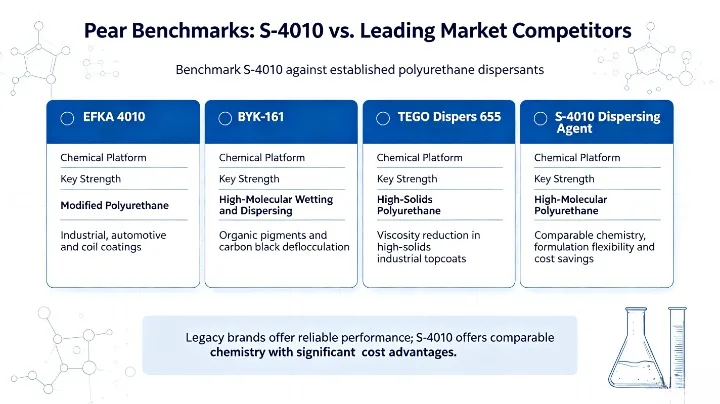
Peer Benchmarks: S-4010 vs. Leading Market Competitors
Understanding how established dispersants perform helps formulators benchmark S-4010 against top-tier additives.
The market features several notable polyurethane dispersants:
- BASF produces EFKA 4010, a widely recognized modified polyurethane dispersant used in industrial, automotive, and coil coatings.
- BYK manufactures BYK-161, a high-molecular-weight wetting and dispersing additive engineered to deflocculate organic pigments and carbon black in solvent-borne systems.
- Evonik supplies TEGO Dispers 655, which excels at viscosity reduction in high-solids industrial topcoat formulations.
While these legacy brands offer reliable performance, S-4010 Dispersing Agent delivers comparable polyurethane chemistry at 100% active concentration, offering exceptional formulation flexibility and significant cost savings.
Technical Parameter Comparison: S-4010 vs. EFKA 4010
Comparing key specification parameters provides formulators with clear guidance on substitution chemistry and formula adjustments.
| Specification Parameter | S-4010 Dispersing Agent PDF | EFKA 4010 (Benchmark) PDF |
| Chemical Structure | Modified Polyurethane Polymer | Modified Polyurethane Polymer |
| Active Content / Non-Volatile | 100% (120°C / 2h) | ~50% (Solvent-Cut) |
| Viscosity (25°C, $\text{mm}^2/\text{s}$) | 1000 – 2000 | 300 – 700 |
| Appearance | Yellow Transparent Liquid | Clear Yellow Liquid |
| Amine Value Range (mg KOH/g) | 15 – 25 | 15 – 25 |
| Solvent Systems | Solvent, Water-based, UV, Inks | Solvent-Borne Systems |
| Target Pigments | Titanium Dioxide, 3, Organics | Inorganic & Organic Pigments |
Note: Because S-4010 contains 100% active non-volatile matter, formulators should adjust carrier solvent quantities when replacing solvent-diluted benchmark products 1:1 on active content.
In-Depth Analysis of Key Technical Metrics
To evaluate S-4010 effectively in your laboratory, let us analyze how specific physical properties influence real-world coating formulations.
1. Active Content (100% Non-Volatile Content)
EFKA 4010 typically arrives pre-diluted in organic solvents (such as PMA or solvent naphtha). In contrast, S-4010 Dispersing Agent delivers 100% active modified polyurethane polymer.
In addition, supply of a 100% active polymer provides three distinct formulation benefits:
- Solvent Versatility: Formulators select their own carrier solvent matrix without introducing unwanted solvents into tight VOC budgets.
- Freight and Storage Efficiency: Shipping 100% active matter reduces fluid volume, cutting transport costs and saving warehouse space.
- Broad System Compatibility: S-4010 transitions effortlessly across solvent-borne, water-based, and UV-curable coating formulas.
2. Viscosity Profile and Processing Rheology
S-4010 exhibits a bulk viscosity of 1000 to 2000 {mm}^2/\{s} at 25°C. Despite its high active concentration, S-4010 dissolves rapidly into resin-solvent blends during the initial pre-mixing stage.
Consequently, once incorporated into a millbase, S-4010 significantly enhances dispersion efficiency and reduces grinding viscosity. Lower millbase viscosity allows formulators to increase pigment loading, shorten bead mill residence times, and lower specific grinding energy.
3. Amine Value and Anchoring Group Efficiency
S-4010 features an optimized amine value range (15 to 25 mg KOH/g), matching standard benchmark specifications. These basic amine anchoring groups attach strongly onto acidic and neutral pigment surfaces.
Specifically, S-4010 excels at stabilizing inorganic fillers and pigments—such as titanium dioxide (2) and calcium carbonate (3). The strong chemical anchoring prevents pigment separation, floating, and hard settling during long-term storage.
Solvent Solubility and Resin Compatibility Testing
A dispersant must demonstrate complete solubility across common coating solvents to prevent haze, seeding, or phase separation.
Solvent Solubility Performance
Laboratory testing confirms that S-4010 Dispersing Agent forms clear, stable solutions across standard industrial solvents:
- Esters: Butyl Acetate, Ethyl Acetate, PMA (Propylene Glycol Monomethyl Ether Acetate)
- Ketones: MEK (Methyl Ethyl Ketone), MIBK (Methyl Isobutyl Ketone)
- Aromatics: Xylene, Toluene, Solvent Naphtha 100
- Alcohols & Glycols: Butanol, Isopropanol, Glycol Ethers
Resin System Compatibility
Furthermore, S-4010 demonstrates broad相容性 (compatibility) across key industrial resin binder systems:
- 2K Polyurethane Systems: Shows zero interference with NCO/OH crosslinking reactions.
- Epoxy Resins: Maintains low viscosity and excellent anti-settling in high-build floor and anti-corrosion coatings.
- Acrylic and Alkyd Binders: Delivers high gloss, deep color clarity, and excellent film levelling.
- UV & Water-Based Systems: Functions as a versatile dispersant across hybrid UV-curable and water-borne formulas.
Surface Appearance and Film Defect Prevention
Physical parameters directly govern how well a dispersant eliminates surface defects in demanding industrial applications.
[Targeted Amine Anchoring] ➔ [Steric Barrier Layer] ➔ [Zero Pigment Floating] ➔ [High Brilliance & Gloss]
1. Eliminating Floating, Flooding, and Mottling
In mixed pigment systems (such as Titanium Dioxide mixed with Phthalo Blue or Organic Red), unequal particle mobility causes color floating and mottling. S-4010 locks inorganic fillers and organic pigments into a uniform, non-flocculating matrix. Consequently, it prevents flooding and floating in floor, coil, and automotive finishes.
2. Boosting Gloss and Matting Powder Orientation
S-4010 optimizes the spatial orientation of silica matting powders in low-gloss coatings, yielding uniform matte finishes. Conversely, in high-gloss topcoats, it boosts surface gloss and clarity, enabling high-brilliance finishes in solvent-borne paints.
Application and Recommended Dosage Guide
Achieving optimal performance requires applying the correct addition levels based on total formulation weight or dry pigment mass.
SailAdditive recommends the following practical dosage guidelines:
- Standard Coating Formulations: 0.1% to 5.0% of total formulation weight.
- UV & Water-Based Formulations: 0.3% to 1.0% of total formulation weight.
- Titanium Dioxide _2) & Fillers: 1.0% to 3.0% calculated on dry pigment weight.
- Organic Pigments & Carbon Black: 10% to 30% calculated on dry pigment weight.
Incorporation Method
Always incorporate S-4010 Dispersing Agent during the paint mixing stage before introducing dry pigment powders. Stir the liquid mixture thoroughly to dissolve S-4010 evenly throughout the resin and solvent phase. This sequence ensures optimal additive distribution before high-shear grinding begins.
Packaging, Storage, and Handling Specifications
SailAdditive supplies S-4010 with commercial packaging options and clear storage guidelines:
- Packaging: Available in standard 25L drums or 200L plastic/steel barrels.
- Storage Requirements: Store in airtight containers in a cool, dry place. S-4010 maintains a 24-month shelf life under proper storage conditions.
- Transport Safety: Transport S-4010 safely as a non-hazardous chemical product.
Upgrade Your Formulations with S-4010 Today
Full technical parameter comparison confirms that S-4010 Dispersing Agent matches legacy benchmark standards in polyurethane chemistry, amine anchoring capability, and resin compatibility. By switching to S-4010, paint manufacturers lower additive costs, secure supply stability, and eliminate surface coating defects.
The technical support team at SailAdditive stands ready to assist your lab with dosage calculations, ladder trials, and free evaluation samples.
Ready to test S-4010 in your laboratory? Contact SailAdditive today to request your free S-4010 sample package and optimize your coating specifications!