
How to Solve Recoatability and Intercoat Adhesion Problems?

Many paint formulators hesitate to use silicone additives because they fear a common production nightmare: peeling paint. When a second layer of coating fails to stick to the first, it can ruin entire production batches.
Introduction: Many coatings experts believe that silicone leveling agents always damage intercoat adhesion and cause severe recoating issues. However, modern polymer chemistry completely changes this narrative. In this guide, we address these common industry fears directly. We will explore why recoatability failures happen and demonstrate how the S-323 Silicone ਲਗਾ ਏਜੰਟ provides superior film consistency and surface slip without compromising your multi-layer bonding.
The Myth Surrounding Silicone Additives and Poor Adhesion
If you speak with experienced painters or coating formulators, many will give you a strict warning: “Keep silicones away from multi-layer paint systems.” This fear is deeply ingrained in the industrial coating world.
The Source of the Fear
For decades, operators have associated silicone additives with catastrophic surface defects. They blame silicones for fish-eyes, severe cratering, and paint layers that peel off like tape. This has created a persistent industry myth that all silicone additives inherently ruin intercoat bonding.
The High Cost of Adhesion Failures
When intercoat adhesion fails in a commercial setting, the consequences are incredibly costly:
- Whole batches of painted automotive parts or wood panels must be stripped down to the raw substrate.
- Production lines stall, delaying shipments and shrinking profit margins.
- Brand reputation suffers when field coatings delaminate after delivery.
Because of these risks, formulators often compromise on surface leveling just to stay on the safe side. However, avoiding silicones entirely is no longer necessary.
Why Traditional Dimethylsiloxanes Trigger Recoating Issues
To overcome these adhesion failures, we must understand the chemical flaws of older generation additives. The root cause of poor recoatability lies in the use of unmodified polydimethylsiloxanes (PDMS).
Extreme Low Surface Energy
Unmodified silicone oils possess an incredibly low surface energy. When you add them to a solvent-based coating, these highly hydrophobic molecules migrate rapidly to the wet air-chemical interface. They form a dense, uniform layer at the very top of the cured paint film.
[ Traditional PDMS Surface ] ---> [ Ultra-Low Surface Energy ] ---> [ Next Paint Layer Crawls / Peels ]
The Mechanism of Recoating Failure
When you apply a subsequent topcoat over an unmodified PDMS base layer, the new wet paint encounters a slick, repelling surface. The wet paint cannot wet out the low-energy film, causing it to “crawl” or bead up. Even if the topcoat manages to dry, it cannot establish mechanical anchoring or chemical bonding with the layer underneath. The slightest scratch or impact will cause the top layer to delaminate completely.
How Polyether Modification Preserves Intercoat Bonding
Modern additive design solves this problem through precise molecular engineering. S-323 Silicone ਲਗਾ ਏਜੰਟ by SailAdditive utilizes a advanced polyether-modified polydimethylsiloxane copolymer structure. This design bridges the gap between high surface slip and reliable recoatability.
                +---------------------------------------+
                |  Polyether-Modified Polydimethylsiloxane |
                +---------------------------------------+
                                    |
            +-----------------------+-----------------------+
            |                                               |
            v                                               v
[Siloxane Backbone]                                [Polyether Chains]
(Slightly reduces surface tension)            (Ensures recoatability & compatibility)
The Power of Co-Polymerization
Instead of using pure, incompatible silicone chains, S-323 chemically attaches hydrophilic polyether blocks to the siloxane backbone. This structural change alters how the molecule behaves within the dried film:
- Controlled Migration: S-323 slightly reduces surface tension to stabilize the flow of coatings without creating a completely unbondable surface layer.
- System Compatibility: The polyether segments significantly improve compatibility with the surrounding resin matrix. This allows subsequent paint layers to wet out and bond smoothly with the previous coat.
- Reliable Alternative: S-323 serves as a dependable alternative to industry standards like BYK-323, offering identical leveling performance without sacrificing intercoat safety.
For premium industrial finishes, formulation experts often rely on Silco Flw 3230 to drive surface slip and anti-cratering effects in high-end systems. However, S-323 provides an incredibly balanced approach, focusing directly on preventing recoatability failures while delivering excellent film consistency.
Testing Tape Adhesion on Multi-Layer Industrial Paint Systems
You should never guess whether your paint layers are properly bonded. Industrial laboratories utilize strict testing protocols to verify intercoat adhesion when qualifying an additive like S-323.
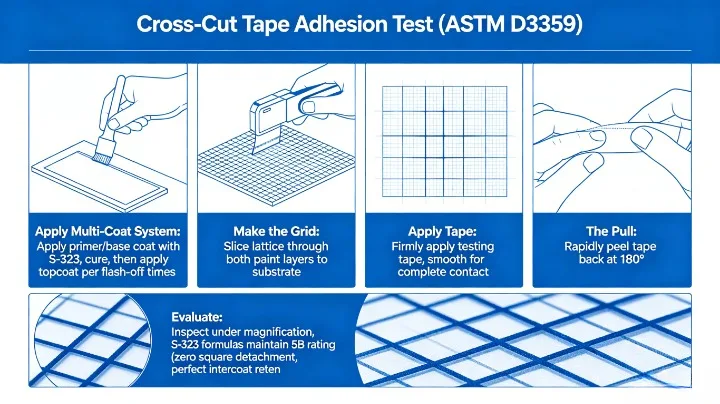
The Cross-Cut Tape Adhesion Test (ASTM D3359)
This standard test method evaluates whether an additive causes intercoat delamination in multi-layer furniture or automotive coatings:
- Apply Multi-Coat System: Apply the primer or base coat containing S-323, let it cure, and then apply the topcoat according to standard flash-off times.
- Make the Grid: Use a cross-hatch cutter to slice a lattice pattern through both paint layers, down to the substrate.
- Apply Tape: Apply a specialized pressure-sensitive testing tape firmly over the grid, smoothing it down to ensure complete contact.
- The Pull: Rapidly peel the tape back at a 180-degree angle.
- Evaluate: Inspect the grid under magnification. Formulas utilizing S-323 consistently maintain a top 5B rating, showing zero square detachment and perfect intercoat retention.
[ Cross-Hatch Cutting ] ---> [ Apply Testing Tape ] ---> [ Snap Pull at 180° ] ---> [ 5B Rating: Zero Peeling ]
Maximizing Surface Slip Without Sacrificing Downstream Paint Layers
High-speed application lines—such as curtain coating, coil coatings, and heavy-duty industrial lines—require a leveling agent that can multi-task. S-323 delivers excellent surface aesthetics while protecting your process window.
Key Benefits for Multi-Layer Lines
- Flawless Leveling: S-323 optimizes film consistency and controls surface flow, which is highly beneficial for demanding curtain coating setups.
- Strong Pigment Orientation: In matte coatings and baking-type metallic paints, it ensures strong matting agent orientation and uniform aluminum alignment. This guarantees consistent gloss across every layer.
- High Thermal Stability: With exceptional thermal stability up to 250°C, S-323 remains stable in high-temperature industrial baking ovens without degrading into adhesion-destroying byproducts.
Recommended Application Parameters
To achieve excellent results without recoating risks, follow these quick formulation guidelines:
- Dosage: Maintain a strict concentration of 0.05% to 0.3% based on the total formula weight.
- Incorporation: Always add S-323 during the paint mixing stage to ensure complete, homogeneous distribution throughout the resin matrix.
Technical Data Table
For lab trials and quality assurance tracking, refer to these typical values for S-323:
| Technical Property | Specification Standard |
| Appearance | Light yellow to amber transparent liquid |
| Chemical Composition | Polyether-modified polydimethylsiloxane copolymer |
| Viscosity (25°C) | 500–1000 mm^2/s |
| Density (25°C) | 1.440–1.450 |
| Non-Volatile Matter Content | >97% (120°C/2h) |
| Maximum Heat Resistance | 250°C |
Packaging and Handling
SailAdditive packages S-323 in durable 25L barrels ਜ 200L plastic/steel barrels. Store the additive in an airtight container in a cool, dry place to ensure a shelf life of 24 months. The product transports easily as a non-hazardous chemical.
Conclusion: Say Goodbye to Intercoat Delamination
You no longer have to choose between a smooth surface and reliable paint adhesion. By shifting to a polyether-modified copolymer like S-323, you eliminate the root causes of recoatability failure. You get excellent leveling, unique deaeration support, and perfect intercoat bonding.
Are you ready to eliminate adhesion issues in your multi-layer paint formulations? Visit SailAdditive to explore our full range of surface solutions. Contact our engineering team today to secure a sample of S-323 for your lab validation testing.