
What Is A Defoamer?

What is a Defoamer?
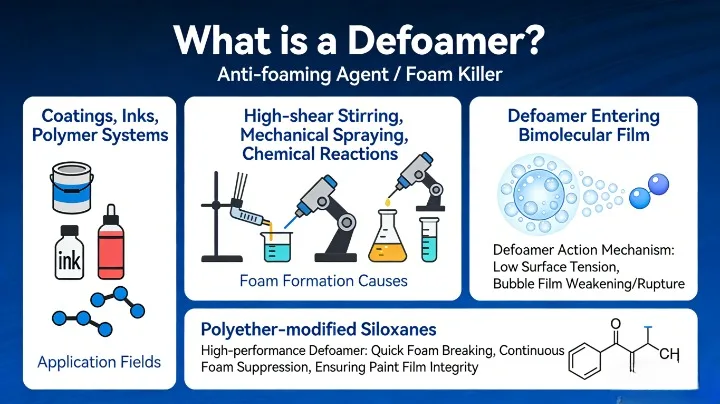
A defoamer, also known as an anti-foaming agent, is a chemical additive designed to inhibit the formation of foam and eliminate existing bubbles. During the production and application of coatings, inks, and polymer systems, air is easily trapped due to high-shear mixing, mechanical spraying, or chemical reactions, forming both macro-bubbles and micro-foam.
Defoamers work by entering the bubble's lamella with extremely low surface tension, causing the bubble wall to weaken and rupture. High-performance defoamers—such as fluorine-modified or polyether-modified siloxanes—not only break bubbles instantly but also provide long-term foam suppression, ensuring the structural integrity and aesthetic beauty of the final film.
Core Applications: Products, Processes, and Industrial Fields
The selection of a defoamer is precisely matched to the resin system and environmental demands to ensure a flawless finish.
1. Core Systems and Product Categories
Based on DongGuan SailAdditive technical standards, the choice of defoamer depends on the specific base material:
- Solvent-based and Solvent-free Systems: For high-solids or solvent-free epoxy systems, products like S-6800 (a special polysiloxane polymer) deliver maximum air release even at ultra-low dosages.
- Water-borne Systems: S-6830 is a polyether-modified polysiloxane ideal for water-based paints and inks, eliminating foam without compromising interlayer adhesion.
- Chemically Demanding Systems: For ambient-curing plastics like epoxy and polyurethane, S-066N modified silicone offers exceptional resistance to hydrolysis, acids, and alkalis.
- Silicone-Free Requirements: For systems sensitive to silicone or requiring maximum compatibility, S-6814 (a non-silicon defoamer) prevents surface defects like fisheyes and shrinkage cavities.
2. Key Manufacturing Processes
Defoamers are critical at specific stages of production and application:
- High-Shear Mixing: They eliminate air entrained during the pigment dispersion and blending phases.
- Ambient Curing: In room-temperature curing systems like industrial flooring or mineral casting, they ensure bubbles escape before the material sets.
- Multi-coat Painting: They are engineered to maintain surface tension balance, ensuring excellent adhesion between multiple layers of paint.
3. Diverse Industrial Fields
- Construction and Flooring: Used in industrial floor coatings, self-leveling systems, polymer concrete, and mineral casting to ensure a bubble-free, structurally sound surface.
- Automotive and Transportation: Applied in OEM finishes and transportation equipment where high-gloss and high-integrity finishes are critical.
- Wood and Furniture: Used in decorative coatings to eliminate micro-foam, showcasing the natural wood grain or high-gloss color.
- Inks and Packaging: Essential for specialized inks to prevent printing defects or uneven color caused by foam.
Anti-corrosion and Leather: Enhances the density of heavy-duty industrial coatings and leather paints to improve chemical resistance
Expert Recommendations for Optimal Performance
To achieve the best results, it is recommended to add the defoamer during the paint mixing stage to ensure optimal distribution. Standard dosages typically range from 0.1% to 1% of the total formula.
Because resin systems vary in sensitivity, users should always conduct compatibility tests or consult technical staff before full-scale use.