
How Does Polyether-Modified Polydimethylsiloxane Improve Paint Flow?

Achieving a perfectly smooth coating surface requires highly specialized chemistry. Coating formulators constantly search for additives that optimize film consistency without causing side effects.
However, standard silicone oils often cause severe cratering or heavy foam stabilization in industrial paints. Therefore, researchers developed modified silicone polymers to solve these industrial challenges.
In this deep technical guide, we will examine polyether-modified polydimethylsiloxane copolymer technology. We will explain how this unique structure improves paint flow using our premium product, SailAdditive S-323, as a primary example.
The Unique Molecular Design of Polyether-Modified Silicone
To understand paint flow improvement, we must first look closely at molecular architecture. Standard dimethylsiloxanes possess a very compact, highly hydrophobic structure.
This raw structure gives them incredibly low surface energy. However, it also makes them highly incompatible with most organic coating resins.
To bridge this compatibility gap, chemical engineers graft organic polyether chains onto the inorganic silicone backbone. This process creates a specialized hybrid molecule.
Specifically, the polydimethylsiloxane (PDMS) segment provides the necessary surface activity. Meanwhile, the polyether segments look outward to interact with the paint matrix.
Consequently, this precise chemical design allows the copolymer to dissolve uniformly within solvent-borne systems. It creates a highly predictable additive that migrates to the surface exactly when needed.
Balancing Compatibility and Surface Activity in Active Systems
Every coating formula represents a delicate thermodynamic balance. If a leveling surfactant is too compatible, it remains trapped deep within the bulk paint layer.
As a result, it fails to fix surface imperfections. Conversely, if the surfactant is too incompatible, it separates from the resin matrix completely.
This separation triggers immediate surface defects like fish eyes and heavy cratering. Therefore, finding the exact balance between compatibility and surface activity is paramount for paint engineers.
SailAdditive S-323 solves this challenge beautifully. The polyether modification acts as a built-in tuning knob for compatibility.
It keeps the molecule perfectly dispersed in the liquid phase during storage. However, during application, it allows the active silicone blocks to orient themselves toward the air interface smoothly.
This balanced migration ensures continuous performance across a wide variety of industrial paint formulations.
If you work with high-performance solvent-borne systems, you might know BYK-323
, which stands as a well-known industry standard for surface flow control. SailAdditive engineered S-323 to provide an identical balance of surface activity and matrix compatibility.
Mechanism of Gentle Surface Tension Reduction
Liquid paint naturally encounters multiple disruptive forces during the drying cycle. For example, localized differences in solvent evaporation create surface tension gradients.
These gradients pull liquid paint away from low-tension regions. This movement generates permanent surface waviness and ugly orange peel textures.
To halt this movement, polyether-modified polydimethylsiloxane utilizes a mechanism of gentle surface tension reduction. Once you spray or roll the paint, S-323 molecules migrate rapidly to the wet film surface
.
The silicone segments reduce the dynamic surface tension across the entire liquid-air boundary layer. More importantly, they equalize the tension variations completely.
Therefore, the liquid paint stops pulling itself into irregular shapes. Instead, the uniform surface tension allows the wet film to flatten out naturally under the force of gravity.
Consequently, you achieve an ultra-smooth, mirror-like finish with excellent film consistency.
Why S-323 Avoids the Trap of Heavy Foam Stabilization
Many traditional silicone leveling agents suffer from one massive drawback. They stabilize micro-foam and macro-foam within the paint layer.
This happens because standard silicones form highly elastic, rigid films around air bubbles. These tough films prevent bubbles from popping, which traps air inside the cured paint.
S-323 avoids this dangerous trap completely due to its specific polyether modification. The polyether chains disrupt the structural elasticity of the bubble walls.
Consequently, it provides a unique deaeration effect depending heavily on the system’s polarity. Instead of stabilizing foam, S-323 weakens the bubble lamella.
This weakness allows micro-bubbles to merge quickly and rise to the surface. Once at the surface, the bubbles burst easily before the paint matrix increases in viscosity.
Thus, you get a completely bubble-free, solid coating layer without adding heavy amounts of separate defoamers.
Long-Term Stability Benefits in Organic Solvent Matrices
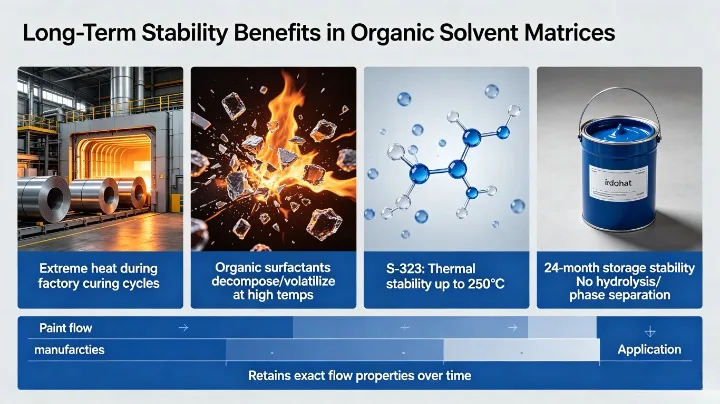
Industrial coatings face highly demanding processing and storage conditions. For instance, coil coatings and baking-type metallic paints endure extreme heat during factory curing cycles
.
Many organic surfactants decompose or volatilize when temperatures rise. This degradation leads to a sudden loss of leveling performance mid-way through the baking oven.
S-323 offers exceptional thermal stability up to 250^C. The strong silicon-oxygen backbone resists thermal cleavage effortlessly under these harsh environments.
Furthermore, S-323 displays outstanding long-term chemical stability within organic solvent matrices. It maintains its molecular structure perfectly inside airtight containers for up to 24 months.
It does not undergo hydrolysis or phase separation over time. Therefore, your stored paint retains its exact flow properties from the day of manufacture until the final application.
Step-by-Step Practical Application Guide for Formulators
To get the absolute best results from this advanced polyether-modified copolymer technology, you must follow correct laboratory and production protocols
:
Determine Your Dosage: Start with a standard dosage between 0.05% and 0.3% based on the total formulation weight. Because S-323 contains over 97% non-volatile matter, a tiny amount provides immense surface power.
Introduce at the Mixing Stage: Always add S-323 during the active paint mixing stage. Do not add it to the final static product without high-shear agitation. High-shear dispersion ensures the copolymer distributes perfectly throughout the resin matrix.
Optimize for Matte Systems: When utilizing S-323 in matte finishes, observe how it aids matting agent orientation. It helps silica particles arrange uniformly, preventing gloss patches.
Optimize for Metallic Coatings: In metallic coatings, verify the precise alignment of aluminum pigments
. S-323 prevents metallic flakes from floating irregularly, which secures a highly consistent metallic finish.
Conduct Compatibility Tests: Always perform standard compatibility tests before large-scale production. Check for absolute transparency in clear coats and ensure excellent intercoat adhesion during recoating trials.
Conclusion: Elevating Your Coating Performance
In conclusion, polyether-modified polydimethylsiloxane is not just a simple surfactant. It represents a highly engineered solution that simultaneously fixes flow, leveling, and air entrapment.
By balancing matrix compatibility with surface energy reduction, SailAdditive S-323 helps industrial paint manufacturers eliminate orange peel, craters, and foam.
Switching to this premium domestic additive allows you to maintain top-tier performance while optimizing raw material costs. Invest in advanced silicone technology today to elevate your industrial coating aesthetics to global standards
Do you want to shield your protective coatings from micro-foam failures and upgrade your substrate wetting? Contact the technical specialists at DongGuan SailAdditive to schedule an engineering consultation or request your testing sample today.