How to Eliminate the “Mirror Frame Effect” and Cratering in Coatings?

In the world of high-end industrial and decorative coatings, achieving a flawless, mirror-like finish is the ultimate goal. However, many manufacturers struggle with two persistent surface defects: the “Mirror Frame” effect and Cratering (Oil Spots). These issues not only compromise the aesthetics of the product but also weaken the protective integrity of the film.
The Core Pain Points: Edge Build-up and Poor Substrate Wetting
The “Mirror Frame” effect, often characterized by an uneven accumulation of coating at the edges of a substrate, occurs due to surface tension gradients during the drying process. When the coating pulls away from or piles up at the boundaries, it creates a thickened “frame” that looks unprofessional and leads to uneven drying.
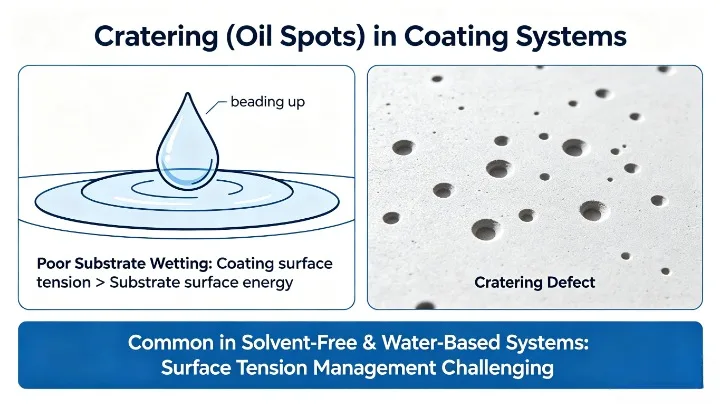
Parallel to this, Cratering—often referred to as “oil spots”—is typically caused by poor substrate wetting. If the coating’s surface tension is higher than the substrate’s surface energy, the liquid “beads up” rather than spreading out, leaving small, circular depressions that expose the underlying surface. These defects are particularly common in solvent-free and water-based systems where surface tension management is more challenging.
The Technical Solution: How S-378 Optimizes Surface Tension
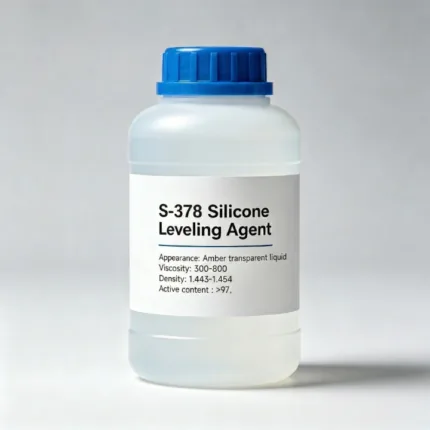
To solve these challenges, chemists require a high-performance additive that can drastically reduce surface energy without causing side effects. This is where S-378 Silicone Leveling Agent becomes an essential tool in your formulation.
S-378 is a polyether-modified polydimethylsiloxane copolymer designed to significantly lower the surface tension of a system. By integrating S-378, the coating gains superior wetting capabilities, allowing it to flow effortlessly across difficult substrates. Its unique chemical structure ensures that surface tension remains uniform across the entire film, effectively preventing the “mirror frame” effect by neutralizing the gradients that cause edge build-up.
Furthermore, S-378 is engineered for high compatibility. Whether you are working with aqueous, solvent-based, or solvent-free systems, S-378 distributes evenly during the mixing stage to ensure a stable, defect-free application. For industry-standard performance, many professionals compare its efficacy to well-known solutions like BYK-378, yet S-378 offers a specialized balance for modern inkjet and automotive coatings.
Key Selling Points: Beyond Preventing Oil Spots
The primary advantage of S-378 is its ability to ensure a “defect-free” finish without the risk of oil spots. But its benefits go much further:
- Improved Spraying Fluidity: It enhances paint atomization, which is critical for automotive and industrial spray applications.
- Anti-Shrinkage Properties: It provides robust protection against film shrinkage, maintaining the dimensions of the coating as it cures.
- Enhanced Surface Durability: S-378 doesn’t just improve the look; it increases scratch resistance and surface slipperiness, giving the final product a premium hand feel.
- Matting Agent Orientation: In matte systems, it promotes the directional arrangement of matting agents, ensuring consistent gloss levels across the entire surface.
For standard formulas, a dosage of 0.05% to 0.5% is usually sufficient, while UV and water-based systems may require 0.3% to 1.0% to achieve optimal distribution.
Conclusion
Don’t let surface defects undermine the quality of your coatings. By incorporating S-378, you can eliminate the mirror frame effect and cratering, ensuring your products meet the highest standards of smoothness and durability.
Contact us today to request a sample or view the full TDS at sailadditive.com.