
How to Achieve High Slip Without Sacrificing Adhesion: The S-333 Guide to Recoatability

In the world of professional coatings, formulators often walk a tightrope between achieving a smooth, high-slip surface and ensuring the next layer of paint actually sticks. Many engineers search for a “silicone additive that doesn’t affect recoatability” to solve common “paint adhesion issues with silicone”.
If you are tired of choosing between a silky finish and structural integrity, understanding the balance of surface tension is the key to success.
1. The Conflict Between Slip and Interlayer Adhesion
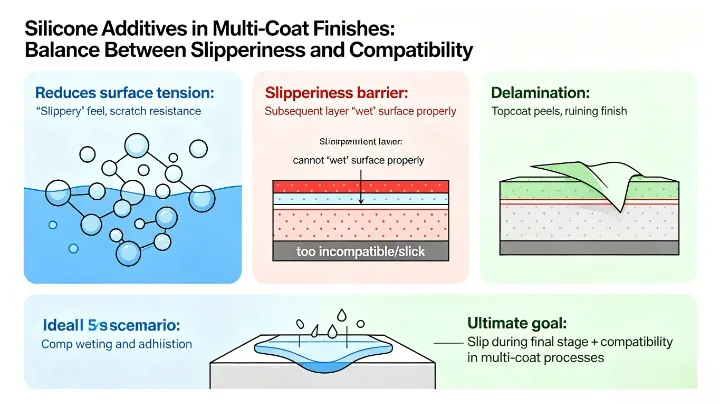
Silicone additives are famous for reducing surface tension, which provides that desirable “slippery” feel and scratch resistance. However, this very same slipperiness can become a barrier for the next coat.
If a leveling agent is too incompatible or “slick,” the subsequent layer cannot “wet” the surface properly. This leads to delamination, where the topcoat peels away from the base, ruining the entire finish. Finding an additive that provides slip during the final stage but remains compatible during multi-coat processes is the ultimate goal.
2. Why S-333 is Engineered for Safe Multi-Coat Processes
S-333 San Bằng Silicon Agent stands out because it provides excellent slip and wear resistance without negatively impacting recoatability.
As a polyether-modified polydimethylsiloxane copolymer, it is engineered to migrate to the surface to provide smoothness while maintaining a chemical profile that allows new layers to bond. This makes it a reliable alternative to industry standards like BYK-333, which is also widely known for its balanced leveling and slip properties in professional industrial lines.
3. Avoiding Delamination in Automotive and Wood Coatings
Delamination is a critical failure in high-end sectors like automotive OEM and furniture coatings. In these industries, products often require multiple layers—primers, base coats, and clear topcoats.
Using S-333 ensures that each layer achieves rapid leveling and improved gloss. Because it significantly reduces the coefficient of friction without creating an impenetrable silicone barrier, it protects the structural integrity of the multi-coat system. Whether you are coating a car door or a wooden tabletop, S-333 prevents the adhesion failures that haunt standard silicone additives.
4. How Polyether-Modification Controls Compatibility
The “secret” to the success of S-333 lies in its polyether-modification. Pure silicone oils are often too incompatible for coatings, but attaching polyether chains makes the molecule more “friendly” to diverse resin systems.
This modification allows S-333 to be highly compatible with:
- UV-curable systems
- Solvent-based paints and inks
- Aqueous (water-based) systems
This controlled compatibility ensures the additive distributes optimally during the paint mixing stage, providing a smooth surface that still welcomes the next coat with open arms.
5. Best Practices for Adding S-333 in Multi-Layer Systems
To guarantee perfect recoatability every time, follow these professional technical guidelines:
- Dosage Precision: For standard formulas, use a dosage of 0.05% – 0.3%; for UV and water-based systems, use 0.3% – 1.0%.
- Optimal Incorporation: Always add S-333 during the mixing stage to ensure uniform distribution throughout the system.
- System Testing: While S-333 is designed for high compatibility, always conduct a preliminary adhesion test for specialized or highly sensitive resins.
Conclusion: No More Compromises on Adhesion
Achieving a mirror-like, scratch-resistant finish no longer requires risking your interlayer adhesion. By choosing a balanced polyether-modified solution like S-333, you can deliver the premium slip your customers want with the reliability your production line needs,TDS for your reference-link.
Ready to upgrade your multi-coat performance? Visit SailAdditive.com to explore our full range of technical solutions or contact us to request a sample of S-333 today.