
Cost-Reduction Without Compromising Performance: A Guide for Chemical Procurement Managers

Industrial purchasing departments constantly face a difficult balancing act. Procurement managers must secure high-quality raw materials while aggressively optimizing costs. In the specialty coatings and inks market, this task is particularly challenging.
For years, many companies have relied on expensive global brands to supply their surface and dispersing additives. However, rigid pricing structures and fluctuating material availability are forcing corporations to rethink their sourcing strategies.
If you want to protect your factory margins, finding a high-performance BYK-110 alternative dispersant is a smart strategic move. This procurement guide analyzes the shifting dynamics of the additive supply chain. We will detail how to evaluate alternative chemicals reliably and show how upgrading your supplier network can lower your total cost of ownership.
1. The Supply Chain Pressure on Premium Coating Additives
For chemical purchasing agents, managing risks within the raw material supply chain has become a daily struggle. Legacy multinational chemical brands have long dominated the additive market. While their products deliver consistent technical results, relying on a single global supplier introduces severe corporate vulnerabilities:
- Frequent and Unpredictable Price Adjustments: Multinational additive producers operate with high corporate overhead and complex international logistics. When energy prices shift or global transport costs rise, these conglomerates frequently pass those expenses directly down to the consumer. These sudden price hikes disrupt your manufacturing budgets and shrink your gross margins.
- Sudden Product Shortages and Delays: A long, centralized supply chain is easily disrupted. Factory shutdowns in Europe, container shortages in major shipping lanes, or port congestion can delay your additive shipments by weeks or months. Specialty dispersants are critical ingredients; if you run out of a vital wetting agent, your entire industrial paint production line grinds to a sudden halt.
- Inflexible Inventory Terms: Global chemical giants often impose rigid minimum order quantities (MOQs) and extended delivery lead times. These strict policies force purchasing managers to tie up significant corporate capital in safety stock just to avoid a factory shutdown. Forward-thinking procurement teams are actively looking to diversify their supplier base with agile, high-performance manufacturers to escape these pressures.
2. What Makes a Dispersing Additive a True “Equivalent” Alternative?
When a procurement manager proposes an alternative supplier, the research and development (R&D) lab is often skeptical. Chemists fear that a cheaper additive will ruin product stability or cause surface defects like color flooding and loss of gloss.
To bridge the gap between purchasing and lab validation, you must evaluate chemical alternatives using objective technical parameters. A true “equivalent” alternative must match the benchmark across four core areas:
- The Polymeric Backbone: The alternative additive must use a similar chemical mechanism to stabilize pigments. If the benchmark relies on steric hindrance (spatial repulsion) through a specific polymer structure, the alternative must use a matching architectural style to ensure it interacts correctly with your existing resins.
- Non-Volatile Matter (Active Solids Content): You must verify the actual purity of the additive. Some cheap commercial alternatives are heavily diluted with carrier solvents. If an additive contains only 50% active chemistry, your factory must use twice as much of it, completely wiping out any initial purchase price savings.
- Delivery Viscosity: The alternative must possess a delivery viscosity that fits your factory’s existing pumping, pouring, and mixing equipment. A fluid that is too thick can complicate material handling on the production floor.
- Active Performance: Ultimately, the chemical must perform identically in the grinding room. It must wet raw pigments rapidly, lower mill-base viscosity effectively, and prevent pigment particles from clustering together during the drying cycle.
3. Evaluating S-110 as a Highly Reliable Alternative to BYK-110
When searching for a direct equivalent to traditional premium standards, S-110 Dispersing Additive from SailAdditive delivers exceptional technical and financial performance. S-110 is engineered as a highly reliable alternative to industry benchmarks like BYK-110.
S-110 functions as a high-efficiency wetting and dispersing agent for solvent-borne and high-solids industrial coatings. When you compare the hard technical data, S-110 stands out as a superior drop-in replacement:
- Appearance: S-110 delivers a clear, light yellow to amber transparent liquid finish. It integrates cleanly into your formulas without causing cloudiness or altering color aesthetics.
- 100% Active Solids Content: This is S-110’s strongest selling point. While the traditional BYK-110 benchmark is a liquid solution containing roughly 52% active polymer diluted in carrier solvents, S-110 is a 100% solvent-free solution. You are buying pure active chemistry, not expensive carrier liquids.
- Delivery Viscosity: S-110 flows easily, pumps smoothly, and incorporates rapidly during the pre-mix stage.
In the grinding room, S-110’s anchoring groups attach firmly to organic pigments, titanium dioxide, and heavy inorganic fillers. It establishes excellent steric stabilization, matching the benchmark’s ability to eliminate micro-haze, boost gloss, and stop flooding and floating. It allows your factory to achieve premium performance at a far more competitive price point.
4. Total Cost of Ownership (TCO) in Chemical Raw Material Sourcing
Smart procurement managers evaluate value based on the Total Cost of Ownership (TCO), rather than just looking at the initial invoice price per kilogram. S-110 provides an impressive TCO reduction through its physical efficiency and streamlined logistics.
- Ultra-Low Addition Quantities: Because S-110 delivers a 100% active, solvent-free polymer matrix, it works with incredible efficiency. It requires a very low dosage within the final recipe—typically ranging from 0.2% to 10% of the total formulation weight, depending on your specific pigment loading. This high concentration means your factory consumes fewer kilograms of raw additive per batch of paint produced.
- Reduced Grinding Time and Energy Use: S-110 reduces internal fluid friction inside your horizontal bead mills. Lowering the mill-base viscosity allows your factory to run mills at maximum speed, cutting down total grinding times. This physical acceleration reduces factory electricity usage and extends the working life of your milling machinery and beads.
- Agile Supply Chain and Lower Working Capital: SailAdditive operates with high manufacturing flexibility and fast delivery turnaround times. Because we provide reliable, steady shipping schedules, your purchasing team no longer needs to store months of expensive safety stock in your warehouse. You can lower your safety inventory levels, freeing up corporate working capital for other growth initiatives.
For those tracking international raw material alternatives, the BYK Additives catalog offers standard reference baselines that our manufacturing team continuously tests against to guarantee true chemical performance parity.
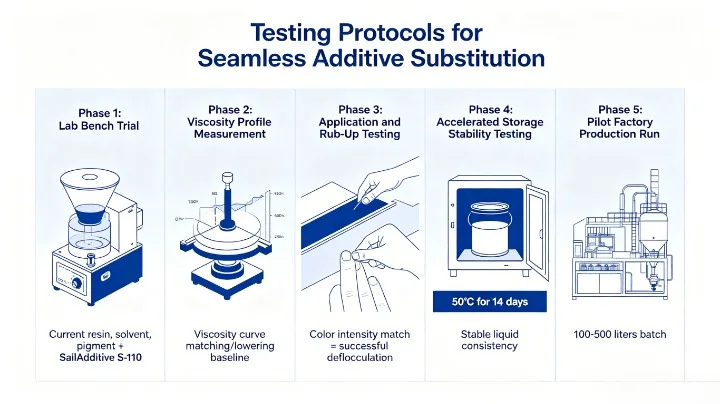
5. Testing Protocols for Seamless Additive Substitution
To eliminate any technical anxiety in your R&D lab and secure a seamless transition, you should follow a structured laboratory testing protocol. This step-by-step evaluation process ensures that S-110 meets all performance criteria before you place a full-scale factory purchase order:
- Phase 1: The Lab Bench Trial — Create a standard mill-base test batch using your current resin, solvent, and pigment blend. Replace your legacy dispersant with SailAdditive’s S-110 at an equivalent active polymer weight. Grind the sample using a laboratory-scale bead mill or basket mill.
- Phase 2: Viscosity Profile Measurement — Measure the viscosity of the freshly ground mill base using a rotational viscometer across different shear rates. S-110 should match or lower the baseline viscosity curve, confirming its active rheology control.
- Phase 3: Application and Rub-Up Testing — Apply the finished paint sample onto a test chart using a wire-wound drawdown bar. Let the film flash off slightly, then firmly rub a small section with your finger. If the rubbed section matches the unrubbed section perfectly in color intensity, S-110 has successfully deflocculated and stabilized the pigments against flooding and floating.
- Phase 4: Accelerated Storage Stability Testing — Place a sealed container of the liquid paint into an oven at 50°C for 14 days. This test simulates months of warehouse shelf storage. After 14 days, check the sample for hard caking or separation. S-110 should maintain a stable, uniform liquid consistency with easily redispersible soft sediment.
- Phase 5: Pilot Factory Production Run — Once the lab approves the chemistry, scale up to a small pilot factory batch (e.g., 100 to 500 liters) to confirm that the additive pumps, mixes, and filters perfectly through your full-scale production equipment.
Conclusion: Optimize Your Sourcing Strategy Today
Sticking with expensive legacy brands out of habit is a costly approach to chemical manufacturing. By introducing a high-purity, 100% active dispersant like S-110, your procurement department can insulate your business from rising material prices and global supply chain shocks.
Deliver the premium surface stability your chemists demand while capturing the direct cost savings your executive team expects.
Ready to evaluate the industry’s leading cost-reduction alternative? Visit SailAdditive.com to explore our complete raw material portfolio, or contact our commercial sales and logistics team directly at 86-13713141735 to request your evaluation samples of S-110 today.