
Preventing Carbon Black Aggregation in Jet-Black Inks and Coatings: Sourcing the Ultimate Jetness

In the world of industrial coatings and high-end printing inks, producing a true, deep black finish is a major test of technical skill. Whether you are coating a luxury sports car or printing sleek packaging graphics, customers demand absolute jetness. They expect a black that looks bottomless, rich, and entirely free of gray or milky tones.
However, achieving this premium optical finish is a constant struggle for research and development (R&D) experts. The primary ingredient responsible for these dark tones—carbon black—is notorious for its unstable behavior. Without the right surface chemistry, your black finishes can easily suffer from texture defects, color shifting, and low gloss.
If you want to master your black formulations, learning how to stabilize carbon black pigment is essential. This technical guide explores why carbon black behaves so poorly during production, details the chemistry of molecular anchoring, and outlines the milling parameters needed to unlock ultimate jetness.
1. Why Carbon Black is the Most Difficult Pigment to Stabilize
Among all organic and inorganic pigments, carbon black stands out as the most challenging material to handle in the grinding room. R&D experts across the globe share a common consensus: carbon black is a chemical rebel.
When you introduce raw carbon black into a liquid resin matrix, it naturally wants to resist uniform dispersion. This intense resistance stems from several unique physical properties:
Immense Surface Area
Carbon black particles are incredibly tiny, which gives them a massive surface area per unit of weight. A single gram of high-jetness carbon black can feature a surface area spanning hundreds of square meters. This vast surface area demands a massive amount of active resin and wetting agent just to coat the particles completely.
Aggressive Aggregation and Re-Agglomeration
Because these primary particles are so small and tightly packed, they experience intense Van der Waals forces of attraction. As soon as your bead mill shears a pigment cluster apart, the newly exposed primary particles immediately try to stick back together. This process, known as pigment aggregation, causes the particles to rapidly cluster, coarsen, and separate into layers.
Vehicle Starvation and Viscosity Spikes
As the carbon black particles aggregate into loose, web-like structures, they trap large amounts of the liquid resin and solvent inside their microscopic voids. This trapping effect robs the formulation of its free flowing vehicle. As a result, the mill base’s viscosity spikes uncontrollably, causing production machinery to slow down and overheat.
Ultimately, failing to stop aggregation results in a gritty paint texture, poor shelf stability, and a severe loss of color intensity.
2. The Chemistry of Anchoring Groups on High-Surface-Area Particles
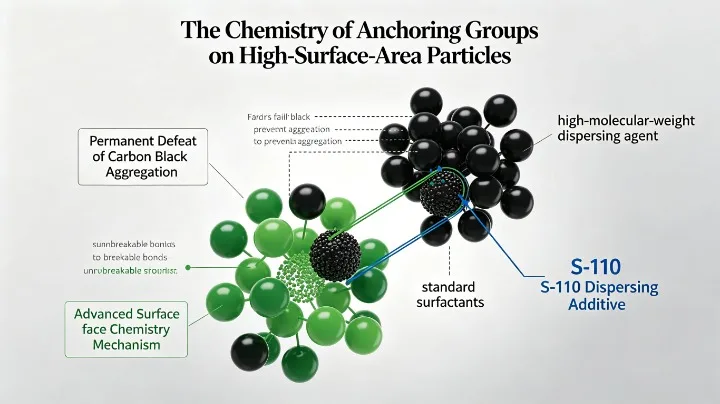
To permanently defeat carbon black aggregation, you cannot rely on standard surfactants. Instead, you must use a high-molecular-weight dispersing agent that can form an unbreakable bond with the pigment’s complex surface. This is where the advanced surface chemistry of S-110 Dispersing Additive becomes vital.
S-110 is a high-performance polyphosphate solution specifically engineered to handle high-surface-area carbon black particles. Its molecular architecture uses an advanced dual-action mechanism to establish long-term stability:
Multi-Point Chemical Anchoring
The surface of a carbon black particle contains various chemical structures, including aromatic rings and localized oxide groups. S-110 features highly polar, active polyphosphate anchoring groups.
Instead of attaching at just one spot, these groups form strong, multi-point coordination bonds across the carbon black particle’s surface. This multi-point attachment ensures that the dispersant molecule stays firmly anchored, even when exposed to intense mechanical forces inside a high-speed bead mill.
Steric Hindrance Protection
Connected to these powerful anchors are long, solvated polymer tails that extend outward into the surrounding solvent and resin matrix. S-110 delivers a 100% active non-volatile matter content, meaning every single molecule contains functional polymer chains without any lazy carrier solvents.
When two stabilized carbon black particles approach one another, their extended polymer tails overlap. This overlap generates a powerful osmotic repulsion force—known as steric hindrance—that pushes the particles apart.
Because the particles can never touch, the internal aggregate networks collapse. The carbon black particles glide past each other freely, lowering fluid resistance and keeping your formulations stable and highly fluid.
3. Eliminating the Haze Effect for Deeper Jetness and Clarity
When you successfully stabilize carbon black pigment with S-110, you achieve a totally deflocculated state. This microscopic shift radically transforms the optical performance and color clarity of your industrial black paints and inks.
Unlocking Ultimate Jetness
The human eye perceives a surface as “jet-black” when it absorbs almost all incoming visible light and reflects virtually none. When carbon black particles aggregate, their large cluster sizes interfere with light waves, scattering a portion of the light back to the viewer. This scattered light creates a milky micro-haze that makes black paint look dark gray.
S-110 keeps the primary carbon black particles perfectly separated. Because the primary particles are smaller than the wavelength of visible light, they absorb light with incredible efficiency, eliminating micro-haze and unlocking a truly bottomless, intense jet-black finish.
Preventing Under-Tone Drifts
Formulators frequently battle under-tone shifts in black coatings, where the paint looks slightly blue or red under different viewing angles. This shift happens when uneven particle sizes scatter specific wavelengths of light unevenly.
S-110 ensures a highly uniform particle size distribution across the entire film. This precise control prevents under-tone drifting, keeping your black tones completely neutral, deep, and true to shade.
Maximizing Transparency in Inks
In high-end packaging and publication inks, clarity is everything. Aggregated pigments cause ink to look cloudy or muddy on clear films or metallic foils. By ensuring total particle separation, S-110 maximizes ink transparency and gloss, allowing rich black text and graphics to display razor-sharp resolution without any hazy blur.
4. Market Standards for Jet-Black Dispersion Engineering
When developing premium black inks and industrial coatings, formulation chemists frequently evaluate their progress against global benchmarks. For example, Lubrizol’s Solplus™ Additives enjoy a strong reputation across the plastic compounding and high-end ink industries for their ability to disperse difficult carbon black powders.
However, modern manufacturing plants must carefully manage raw material costs, local warehouse availability, and supply chain agility. SailAdditive’s S-110 serves as an exceptional peer-performing alternative, specifically optimized for high-solids solvent-borne paints and premium polyurethane (PU) packaging inks.
While global standards are highly effective, they often come with premium pricing and long shipping delays from overseas chemical plants. S-110 matches these international benchmarks by offering equal deflocculation power and anti-flooding protection.
S-110 features a fluid delivery viscosity of 30–80 $mm^2/s$ ($25^{\circ}C$), making it easy to incorporate directly into solvent-based varnishes. By switching to S-110, your R&D lab maintains elite standards for depth of shade and gloss retention, while your procurement team secures a reliable, cost-effective raw material supply line.
5. Milling Parameters and Additive Sequencing for Optimal Grinding
Carbon black requires massive mechanical shear energy to break down, but equipment alone cannot do the job. To achieve the lowest possible viscosity and the deepest jetness, you must use the correct additive sequencing and milling parameters. Introducing your raw materials in the wrong order can waste your dispersant and leave your carbon black under-protected.
Follow this professional manufacturing sequence to ensure that S-110 coats every freshly exposed carbon black surface instantly:
The Correct Incorporation Sequence
- Prepare the Liquid Phase: Charge your solvents and a portion of your grinding resin into the pre-mix tank. Stir at a low speed to create a uniform liquid blend.
- Add S-110 Pre-Grind: Pour the calculated dose of S-110 directly into the liquid phase before you add any dry pigment powder. Mix at medium speed for 5 to 10 minutes. This step ensures the polyphosphate anchoring chains dissolve completely and are ready to capture the incoming carbon black.
- Introduce the Carbon Black: Slowly feed your raw carbon black powder into the vortex. Because S-110 is already active in the liquid, it wets the carbon black immediately, preventing the powder from forming stubborn, dry clumps.
- High-Shear Pre-Dispersion: Run your high-speed dissolver at maximum speed to create a deep vortex for 20 to 30 minutes. This initial shear breaks the largest chunks down, allowing S-110 to anchor across the fresh surfaces.
- Transfer to the Bead Mill: Pump the fluid paste into your horizontal bead mill for final grinding.
[Resin + Solvent] ➔ [Add S-110 Dispersant] ➔ [Feed Carbon Black] ➔ [High-Speed Dissolver] ➔ [Bead Mill Grinding]
Optimizing Milling Parameters
- Bead Selection: Use high-quality zirconium oxide grinding beads with a small diameter (typically 0.4 to 0.8 mm). Smaller beads provide significantly more contact points, which helps accelerate the breakdown of tiny carbon black aggregates.
- Temperature Control: Carbon black grinding generates intense friction and heat. High temperatures can damage the resin matrix and cause the dispersant to desorb. Keep your mill’s cooling jacket running efficiently to maintain a product temperature below 50°C.
- Dosage Calculations: Because carbon black features an immense surface area, it demands a much higher dosage than standard inorganic fillers. Formulators should use a dosage of 30% to 50% of S-110 based on the total carbon black weight to ensure complete stabilization.
Conclusion: Achieve the Ultimate Black Finish
Carbon black aggregation is a difficult challenge, but it is completely manageable with the right surface chemistry. By utilizing a high-purity, 100% active polyphosphate dispersant like S-110, you insulate your primary particles from attractive forces, lower your mill-base viscosity, and eliminate optical micro-haze.
Stop settling for faded, graying blacks and long, sluggish grinding cycles. Upgrade your ink and coating formulations and capture a true, bottomless mirror finish with precision engineering.
Ready to maximize your color depth and reduce your production costs? Visit SailAdditive.com to explore our full raw material portfolio, or connect directly with our technical support team at 86-13713141735 to request a sample of S-110 today.