The Secret to Solving Uneven Matting Agent Orientation in Matte Finishes

Achieving a sophisticated, uniform matte finish is a hallmark of quality in furniture, automotive, and industrial coatings. However, achieving that perfect “low-gloss” look is often harder than it seems. Formulators frequently struggle with surfaces that appear patchy, inconsistent, or plagued by settling issues.
The Core Pain Points: Inconsistent Gloss and Settling
The most frustrating challenge in matte paint production is uneven surface gloss. This usually happens when matting agents (such as silica) fail to distribute evenly across the wet film during the drying phase. Instead of forming a uniform micro-roughness, the particles clump or sink, leading to “gloss spots” or a cloudy appearance.
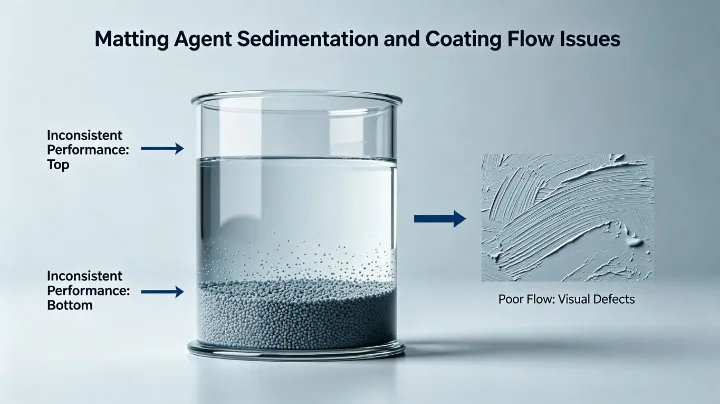
Furthermore, matting agent sedimentation—where particles settle at the bottom of the container—can lead to inconsistent performance between the top and bottom of a batch. Without the right surface additive, the coating may also suffer from poor flow, making these visual defects even more prominent.
The Technical Solution: How S-323 and S-378 Ensure Precision Orientation
To overcome these obstacles, you need additives that manage the internal dynamics of the coating film. At SailAdditive, we provide two high-performance solutions: S-323 and S-378.
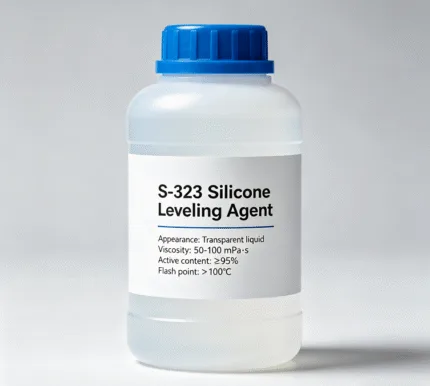
- S-323: The Specialist for Matte Systems As a reliable alternative to industry standards like BYK-323, S-323 is a polyether-modified polydimethylsiloxane copolymer specifically engineered to optimize surface aesthetics. It functions by slightly reducing surface tension to stabilize flow, maintaining a viscosity of 500-1000 mm^2/s at 25°C and a density of 1.440-1.450 to allow matting agents to align themselves precisely across the surface.
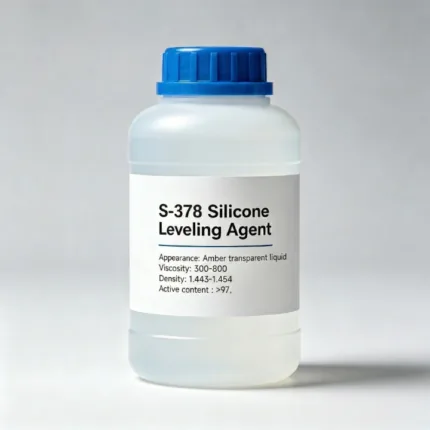
- S-378: Enhancing Distribution and Fluidity While S-323 focuses on orientation, S-378 provides the necessary surface tension reduction to improve the overall “wetting” of the particles. With a slightly lower viscosity of 300-800 $mm^2/s$ and a density of 1.443-1.454, it ensures that matting agents remain suspended and distributed evenly throughout the film, preventing the dreaded “mirror frame” effect at the edges.
Together, these additives—both featuring a non-volatile matter content exceeding 97%—create a stable environment where matting agents can perform their job without interference.
Key Selling Points: Consistency, Beauty, and Thermal Stability
The primary reason to choose S-323 for your matte formulations is its ability to ensure film consistency and beauty. But its advantages extend into the processing phase:
- Aluminum Pigment Alignment: Beyond silica, S-323 is exceptionally effective at facilitating the uniform alignment of aluminum pigments in baking-type metallic coatings.
- Superior Thermal Stability: S-323 maintains its integrity at temperatures up to 250°C, making it the ideal solution for demanding wood and furniture industry applications.
- Defect-Free Finish: S-378 eliminates oil spots and ensures a smooth hand feel, while S-323 provides a unique deaeration effect that prevents foam stabilization.
For most matte systems, a recommended dosage of 0.05% to 0.3% of S-323 is sufficient to transform your surface quality.
The S-323 and S-378 TDS for your reference.
Conclusion
Stop settling for inconsistent gloss levels. By utilizing the synergistic effects of S-323 and S-378, you can master the orientation of matting agents and deliver a premium, durable matte finish every time.
Visit sailadditive.com to explore our full range of additives, or contact us for technical support.