
Overcoming Pigment Flocculation and Flooding in Industrial Coatings: The Definitive Guide to Flawless Color Stability

In the industrial coatings sector, producing a batch of paint that achieves a perfect, uniform color is both a science and an art. Manufacturers and formulation engineers constantly chase maximum color development, high gloss, and long-term shelf stability. Yet, a hidden chemical struggle often occurs inside the mill base and the final paint can.
Formulators frequently face frustrating surface defects like macro-haze, micro-haze, flooding, and floating. These issues can ruin the visual appeal of a high-end coating and destroy its protective capabilities.
If your production line struggles with inconsistent color depth, shifting shades during application, or a sudden loss of gloss, you are likely dealing with pigment flocculation.
This comprehensive guide explores why pigments behave uncontrollably in industrial formulations. We will analyze the physics of stabilization and introduce a professional-grade solution to eliminate separation defects permanently.
1. The Root Cause of Haze and Floating Color in Paint Production
To solve surface defects, you must first understand the physical chemistry occurring inside the liquid coating. Pigments are inherently unstable when you disperse them into a liquid vehicle. Manufacturers supply organic and inorganic pigments as dry aggregates. The manufacturing process relies on mechanical energy—such as high-speed bead mills or sand mills—to break these large aggregates down into primary particles.
However, mechanical force alone cannot keep pigments separated. Once the primary particles leave the high-shear zone of the mill, they naturally want to stick back together to reduce their surface energy. This re-aggregation process is what we call pigment flocculation.
When flocculation occurs unchecked inside a paint formulation, it triggers a chain reaction of visual and structural problems:
Floating (Horizontal Separation)
Floating occurs when different pigments in a blended paint system separate from one another. This separation creates a patchy, mottled, or striated appearance on the dried film surface. For example, in a green paint made from a mixture of phthalocyanine blue and carbon black, one pigment may migrate to the surface while the other settles. This results in an uneven color distribution across the substrate.
Flooding (Vertical Separation)
Flooding is a uniform color shift across the entire coating layer. It happens when a specific pigment preferentially floats to the top layer during the drying process, making the color appear deeper or lighter than intended. This vertical separation makes color matching across different batches nearly impossible.
The Role of Bénard Cells
As a solvent-borne paint dries, solvent evaporation creates convection currents within the wet film. The liquid moves up from the bottom of the layer, spreads across the surface, cools, and sinks back down. This movement forms hexagonal circulation patterns known as Bénard cells.
Flocculated pigments, which possess different mobilities due to their larger effective size, become trapped in these currents. Finer particles move quickly to the cell boundaries, while heavier, flocculated clusters lag behind or sink. This physical segregation freezes into place as the film cures, causing visible floating, flooding, and severe color inconsistencies.
Haze and Loss of Gloss
When primary pigment particles cluster into large, flocculated aggregates, they scatter light rather than reflecting it uniformly. This scattered light creates a cloudy, milky appearance on high-gloss finishes, which is known as micro-haze. Additionally, flocculated particles can protrude through the surface of the dried film, increasing surface roughness and drastically reducing the distinctness of image (DOI) and overall gloss.
2. How Steric Stabilization Keeps Pigments Perfectly Deflocculated
To prevent flocculated clusters from ruining your paint, you must establish a reliable physical barrier between individual pigment particles. In solvent-borne and high-solids industrial coatings, formulators rely on steric stabilization to achieve a completely deflocculated state.
Steric stabilization is a chemical mechanism that prevents particles from sticking together through space-directed physical barriers. It relies on the use of high-molecular-weight wetting and dispersing additives. These additives possess a unique, dual-functional polymeric architecture consisting of two primary components:
- Pigment-Affiinic Anchoring Groups: Highly polar functional groups that attach firmly to the surface of the raw pigment particle.
- Solvent-Soluble Polymeric Chains: Long, organic loops and tails that extend outward into the surrounding resin and solvent matrix.
When two pigment particles coated with these additives approach each other due to Brownian motion or thermal currents, their extended polymeric chains begin to overlap and interpenetrate. This overlap restricts the movement of the polymer chains, which causes a local reduction in entropy.
Simultaneously, squeezing the solvent molecules out from between the overlapping chains increases the local concentration of the polymer. This creates an osmotic pressure gradient that pushes the pigment particles apart before they can enter the attractive Van der Waals zone.
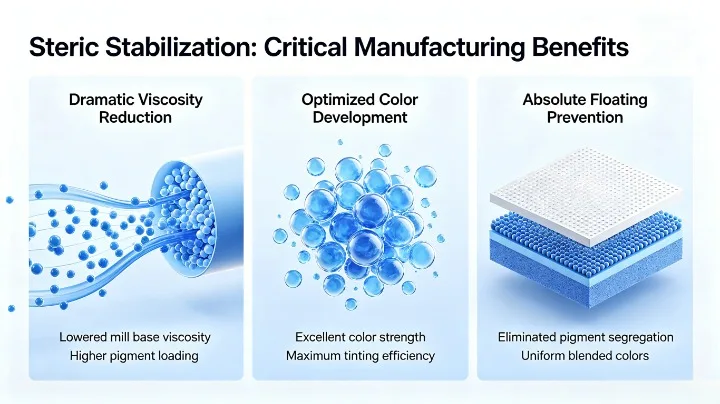
By maintaining a continuous state of deflocculation, steric stabilization yields several critical manufacturing benefits:
- Dramatic Viscosity Reduction: Deflocculated particles flow freely past one another, lowering the viscosity of the mill base and allowing for higher pigment loading.
- Optimized Color Development: Maximizing the available surface area of primary particles ensures excellent color strength and maximum tinting efficiency.
- Absolute Floating Prevention: Eliminating pigment segregation ensures that blended colors remain perfectly uniform across the entire coated substrate.
3. S-110: The Ultimate Polyphosphate Solution for Color Brilliance
When formulating high-performance industrial paints, choosing an additive with the right anchoring chemistry is critical. S-110 Dispersing Additive is engineered to provide elite color stabilization across demanding solvent-borne matrices.
S-110 is a specialized polyphosphate solution that functions as a high-efficiency wetting and dispersing additive. Its molecular structure features optimized polyphosphate anchoring groups that exhibit an aggressive chemical affinity for both inorganic fillers and organic pigments.
Unlike standard monomeric surfactants that can easily desorb from particle surfaces under mechanical stress, the polyphosphate groups of S-110 form strong, multi-point coordination bonds with the pigment surface. This ensures long-term anchoring stability, even during intense milling and high-shear processing phases.
The technical specifications of S-110 highlight its purity and ease of handling:
- Exterior: Clear, light yellow to amber transparent liquid that integrates smoothly without causing cloudiness or haze in clear varnishes or pigmented topcoats.
- Non-Volatile Matter Content: 100% active matter content. This solvent-free profile is a massive advantage for modern R&D departments. It allows formulators to design low-VOC, high-solids coatings without introducing unwanted carrier solvents that could alter the system’s viscosity or flash point.
- Viscosity ($25^{\circ}C$): Optimized at 30–80 $mm^2/s$. This liquid form allows for easy pumping, pouring, and rapid incorporation during the pre-mix stage.
By ensuring complete deflocculation, S-333 or S-110 allows individual pigment particles to distribute evenly throughout the coating film. This results in excellent transparency in wood clears, intense jetness in carbon blacks, and an overall boost in color brilliance and DOI across all industrial topcoats.
4. Benchmarking with BYK-110: A High-Performance Alternative for Solvents
For decades, international brands like BYK have set the standard for specialty additives. Specifically, BYK-110 is widely recognized as an industry benchmark for dispersing inorganic pigments like titanium dioxide and preventing flooding in solvent-borne industrial coatings.
However, relying solely on legacy global brands can expose procurement managers and formulators to high raw material costs, supply chain bottlenecks, and sudden product shortages.
S-110 from SailAdditive serves as a direct, high-performance alternative to BYK-110. It is engineered to deliver comparable chemical properties and deflocculation efficiency, making it an excellent drop-in solution for cost-reduction initiatives.
| Technical Parameter | BYK-110 Benchmark | SailAdditive S-110 |
| Chemical Structure | Copolymer with acidic groups | Polyphosphate solution |
| Active Solids Content | ~52% (contains solvent) | 100% (Solvent-Free) |
| Primary System Fit | Solvent-borne / Industrial | Solvent-borne, High-Solids, UV |
| Deflocculation Power | High | High |
The most significant performance advantage of S-110 over standard benchmarks is its 100% active solids profile. While many traditional additives use aromatic or glycol-based carrier solvents, S-110 delivers pure, active polyphosphate polymer. This means you buy less solvent and more active chemistry, giving you greater control over your low-VOC paint formulations.
When utilized as a direct equivalent, S-110 matches the benchmark’s ability to lower mill-base viscosity, reduce grinding time, and secure absolute resistance to floating and flooding. It allows procurement departments to diversify their supplier base and reduce raw material costs while ensuring that the lab maintains strict quality standards for color development and shelf stability.
5. Optimized Dosage Strategies for Eliminating Separation Defects
To completely eliminate flooding, floating, and haze, you must apply S-110 using precise, calculated dosage strategies. Adding too little dispersant leaves pigment surfaces unprotected, leading to flocculation. Conversely, over-dosing can create a free surfactant layer that plasticizes the resin film, leading to a loss of chemical resistance and water spotting.
Wetting and dispersing additives should always be added during the pre-mix stage, prior to the introduction of raw pigments. This allows the additive molecules to dissolve fully in the resin/solvent blend and immediately coat the pigment particles as the bead mill shears them down to their primary size.
The optimal dosage of S-333 or S-110 depends heavily on the specific surface area of the pigments used in your formulation. Inorganic pigments feature a lower surface area and require less active matter, whereas organic pigments and carbon blacks have massive surface areas that demand a higher concentration of anchoring groups.
Formulators should use the following professional dosage guidelines based on total pigment weight:
- Inorganic Pigments (e.g., Titanium Dioxide, Iron Oxides): 1% – 4% of the pigment weight.
- Organic Pigments (e.g., Phthalo Blue, Quinacridone Red): 10% – 30% of the pigment weight.
- Carbon Blacks (High Surface Area Jet-Blacks): 30% – 50% of the pigment weight.
- Titanium Dioxide Specific Systems: For pure slurries, an addition of 1.5% – 2.5% based on pigment weight provides an optimized, low-viscosity paste.
For general coating calculations where multiple pigments are blended together, S-110 can also be calculated based on the total formulation weight, typically ranging from 0.2% to 10% depending on the organic-to-inorganic ratio.
Testing Your Dosage Accuracy
To confirm that you have achieved the perfect dosage, we recommend conducting a standard rub-up test on a wet applied film. Apply the paint to a test panel, allow it to flash off slightly, and firmly rub a small section with your finger. If the rubbed area matches the unrubbed area perfectly in color and intensity, your pigments are completely stabilized. If a color shift occurs, adjust your S-110 dosage to achieve total deflocculation.
Conclusion: Secure Flawless Finishes with Sail Additive
Don’t let pigment separation, floating, and micro-haze undermine the quality of your industrial coatings. By choosing a high-purity, 100% active polyphosphate dispersant like S-110, you give your formulation the steric stabilization it needs to withstand the thermal and physical stresses of production and curing.
Whether you are looking to replace expensive global benchmarks, lower your mill-base viscosity, or optimize the gloss of automotive topcoats, SailAdditive provides the precise technical solutions your business requires.
Ready to transform your color brilliance and reduce your raw material costs? Visit SailAdditive.com to explore our full range of surface and dispersing additives, or contact our technical support team directly at 86-13713141735 to request your samples of S-110 today.