
The Impact of Solvent Selection on Dispersant Activity: Solubility Performance in Butyl Acetate, PMA, and Xylene

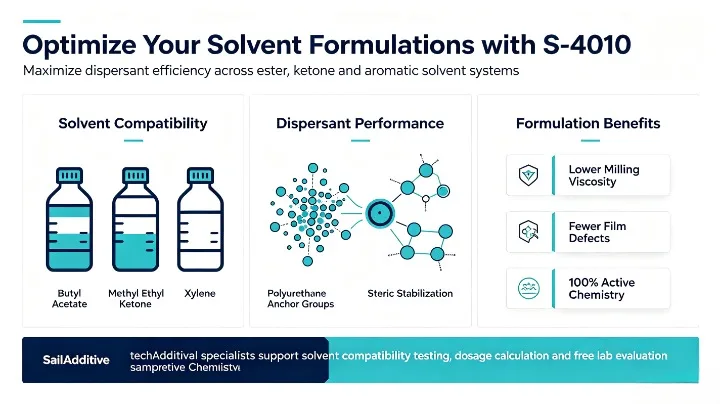
Solvent selection plays a decisive role in industrial coating formulation design. Solvent matrices do not merely act as liquid carriers to adjust application viscosity; they directly influence how active polymer additives behave during pigment grinding and storage. Choosing an incompatible solvent blend can suppress additive activity, cause polymer coiling, or induce resin haze and pigment flocculation.
Polyurethane-based dispersants rely on ideal solvent-polymer interactions to achieve maximum steric stabilization. Consequently, paint formulators must evaluate how dispersant polymers dissolve and uncoil across common ester, ether-ester, and aromatic solvent systems.
To solve these complex solvent compatibility challenges, SailAdditive engineered S-4010 Dispersing Agent, a 100% active content, high-performance modified polyurethane polymer designed for solvent-based, water-based, and UV coating systems.
In this technical guide, we analyze how solvent polarity affects dispersant solubility, examine S-4010 performance across butyl acetate, PMA, and xylene, and show you how to optimize solvent choices for maximum dispersion efficiency.
How Solvent Polarity Influences Polyurethane Dispersant Activity
Polyurethane dispersants possess a dual-affinity molecular architecture. Anchoring groups attach firmly onto pigment surfaces, while flexible polymer chains stretch out into the surrounding liquid solvent phase.
Solvent quality directly determines how far these polymer chains extend:
- Good Solvents (High Affinity): The solvent molecules interact strongly with the polymer backbone. Consequently, the polyurethane chains uncoil fully, creating a thick, robust steric layer around each pigment particle.
- Poor Solvents (Low Affinity): The polymer backbone prefers interacting with itself rather than the solvent. As a result, the chains coil tightly, reducing steric hindrance thickness and leading to pigment flocculation or high viscosity.
Therefore, selecting solvent blends with ideal solubility parameters ensures that high-molecular dispersants function at peak performance.
Market Landscape: S-4010 vs. Leading Industry Alternatives
Evaluating established market additives helps formulators benchmark solvent compatibility and formulation versatility across leading chemical manufacturers.
The industrial coatings market features several prominent polyurethane dispersants:
- BASF manufactures EFKA 4010, a classic modified polyurethane dispersant used in high-performance automotive and industrial coatings.
- BYK produces BYK-161, a high-molecular wetting and dispersing additive engineered to deflocculate pigments in solvent-borne systems.
- Evonik supplies TEGO Dispers 655, which offers strong viscosity reduction in demanding high-solids solvent-borne formulations.
While these legacy additives offer reliable technical results, S-4010 Dispersing Agent delivers a 100% active polyurethane structure with broad solubility across esters, ketones, and aromatics, providing exceptional formulation freedom and lower raw material costs.
Technical Data Overview
| Parameter / Feature | S-4010 Dispersing Agent PDF | EFKA 4010 (Benchmark) PDF |
| Chemical Foundation | Modified Polyurethane Polymer | Modified Polyurethane Polymer |
| Active Non-Volatile Content | 100% (120°C / 2h) | ~50% (Solvent Cut) |
| Viscosity Range (25°C | 1000 – 2000 | 300 – 700 |
| Normal Appearance | Yellow Transparent Liquid | Clear Yellow Liquid |
| Solvent Systems | Solvent, Water-based, UV, Inks | Solvent-Borne Industrial Systems |
| Primary Pigment Focus | Titanium Dioxide, Organics | Inorganic & Organic Pigments |
Performance Breakdown: S-4010 Solubility in Key Industrial Solvents
Because S-4010 Dispersing Agent delivers 100% active polymer without carrier solvent pre-dilution, formulators enjoy complete freedom when choosing their solvent matrix. Let us evaluate how S-4010 performs across the three most common industrial coating solvents.
[Butyl Acetate: Optimal Uncoiling] ➔ [PMA: Rapid Viscosity Drop] ➔ [Xylene: Excellent Compatibility]
1. Butyl Acetate (Esters)
Butyl acetate serves as a standard medium-evaporating ester solvent in 2K polyurethane, acrylic, and industrial lacquer formulations.
- Solubility Result: S-4010 dissolves rapidly into butyl acetate, yielding a completely clear, transparent solution.
- Polymer Activity: Ester oxygen groups interact favorably with the polyurethane backbone. This strong solvent affinity allows polyurethane chains to extend fully, maximizing steric stabilization and delivering rapid millbase viscosity reduction.
2. PMA / Propylene Glycol Monomethyl Ether Acetate (Ether-Esters)
PMA is a widely used active solvent in high-solids automotive topcoats, coil coatings, and industrial OEM finishes.
- Solubility Result: S-4010 exhibits complete miscibility in PMA across all concentration ratios without haze or phase separation.
- Polymer Activity: PMA provides exceptional solvency power, allowing S-4010 to wet inorganic fillers like titanium dioxide and calcium carbonate rapidly. This rapid wetting slashes bead milling time significantly.
3. Xylene and Aromatic Hydrocarbons
Xylene remains a cost-effective workhorse solvent in industrial epoxy, alkyd, and anti-corrosion coatings.
- Solubility Result: S-4010 forms clear, stable solutions in xylene and aromatic blend solvents.
- Polymer Activity: While aromatic solvents possess lower polarity than polar esters, S-4010 maintains excellent polymer chain expansion. It effectively prevents heavy inorganic filler settling and eliminates color floating in thick-film epoxy floor coatings.
Technical Performance: How Solvent-Dispersant Harmony Prevents Coating Defects
Matching S-4010 with the correct solvent environment directly improves film appearance and prevents processing defects.
1. Rapid Viscosity Drop and Higher Millbase Yields
When S-4010 dissolves fully in polar ester or ether-ester blends (like Butyl Acetate and PMA), it drastically reduces millbase grinding viscosity. Consequently, formulators can increase pigment concentration in the bead mill, boost hourly factory output, and reduce total energy consumption per ton.
2. Complete Elimination of Floating, Flooding, and Mottling
In mixed pigment formulations (such as Titanium Dioxide mixed with Phthalo Blue or Organic Red), improper solvent selection can cause selective pigment flocculation. S-4010 locks organic pigments and inorganic fillers into a uniform, non-separating matrix. This stabilization prevents floating, flooding, and mottling in demanding floor, coil, and automotive coatings.
3. Matting Powder Orientation and Gloss Enhancement
In low-gloss industrial coatings, S-4010 optimizes the spatial distribution of silica matting powders across solvent-borne systems. Conversely, in high-gloss topcoats, it boosts surface gloss and clarity, ensuring high-brilliance finishes.
Practical Dosage and Incorporation SOP
Achieving optimal performance requires applying the correct addition levels and following proper laboratory incorporation procedures.
SailAdditive recommends the following practical dosage guidelines based on formula mass or pigment weight:
- Standard Industrial Formulations: 0.1% to 5.0% of total formulation weight.
- UV & Water-Based Systems: 0.3% to 1.0% of total formulation weight.
- Inorganic Fillers & Titanium Dioxide : 1.0% to 3.0% calculated on dry pigment weight.
- Organic Pigments & Carbon Black: 10% to 30% calculated on dry pigment weight.
Proper Incorporation Sequence
Always incorporate S-4010 Dispersing Agent during the paint mixing stage before introducing dry pigment powders. Stir the liquid resin and solvent mixture thoroughly to dissolve S-4010 evenly. This pre-mixing sequence guarantees optimal additive distribution before high-shear bead milling begins.
Recommended Application Fields
Because S-4010 functions as a highly versatile, universal dispersant, technical teams can deploy it across diverse coating sectors:
- Automotive & OEM Coatings: Delivers high brilliance, deep jetness, and zero haze in solvent-borne topcoats.
- Рулонные покрытия: Withstands high-temperature baking cycles while maintaining film flexibility and gloss stability.
- Floor & Epoxy Coatings: Prevents heavy filler settling and eliminates surface mottling in thick films.
- Wood & Plastic Coatings: Improves pigment clarity, color development, and matting agent orientation.
Packaging, Storage, and Handling Specifications
SailAdditive supports commercial manufacturing with flexible packaging options and clear storage guidelines:
- Packaging Options: Supplied in standard 25L drums or 200L plastic/steel barrels.
- Storage Conditions: Store in airtight containers in a cool, dry place. S-4010 maintains a 24-month shelf life under proper storage conditions.
- Transportation Safety: Transport S-4010 safely as a non-hazardous chemical product.
Optimize Your Solvent Formulations with S-4010
Mastering solvent-dispersant interactions allows paint manufacturers to maximize additive efficiency, lower milling viscosity, and prevent costly coating defects. By choosing S-4010 Dispersing Agent, formulators secure 100% active polyurethane chemistry with complete solvency freedom across ester, ketone, and aromatic systems.
The technical specialists at SailAdditive stand ready to assist your lab with solvent compatibility testing, dosage calculations, and free laboratory evaluation samples.
Ready to optimize your solvent formulations and cut additive costs? Contact SailAdditive today to request your free S-4010 evaluation sample and elevate your coating performance!