
How to Choose Leveling Additives for Coatings and Inks: A Sail Additive Guide

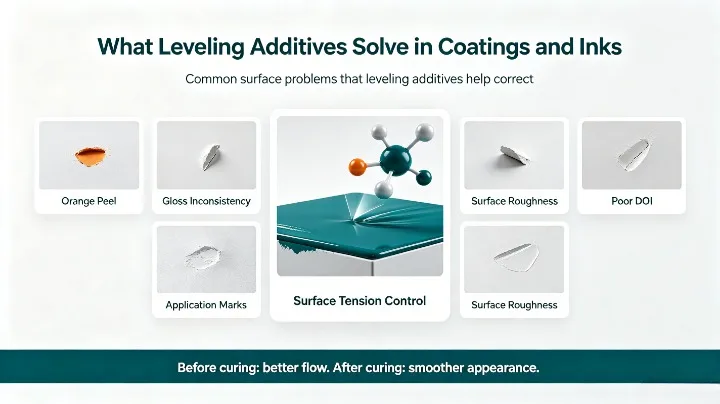
Quick answer: Leveling additives should be prioritized when the liquid coating or ink has already successfully covered the substrate, but the cured film fails to achieve a premium appearance. If your system is plagued by orange peel, uneven gloss, visible brush marks, or persistent surface roughness, your search should start with a dedicated leveling route rather than adding more wetting agents or dispersants.
Distinguishing these problems is critical. A coating can wet a difficult substrate perfectly and still result in a poor commercial finish. At Sail Additive, we help formulators divide surface challenges into three distinct questions: Can the liquid spread? Can the pigment stay stable? And can the final film level into a flawless surface? Leveling additives are the key to solving that third problem.
What Leveling Additives Solve in Coatings and Inks
Leveling agents are designed to control surface laydown and aesthetics during the critical window between application and curing. Common symptoms that signal a need for a leveling additive include:
- Orange Peel: The surface texture appears wavy and uneven rather than perfectly flat.
- Gloss Inconsistency: The cured film looks patchy or visually unstable under reflective light.
- Application Marks: Brush, roller, or spray marks fail to flow out and flatten before the film sets.
- Surface Roughness: The final appearance falls below decorative or premium quality targets.
- Poor DOI (Distinctness of Image): High-gloss systems cure, but the image reflection looks hazy or weak.
If the complaint on your lab bench is about final appearance rather than substrate skipping or pigment settling, a leveling agent belongs early in your additive screening.
When to Choose Leveling Additives Before Other Additive Types
| Observed Surface Problem | Best First Additive Direction | Why |
| Orange peel, gloss variation, or rough surface texture | Leveling Additive | The core issue is final film appearance, surface tension gradient control, and flow-out. |
| Poor spreading, crawling, or edge pullback | Wetting Additive | The issue starts with low substrate coverage and high contact angles, not final laydown. |
| Pigment settling, flooding, floating, or weak color | Dispersant | The problem lies in pigment-particle interaction and stabilization, not surface leveling. |
| Extreme cratering or severe surface repellency needs | Specialized Surface Control Agent | A heavy-duty silicone or fluorine-modified surfactant may be required to eliminate deep defects. |
The SailFlow Polyether-Modified Silicone Route to Review First
For formulations where surface smoothness and gloss consistency are the top priorities, Sail Additive recommends starting with our Sailadditve series of polyether-modified polydimethylsiloxane leveling agents (such as our hydroxyl-functional silicone glycol surfactants).
By incorporating polyether modifications, these additives provide an optimal balance of surface tension reduction and compatibility, making them an ideal first choice for content and formulation planning without confusing the problem with pigment stability.
SailAdditive Series Spotlight
- What it supports: Polyether-modified silicone leveling chemistry.
- Why it belongs early: It eliminates surface tension gradients (preventing the Marangoni effect) without ruining recoatability or inducing severe foam stabilization.
- Best commercial use: Premium industrial coatings, high-gloss decorative paints, and high-end packaging inks where flawless visual surface quality dictates buyer acceptance.
How Formulators Should Screen Leveling Additives
- Confirm the Problem is Appearance, Not WettingIf the liquid is already hiding the substrate completely but still looks uneven after curing, do not add more wetting agents—go straight to a leveling route.
- Separate Gloss Issues from Pigment IssuesA hazy or patchy finish can stem from pigment flocculation or poor surface flow. Isolate these variables. Ensure your pigment is stable before judging the leveling performance.
- Keep the Curing Window in MindLeveling performance must be evaluated under real production conditions—accounting for actual viscosity, flash-off times, line speeds, and UV/thermal cure windows, not just a static lab drawdown.
- Evaluate Secondary Effects EarlyWhen screening a silicone leveling agent, always check for secondary properties like slip enhancement, scratch resistance, and whether it introduces unwanted micro-foam.
FAQ
What is the primary mechanism of a leveling additive?
Leveling additives primarily work by migrating to the air-liquid interface to homogenize the surface tension. This eliminates surface tension gradients caused by solvent evaporation or curing, allowing the film to flow into a perfectly flat plane.
Should I choose a silicone-based or an acrylic-based leveling agent?
Silicone-based leveling agents (like the Sailadditve series) strongly reduce surface tension and excel at correcting severe orange peel and cratering. Acrylic leveling agents work by leveling out the surface without significantly altering surface tension, making them excellent for optical clarity and zero-foam risks.
Can leveling additives be used in UV-curable inks?
Yes. In fact, UV systems cure so rapidly that they require highly active, fast-migrating leveling agents (such as hydroxyl-functional silicone surfactants) to force the film to level out before the radiation locks the chemistry in place.