How to Achieve Perfect Aluminum Pigment Alignment in Metallic Coatings?

Metallic coatings provide a highly luxurious, reflective appearance for modern industrial products.
Specifically, automotive bodies, high-speed trains, and consumer electronics rely heavily on metallic paints to look premium.
This beautiful effect comes directly from tiny, reflective aluminum flakes suspended inside the paint film.
However, achieving a completely uniform appearance with these flakes is notoriously difficult for paint manufacturers.
If the aluminum pigments do not align perfectly, the cured film will suffer from severe visual defects.
For example, you might see dark patches, cloudy variations, or a complete loss of the metallic flip-flop effect.
Therefore, controlling pigment orientation during the drying stage is a top priority for formulators.
In this comprehensive guide, we will explore why aluminum alignment fails and how SailAdditive S-323 solves this craft challenge effortlessly
.
The Challenge of Floating Pigments in Metallic Automotive Paints
Automotive metallic topcoats demand absolute visual perfection under bright sunlight.
Unfortunately, technical teams frequently face the frustrating phenomenon of floating pigments.
During the application and wet stages, aluminum flakes possess a much higher density than the surrounding liquid resin matrix.
Despite their weight, localized currents within the wet paint film push these delicate metallic flakes into irregular positions.
Consequently, some flakes stand completely upright, while others clump together tightly.
This chaotic arrangement scatters light in random directions instead of reflecting it uniformly.
As a result, the paint finish looks blotchy, uneven, and heavily mottled.
Quality control managers refer to this defect as “mottling” or “clouding.”
Ultimately, this defect leads to high product rejection rates on high-speed automotive assembly lines.
How Surface Flow Affects the Orientation of Aluminum Flakes
To prevent mottling, we must understand the microscopic fluid dynamics inside a drying paint film.
As liquid solvent evaporates from the sprayed surface, it creates severe temperature and density differences across the film layer.
These differences trigger vertical circulation currents known as Bénard cells.
Warm, thin paint moves rapidly upward from the substrate toward the air interface.
Simultaneously, cold, concentrated paint at the surface sinks back down to the bottom.
These circular currents drag the flat aluminum flakes along with them.
Consequently, the flakes become trapped in vertical or tilted angles as the paint viscosity increases during baking.
Therefore, if you want a perfect horizontal alignment, you must suppress these violent surface flow movements completely before the film solidifies.
S-323: The Secret to a Uniform, Mottled-Free Metallic Finish
Fortunately, advanced additive engineering offers a highly effective solution to stabilize surface flow.
Our Силиконовый Выравнивающий агент S-323 consists of a premium polyether-modified polydimethylsiloxane copolymer.
This specialized chemical structure acts as an ultra-fast surface tension regulator.
Once incorporated, S-323 molecules migrate instantly to the liquid-air interface of the wet paint film.
By slightly reducing and perfectly equalizing the surface tension across the entire area, S-323 halts the formation of Bénard cells completely.
Without vertical currents disrupting the matrix, gravity allows the flat aluminum flakes to lay completely flat and parallel to the substrate.
Consequently, you achieve an incredibly uniform, mottled-free metallic finish with an enhanced “flip-flop” effect
.
If you currently formulate high-end baking-type metallic paints, you are likely familiar with BYK-323
. This global brand serves as an industry standard for solvent-borne pigment orientation. SailAdditive engineered S-323 as a premium alternative to deliver identical alignment control at an optimized cost.
Enhancing the Distinctness of Image (DOI) in Topcoats
Achieving a flat pigment orientation does more than just eliminate ugly mottling defects.
In addition, it significantly enhances the Distinctness of Image (DOI) of the final automotive clearcoat.
DOI measures how sharply and clearly a cured paint surface reflects an image or light source.
If aluminum flakes protrude irregularly into the upper layer, they create microscopic surface roughness.
This roughness scatters incoming light rays, which makes the clearcoat look cloudy, hazy, or dim.
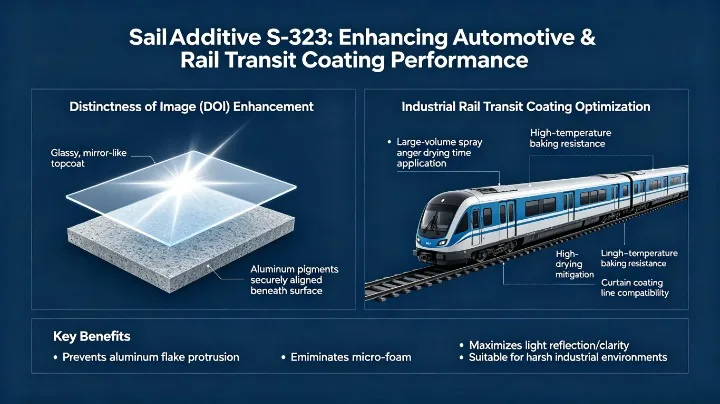
By utilizing SailAdditive S-323, you keep the aluminum pigments securely aligned beneath the surface plane.
The topcoat cures into a glassy, mirror-like layer that maximizes light reflection and clarity.
Furthermore, S-323 provides an exceptional deaeration effect that prevents micro-foam from ruining your topcoat gloss.
Formula Optimization for Industrial Rail Transit Coatings
Rail transit coatings and heavy-duty industrial paints face exceptionally harsh processing environments.
For example, train bodies require large-volume spray applications over massive metal surfaces.
These large surfaces take a longer time to dry, which gives pigments more opportunities to float irregularly.
Moreover, rail coatings must undergo high-temperature baking cycles to secure extreme outdoor durability.
S-323 is perfectly optimized for these demanding industrial application methods, including curtain coating lines
.
It features an outstanding thermal stability profile that withstands intense heat up to $250^{\circ}C$ without breaking down.
To optimize your rail transit or automotive formula, we recommend following these exact production parameters:
Recommended Dosage: Keep S-323 between 0.05% and 0.3% of your total formula weight.
Active Profile: Because S-323 boasts a non-volatile matter content greater than 97%, a tiny amount provides immense orientation power.
Incorporation Stage: Always add S-323 directly during the paint mixing stage to guarantee homogeneous distribution.
Compatibility: Our polyether modification ensures excellent long-term storage stability for up to 24 months inside airtight barrels.
Conclusion: Elevate Your Metallic Coating Standards Today
In conclusion, perfect aluminum pigment alignment is not a matter of luck.
Instead, it requires precise thermodynamic control over your paint film’s surface tension gradients.
When standard surfactants fail to stop internal currents, SailAdditive S-323 keeps the resin matrix calm, uniform, and stable.
By eliminating mottling defects, boosting DOI, and resisting extreme baking temperatures up to $250^{\circ}C$, this polyether-modified silicone copolymer secures global-tier aesthetics.
Switch to SailAdditive S-323 today to protect your formulas from floating pigments and optimize your raw material procurement costs.