
The Ultimate Guide to Selecting High-Performance Paint and Coating Defoamers

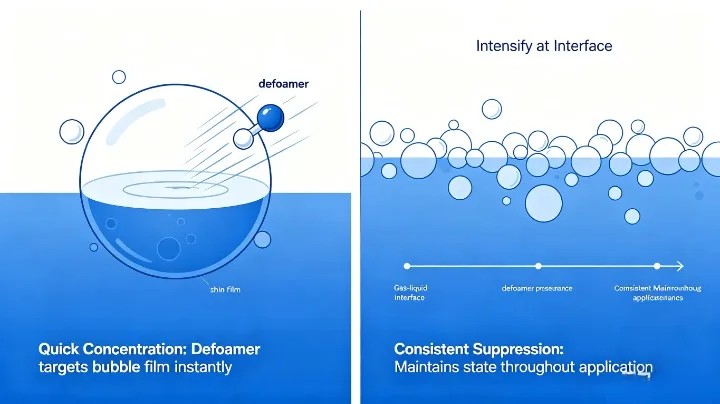
Whether you are formulating industrial coatings or decorative paints, bubbles are the enemy of a perfect finish. Choosing the right defoamer is a balancing act between chemistry, compatibility, and application technique. At SailAdditive, we understand that a "flawless" surface requires more than just good pigment—it requires high-performance additives that eliminate micro-foam without compromising film integrity.
Here is a guide to selecting the ideal defoamer for your next project.
1. The Science of Bubble-Breaking
To effectively burst a bubble, a defoamer must concentrate quickly on the bubble film. For immediate "bubble breaking," the additive needs to intensify at the gas-liquid interface instantly. For "bubble suppression," it must maintain this state consistently throughout the application process.
- Volatility Matters: The best defoamers are supersaturated and exhibit low volatility. This allows them to accumulate easily at the interface and weaken the foam film's concentration.
- The HLB Rule (Water-Based): For water-based systems, the active components must be strongly hydrophobic and weakly hydrophilic. Aim for an HLB value between 1.5 and 3 for optimal performance.
2. Match the Chemistry to Your System
The first question is always: Is your liquid water-based or solvent-based?
- Water-Based Paints: Typically require specialized water-based or silicone-modified defoamers.
- Solvent-Based / Industrial Paints: These often utilize polyether defoamers or polyether-modified silicone polymers to handle the higher surface tension and shear forces.
3. Key Selection Criteria
When comparing products, keep these four technical requirements in mind:
- Chemical Neutrality: The defoamer should not react with the foaming liquid. Chemical reactions can create harmful byproducts or neutralize the defoamer’s effectiveness.
- Surface Tension: To penetrate the foam film, the defoamer must have a lower surface tension than the foaming agent itself.
- Controlled Compatibility: If a defoamer is too compatible, it dissolves and disappears; if it is too incompatible, it won't disperse and may cause "fish-eyes." The "sweet spot" is a product that disperses quickly but remains active as a separate phase.
- Interlayer Adhesion: Especially in multi-coat systems, your defoamer must not interfere with the bond between the primer and the topcoat.
Our Top Recommendations from SailAdditive
We have engineered a range of specialized defoamers to meet the rigorous demands of modern coating manufacturing. Based on your specific application, here are our top three solutions:
ਉਤਪਾਦ | Base Chemistry | Best For | Key Feature | |
|---|---|---|---|---|
| Special Polysiloxane | Solvent-free Epoxy Floor Coatings, Heavy-duty Industrial | High efficiency in high-viscosity systems; 100% non-volatile. | |
S-6830 | Polyether-modified Silicone | Water-based paint, Ink, Leather paint | Exceptional micro-foam inhibition and rapid macro-bubble elimination. | |
S-6814 | Non-silicon (Silicone-free) | Oil-based paint, Ink, Leather paint | Maximum interlayer adhesion; perfect for multi-coat industrial finishes. |
S-6800: The Heavy-Duty Specialist
If you are working with high-solids or solvent-free epoxy coatings, S-6800 is your go-to. It is specifically optimized for high-film-thickness systems, ensuring a crater-free finish even in demanding floor coating applications.
S-6830: The Versatile All-Rounder
For water-based applications, S-6830 utilizes polyether-modified polysiloxane to provide a flawlessly smooth film. It is designed to resist shrinkage cavities (fish-eyes) while maintaining excellent compatibility across diverse resin systems.
S-6814: The Silicone-Free Choice
When structural integrity and interlayer adhesion are the highest priority—such as in complex decorative painting—S-6814 offers a high-efficiency, silicone-free alternative. It eliminates macro-bubbles and micro-foam without the risks sometimes associated with silicone-based additives.
Professional Usage Tip:
For optimal distribution, always add these defoamers during the paint mixing stage. We recommend a dosage between 0.1% and 1% of the total formula depending on the specific product and your system requirements.
Ready to eliminate surface defects? Visit SailAdditive.com to explore our full range of additives and consult with our technical team.