
Enhancing Carbon Black Jetness and Blue Undertone Performance: The Mechanism of Modified Polyurethane Dispersants

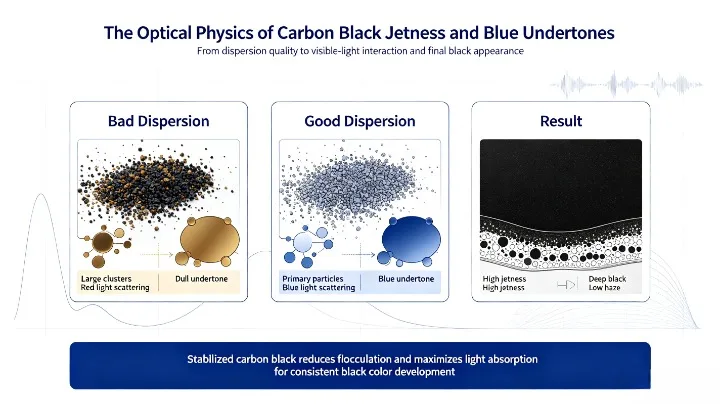
Formulating deep black coatings with exceptional jetness and desirable blue undertones represents one of the most demanding tasks in industrial paint R&D. High-jetness carbon black pigments feature extremely small primary particle sizes (<15nm) and high specific surface areas. However, these tiny particles possess powerful van der Waals attraction forces. Consequently, carbon black particles tend to re-agglomerate rapidly after high-shear grinding, leading to severe pigment flocculation, loss of jetness, dull brownish undertones, and surface haze.
Traditional wetting agents often fail to stabilize fine carbon black particles because they lack sufficient steric volume. To secure deep blackness and a brilliant bluish tone, formulators must achieve complete particle deflocculation down to primary aggregates.
To solve these challenging color development issues, SailAdditive developed S-4010 Dispersing Agent, a 100% active content, high-performance modified polyurethane polymer engineered for solvent-based, water-based, and UV coating systems.
In this technical guide, we analyze the physical optics behind carbon black jetness and blue undertones, demonstrate how S-4010 optimizes particle separation, and share step-by-step laboratory best practices for industrial paint formulators.
The Optical Physics of Carbon Black Jetness and Blue Undertones
Achieving high jetness (My value) and a bluish undertone (dM value) depends directly on the average particle size of carbon black in the final liquid coating.
Light interaction with carbon black follows distinct physical optical rules:
- Particle Size and Light Scattering: When carbon black particles exist as large, flocculated clusters (>100nm), they scatter longer wavelengths of visible light (red light) preferentially. Consequently, the coating appears dull with an unwanted yellowish-brown undertone.
- Primary Aggregate Deflocculation: When a dispersant separates carbon black down to primary particle dimensions (<20nm), Rayleigh scattering dominates. Fine particles scatter shorter wavelengths of light (blue light) back to the observer, creating a desirable, high-value blue undertone.
- Absorptive Jetness: Complete particle deflocculation maximizes total light absorption, creating an intense, deep black appearance (high jetness) without surface fogging or haze.
Therefore, formulators need a high-performance modified polyurethane dispersant that anchors permanently onto carbon black and prevents re-agglomeration.
Market Landscape: S-4010 vs. Leading Competitors
Evaluating established market additives helps technical teams benchmark polymer efficiency and formulation fit across leading global chemical manufacturers.
The industrial coatings market features several prominent polyurethane dispersants:
- BASF manufactures EFKA 4010, a widely recognized modified polyurethane dispersant used in high-performance automotive and industrial coatings.
- BYK produces BYK-161, a high-molecular-weight wetting and dispersing additive engineered to deflocculate organic pigments and carbon black in solvent-borne systems.
- Evonik supplies TEGO Dispers 655, which offers strong viscosity reduction in demanding high-solids solvent-borne formulations.
While these legacy brands deliver high technical performance, S-4010 Dispersing Agent offers a 100% active polyurethane structure with broad system compatibility, providing exceptional formulation flexibility and lower raw material costs.
Technical Specification Overview
| Specification / Property | S-4010 Dispersing Agent | EFKA 4010 (Benchmark) |
| Chemical Foundation | Modified Polyurethane Polymer | Modified Polyurethane Polymer |
| Active Non-Volatile Content | 100% (120°C / 2h) | ~50% (Solvent Cut) |
| Viscosity Range (25°C, mm^2/s) | 1000 – 2000 | 300 – 700 |
| Exterior | Yellow Transparent Liquid | Clear Yellow Liquid |
| Target Pigments | Organics | Inorganic & Organic Pigments |
| System Compatibility | Solvent-based, Water-based, UV, Inks | Solvent-Borne Industrial Systems |
How S-4010 Enhances Jetness and Blue Undertones via Steric Hindrance
S-4010 Dispersing Agent utilizes an advanced modified polyurethane polymer matrix engineered for difficult carbon black stabilization.
[Dense Amine Anchoring] ➔ [Polymer Chain Expansion] ➔ [Steric Hindrance Barrier] ➔ [Maximum Jetness & Blue Undertone]
1. Robust Multi-Point Amine Anchoring
Carbon black surfaces contain sparse oxygen-containing functional groups. S-4010 features multiple basic amine anchor sites distributed across its polyurethane backbone. These anchor groups form strong, multi-point attachments onto carbon black particle surfaces, preventing polymer desorption under high-shear bead milling.
2. Powerful Steric Hindrance Barrier
Once anchored, solvated polyurethane loops and tails extend outward into the liquid resin and solvent matrix. This extended polymer barrier creates powerful steric hindrance around every carbon black particle. This steric barrier prevents fine particles from touching or re-agglomerating, locking in primary particle fineness.
3. Viscosity Drop and Higher Carbon Black Loading
By breaking up particle-particle networks, S-4010 slashes millbase viscosity significantly. Lower millbase viscosity allows formulators to process higher carbon black concentrations in bead mills, shorten grinding cycles, and reduce total energy consumption.
Surface Quality Benefits: Preventing Flooding, Floating, and Mottling
High jetness carbon black performance must not come at the expense of film appearance. S-4010 Dispersing Agent ensures superior surface brilliance and film integrity across demanding industrial applications:
- Complete Prevention of Floating and Mottling: In mixed pigment systems (such as carbon black mixed with white titanium dioxide or organic red), unequal particle mobility causes color floating. S-4010 locks carbon black and inorganic pigments into a cohesive, non-separating matrix, eliminating floating, flooding, and mottling in floor, coil, and automotive topcoats.
- Matting Powder Control and Gloss Enhancement: In low-gloss industrial coatings, S-4010 optimizes the spatial orientation of silica matting powders. Conversely, in high-gloss carbon black finishes, it boosts surface gloss and clarity, delivering flawless, high-brilliance topcoats.
Recommended Addition Amount and Incorporation SOP
Achieving maximum jetness and blue undertone performance requires applying correct addition levels and following proper laboratory incorporation procedures.
SailAdditive recommends the following practical dosage guidelines based on total formula mass or dry pigment weight:
- Standard Industrial Coating Formulations: 0.1% to 5.0% of total formulation weight.
- UV-Curable & Water-Based Formulations: 0.3% to 1.0% of total formulation weight.
- High-Surface Carbon Black & Organic Pigments: 10% to 30% calculated on dry pigment weight.
- Standard Inorganics _2-3): 1.0% to 3.0% calculated on dry pigment weight.
Proper Incorporation Sequence
Always incorporate S-4010 Dispersing Agent during the paint mixing stage before introducing dry pigment powders. Stir the liquid resin and solvent mixture thoroughly to dissolve S-4010 evenly throughout the matrix. This pre-mixing sequence guarantees optimal additive distribution before high-shear bead milling begins.
Recommended Industrial Application Fields
Because S-4010 functions as a highly versatile, universal dispersant, technical teams can deploy it across diverse coating sectors:
- Automotive OEM & Refinish Coatings: Delivers intense color depth, maximum jetness, blue undertone, and zero haze in carbon black topcoats.
- ਕੁਆਇਲ Coatings: Withstands high-temperature baking cycles while maintaining film flexibility, color consistency, and gloss stability.
- Floor & Industrial Coatings: Prevents heavy filler settling CaCO_3) and eliminates surface mottling in thick industrial coatings.
- Wood & Plastic Coatings: Improves pigment clarity, color development, and matting agent orientation.
Packaging, Storage, and Safe Handling Specifications
SailAdditive supports commercial manufacturing with flexible packaging options and clear storage guidelines:
- Packaging Options: Supplied in standard 25L drums or 200L plastic/steel barrels.
- Storage Conditions: Store in airtight containers in a cool, dry place. S-4010 maintains a 24-month shelf life under proper storage conditions.
- Transportation Safety: Transport S-4010 safely as a non-hazardous chemical product.
Maximize Carbon Black Jetness and Blue Undertones with S-4010
Achieving maximum jetness and desirable blue undertones allows industrial paint manufacturers to produce premium black coatings while eliminating haze and flocculation defects. By choosing S-4010 Dispersing Agent, formulators secure 100% active polyurethane chemistry that optimizes carbon black and inorganic pigment dispersion across solvent, water, and UV systems.
The technical specialists at SailAdditive stand ready to assist your lab with carbon black dispersion trials, dosage calculations, and free laboratory evaluation samples.
Ready to elevate your carbon black jetness and blue undertone performance? Contact SailAdditive today to request your free S-4010 evaluation sample and optimize your high-brilliance coating performance!