What are Leveling Agents? The Secret to Achieving a Mirror-Like Finish

In the world of coatings, inks, and high-performance finishing, the smoothness and gloss of the final film are the primary standards of quality. To completely eliminate defects like "orange peel," "craters," or "brush marks," manufacturers rely on a critical additive: the Leveling Agent.
ਕੀ ਹਨ ਲਗਾ ਏਜੰਟ?
A leveling agent is a chemical additive designed to reduce surface tension and eliminate surface tension gradients. This allows a wet paint film to flow into a flat, smooth, and uniform surface during the drying process.
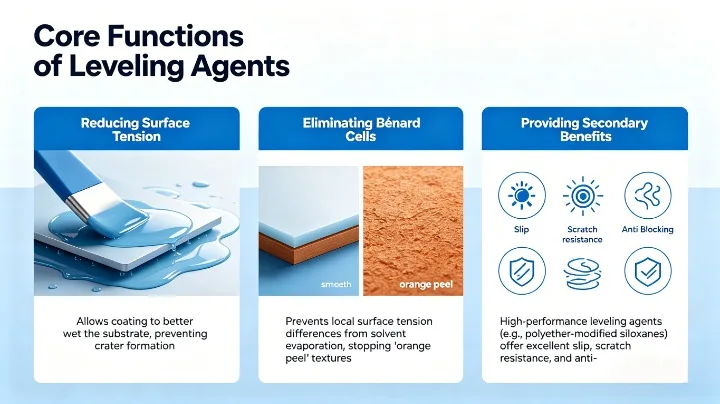
Core Functions of Leveling Agents
Reducing Surface Tension: This allows the coating to better wet the substrate, preventing the formation of craters.
Eliminating Bénard Cells: By preventing local surface tension differences caused by solvent evaporation, leveling agents stop the formation of "orange peel" textures.
Providing Secondary Benefits: High-performance leveling agents, such as polyether-modified siloxanes, often provide excellent slip, scratch resistance, and anti-blocking properties.
Core Applications: Products and Industrial Fields
Based on technical documentation from DongGuan SailAdditive, you must precisely match your leveling agent to the coating system (aqueous, solvent-based, or solvent-free) and the application environment.
1. Core Systems and Product Categories
Solvent-based and High-Temperature Systems: S-323 (a reliable alternative to BYK-323) offers exceptional thermal stability up to 250°C. It is ideal for metallic finishes and wood paints that undergo high-temperature processing.
Universal High-Slip Solutions: S-333 is a highly compatible additive that significantly reduces the coefficient of friction. It enhances surface smoothness and scratch resistance across UV, solvent, and waterborne systems.
Solvent-Free and High-Solid Systems: S-6800 is specifically optimized for high-viscosity floor coatings. It provides a perfect balance of excellent leveling and powerful degassing to eliminate micro-foam.
2. Key Manufacturing Processes
Curtain Coating: S-323 excels at stabilizing the flow of curtain coatings to ensure consistent film thickness.
Multi-coat Processes: Products like S-333 enhance surface properties without negatively impacting recoatability or interlayer adhesion.
Pigment and Matting Agent Orientation: These additives facilitate the precise, uniform alignment of aluminum pigments in metallic coatings and matting agents in matte finishes.
3. Broad Industrial Fields
Automotive Industry: Used in car OEM coatings, repair coatings, and rail transit finishes to provide high-gloss, flawless surfaces.
Wood and Furniture: Applied to furniture coatings to provide a smooth touch and superior scratch protection.
Printing and Packaging: Used in screen, gravure, and flexo inks to improve anti-blocking and wear resistance.
Market Comparisons
In the global market, professionals often look for established benchmarks. For instance, the BYK-333 silicone surface additive is a widely recognized standard for providing slip and leveling. Our S-333 is engineered to provide similar high-performance results, ensuring your formulation meets international quality standards while remaining cost-effective.
Expert Usage Tips for Optimal Leveling
To achieve a mirror-like result, follow these professional guidelines:
Incorporation: Add leveling agents during the paint mixing stage to ensure optimal distribution.
Standard Dosage: Typical dosages are low, ranging from 0.05% to 0.5% of the total formula.
'ਤੇ DongGuan SailAdditive, we provide the technical expertise and high-performance chemicals to optimize your formulations.
Ready to enhance your product performance? Send a email contact our technical for a consultation or to request samples.