
Why Is Thermal Stability Crucial for Baking-Type Metallic Paints?

High-performance industrial coatings must withstand extreme environments during application.
Specifically, automotive paints, rail transit coatings, and coil coatings require severe heat to cure fully.
This intense heat forces cross-linking reactions to happen very rapidly.
However, high temperatures also put tremendous thermal stress on every single component in the paint formula.
If your chemical additives cannot take the heat, your final finish will suffer from severe defects.
Therefore, choosing a leveling agent with exceptional thermal stability is vital for your production line.
In this comprehensive guide, we will analyze why thermal resistance matters so much for baking-type metallic paints.
Furthermore, we will demonstrate how SailAdditive S-323 provides the ultimate protection against heat degradation up to 250C.
The Harsh Conditions of Industrial Baking Paint Cycles
Industrial manufacturing lines rely heavily on automated baking ovens to speed up curing times.
For example, modern coil coating lines move metal sheets through curing zones at incredible speeds.
Consequently, the localized peak metal temperature rises dramatically within seconds.
These ovens often maintain temperatures well above 200^C to ensure complete chemical resistance.
Similarly, automotive topcoats and container coatings require prolonged high-heat baking cycles to achieve maximum durability.
During this intensive heating phase, the liquid paint film undergoes rapid physical changes.
The viscosity drops initially, and solvents flash off aggressively.
Therefore, any surface control surfactant must remain perfectly intact and active during this entire violent transformation.
It must regulate the film interface smoothly from the moment it enters the oven until it cools down completely.
What Happens When Low-Quality Leveling Agents Degrade at High Heat
Using a standard, low-cost organic or modified silicone surfactant under baking conditions creates severe chemical risks.
Most standard leveling agents possess weak molecular chains that break apart under high temperatures.
When these low-quality additives degrade inside a hot industrial oven, several catastrophic issues occur immediately:
- Volatilization: The additive boils away prematurely.
- Loss of Control: The wet paint film completely loses its surface tension control mid-way through the baking cycle.
- Surface Irregularities: The sudden loss of leveling power triggers immediate orange peel, heavy cratering, and severe surface waviness.
- Pigment Floating: In metallic paints, the degrading additive disrupts the suspension balance.
- Flake Misalignment: Consequently, aluminum flakes begin to float irregularly, creating ugly dark patches and inconsistent metallic finishes.
Ultimately, these thermal failures ruin your product quality.
They create expensive factory reworks and lead to immediate rejections from your buyers.
Analyzing the 250°C Thermal Resistance of S-323
To solve these high-temperature challenges, SailAdditive engineered a highly robust molecular architecture.
Our S-323 Silicone Leveling Agent utilizes an advanced polyether-modified polydimethylsiloxane copolymer structure.
This specific hybrid polymer features an exceptionally strong silicon-oxygen backbone.
This inorganic backbone withstands thermal energy effortlessly compared to standard carbon-carbon chains.
Specifically, S-323 delivers outstanding, documented thermal stability up to 250^C.
Because of this superior thermal resistance, S-323 does not decompose, discolor, or volatilize inside industrial baking ovens.
It continues to reduce surface tension evenly throughout the entire hot curing phase.
Therefore, it serves as an ideal, reliable solution for demanding furniture coatings, heavy-duty industrial paints, and high-temperature coil coatings.
If your technical team currently formulates high-heat industrial baking finishes, you are likely familiar with BYK-323. This global benchmark is highly trusted for solvent-borne baking systems. SailAdditive engineered S-323 as a premium alternative to match these exact high-temperature performance metrics perfectly.
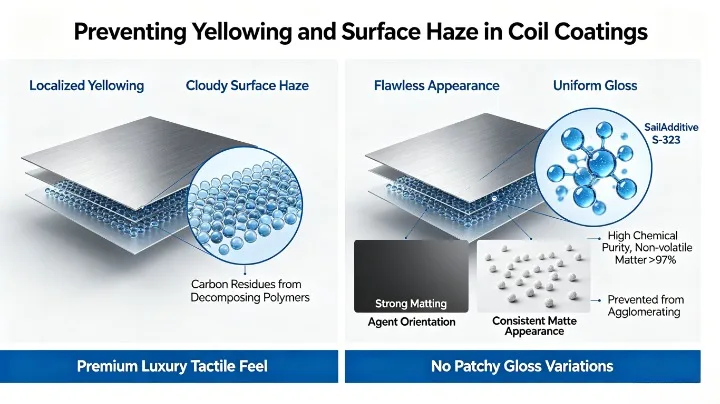
Preventing Yellowing and Surface Haze in Coil Coatings
Coil coatings require a highly flawless appearance and uniform gloss levels across miles of continuous steel sheets.
This happens because decomposing polymers leave carbon residues behind trapped inside the transparent resin matrix.
SailAdditive S-323 completely eliminates this risk due to its high chemical purity and non-volatile matter content exceeding 97%.
It remains completely clear and transparent, even under prolonged baking intervals.
Furthermore, S-323 shines exceptionally well in matte finish systems.
It ensures strong, uniform matting agent orientation across the entire sheet surface.
By preventing silica particles from agglomerating irregularly in the hot oven, it maintains a highly consistent matte appearance.
Thus, you get a premium, luxury tactile feel without any patchy gloss variations.
Testing Protocols for High-Temperature Coating Additives
If you want to validate the superior thermal properties of S-323 in your own research lab, we highly recommend following this strict evaluation protocol:
- Formulate the Base Metallic Paint: Prepare your standard solvent-based automotive or coil coating formulation containing aluminum pigments.
- Incorporate S-323 Correctly: Add S-323 directly during the paint mixing stage. This ensures optimal, homogeneous distribution before baking. Use a standard testing dosage of 0.1% of the total formula weight.
- Prepare a Control Sample: Create a twin sample using your current standard leveling agent for a direct comparative test.
- Execute the Baking Cycle: Apply both paints onto test panels, then place them inside a laboratory oven set to your target industrial temperature, up to 250^C.
- Examine the Cured Surface: Once cooled, use a gloss meter and wave-scan tool to check for orange peel, surface haze, and cratering defects. Furthermore, evaluate the precise, uniform alignment of the aluminum pigments under a microscope to confirm the superior metal orientation.
Best Practices for Storage and Scale-Up Production
Once your laboratory validation confirms the high performance of S-323, scaling up to mass production is incredibly straightforward.
S-323 behaves as a highly stable, non-hazardous chemical liquid.
Therefore, it does not require complex hazardous shipping or specialized storage infrastructure.
To maintain its premium active quality over long periods, simply store it in its original airtight container.
Keep the container in a cool, dry place away from direct environmental moisture.
Under these standard conditions, S-323 retains its full structural integrity and chemical properties for an impressive shelf life of 24 months.
Whether you choose our convenient 25L barrels for specialized batches or our heavy-duty 200L steel barrels for large-scale factory production, you receive a highly dependable supply chain solution.
Conclusion: Secure Your Surface Quality Against Extreme Heat
In conclusion, thermal stability is not an optional feature for baking-type industrial coatings.
It represents a fundamental requirement to achieve a professional, defect-free surface finish.
When low-quality alternatives fail under intense heat, SailAdditive S-323 remains perfectly stable, functional, and efficient up to $250^{\circ}C$.
By protecting your resin system from orange peel, stabilizing aluminum pigment alignment, and ensuring excellent matting agent orientation, this polyether-modified silicone copolymer elevates your product standards.
Switch to SailAdditive S-323 today to optimize your production economics while securing flawless surface aesthetics across all your high-temperature coating lines.