
Low-Temperature Crystallization and Turbidity: Winter Storage Behavior and Recovery of High-Performance Polyurethane Dispersants

Winter warehouse temperatures create severe logistics challenges for industrial chemical raw materials. Formulators and plant managers often open a drum of high-molecular polyurethane dispersant during cold months only to find cloudy liquids, phase turbidity, or solid crystallization. Naturally, production operators worry that low temperatures have permanently ruined the additive’s chemical structure.
Polyurethane polymer chains naturally align and become viscous or cloudy under cold storage conditions. Understanding how low temperatures affect physical characteristics allows formulators to handle cold raw materials safely without damaging paint film performance.
To solve these cold-weather storage issues, SailAdditive engineered S-4010 Dispersing Agent, a 100% active content, high-performance modified polyurethane polymer designed as a direct drop-in alternative to EFKA 4010.
In this practical guide, we analyze why low-temperature turbidity occurs in polyurethane dispersants, how cold storage impacts viscosity, and how you can restore S-4010 safely to preserve peak dispersion efficiency.
Why Polyurethane Dispersants Cloud and Crystallize in Cold Weather
High-molecular-weight polyurethane dispersants contain polymer segments with varying degrees of solubility and crystallinity. Under normal room temperatures (20°C to 25°C), thermal movement keeps polymer chains loose, yielding a clear, yellow transparent liquid.
However, when warehouse temperatures drop below 10°C, physical changes occur rapidly:
- Reduced Polymer Mobility: Cold temperatures decrease kinetic energy, causing long polyurethane chains to pack closely together.
- Reversible Crystallization: Specialized anchoring groups align into semi-crystalline micro-domains, causing the liquid to turn hazy or cloudy.
- Viscosity Increase: Low thermal motion increases bulk viscosity, making cold liquid thicker and harder to pump.
Fortunately, low-temperature turbidity represents a purely physical change rather than a chemical degradation. Consequently, warming the dispersant back to room temperature completely restores its original liquid clarity and performance.
Market Landscape: S-4010 vs. Leading Competitors
Evaluating establish market additives helps formulators understand winter handling requirements across different polyurethane brands.
The global coating additive market features several prominent polyurethane dispersants:
- BASF produces EFKA 4010, a classic modified polyurethane dispersant used in high-performance automotive and industrial coatings.
- BYK manufactures BYK-161, a high-molecular wetting and dispersing additive designed to deflocculate pigments in solvent-borne systems.
- Evonik supplies TEGO Dispers 655, which offers strong viscosity reduction in demanding high-solids solvent-borne formulations.
While these legacy brands deliver high technical performance, S-4010 Dispersing Agent offers a 100% active polyurethane structure with outstanding thermal stability, providing exceptional formulation flexibility and lower winter storage risks.
Technical Property Comparison
| Specification Parameter | S-4010 Dispersing Agent PDF | EFKA 4010 (Benchmark) PDF |
| Chemical Base | Modified Polyurethane Polymer | Modified Polyurethane Polymer |
| Active Content / Non-Volatile | 100% (120°C / 2h) | ~50% (Solvent Cut) |
| Viscosity Range (25°C, {mm}^2/\{s}) | 1000 – 2000 | 300 – 700 |
| Normal Appearance | Yellow Transparent Liquid | Clear Yellow Liquid |
| Winter Handling Method | Mild Heating & Homogenization | Mild Heating & Homogenization |
| Compatible Systems | Solvent, Water-based, UV, Inks | Solvent-Borne Industrial Systems |
Step-by-Step SOP: How to Safely Recover Cold-Crystallized S-4010
Using cold, hazy, or partially crystallized dispersant directly during paint grinding leads to incomplete additive dissolution and pigment shock. Follow this simple 4-step recovery protocol before dosing cold S-4010 Dispersing Agent into your mixing tanks:
[Step 1: Inspect Drum] ➔ [Step 2: Gentle Water-Bath Heating] ➔ [Step 3: Thorough Stirring] ➔ [Step 4: Quality Check]
Step 1: Inspect the Storage Drums
When retrieving S-4010 drums from unheated winter warehouses, check the liquid appearance and fluid viscosity. If the material appears hazy or thick, move the container into a warm room (20°C to 25°C) for 24 hours prior to production.
Step 2: Apply Gentle Warm Water Bath Heating
To speed up recovery, place 25L drums or 200L barrels into a warm water bath or heated drum blanket set between 35°C and 50°C.
- Warning: Avoid applying open flames or high-temperature localized heating elements. Direct overheating can discolor the polymer matrix.
Step 3: Stir and Homogenize Thoroughly
Polymer chains uncoil as internal liquid temperatures rise above 20°C. Stir the drum thoroughly with a clean mechanical mixer for 5 to 10 minutes. Homogenization ensures that active polyurethane chains redistribute evenly throughout the barrel.
Step 4: Verify Liquid Clarity
Once S-4010 returns to a clear, yellow transparent liquid, measure bulk viscosity. The fully recovered material delivers 100% of its original pigment wetting, viscosity reduction, and anti-settling performance.
Technical Performance: How S-4010 Performs Post-Recovery
Once recovered, S-4010 Dispersing Agent delivers exceptional operational benefits across demanding industrial coating applications.
1. Rapid Viscosity Reduction and Grinding Efficiency
S-4010 rapidly wets hard-to-disperse inorganic fillers like calcium carbonate and titanium dioxide. It slashes millbase viscosity significantly, allowing factories to shorten bead milling time and boost hourly production output.
2. Complete Prevention of Surface Film Defects
In mixed pigment formulations, temperature variations during paint application can trigger color floating and mottling. S-4010 provides strong steric hindrance, locking organic and inorganic pigments into a uniform matrix. This stabilization prevents floating, flooding, and mottling in floor, coil, and automotive finishes.
3. Matting Powder Control and Gloss Enhancement
In low-gloss industrial coatings, S-4010 optimizes the spatial distribution of silica matting powders. Conversely, in high-gloss topcoats, it boosts surface gloss and clarity, ensuring flawless, high-brilliance finishes.
Application and Dosage Guidelines
Achieving consistent results in winter formulations requires applying the correct addition levels based on total formula weight or pigment mass.
SailAdditive recommends the following practical dosage parameters:
- Standard Industrial Formulations: 0.1% to 5.0% of total formulation weight.
- UV & Water-Based Systems: 0.3% to 1.0% of total formulation weight.
- Inorganic Fillers & Titanium Dioxide : 1.0% to 3.0% calculated on dry pigment weight.
- Organic Pigments & Carbon Black: 10% to 30% calculated on dry pigment weight.
Proper Addition Sequence
Always incorporate S-4010 Dispersing Agent during the paint mixing stage before introducing dry pigment powders. Stir the liquid phase thoroughly to dissolve S-4010 evenly into the resin and solvent mixture. This sequence guarantees optimal additive distribution before high-shear bead milling begins.
Recommended Applications for Cold-Weather Products
Because S-4010 functions as a highly versatile, universal dispersant, technical teams can deploy it across diverse industrial coating sectors:
- Floor Coatings: Prevents heavy filler settling during cold winter storage and eliminates surface mottling.
- Coil Coatings: Withstands high-temperature baking cycles while preserving film flexibility and gloss stability.
- Automotive Coatings: Delivers high brilliance, deep jetness, and zero haze in OEM and refinish topcoats.
- Plastic & Wood Coatings: Improves pigment clarity, color development, and matting agent orientation.
Packaging, Shelf Life, and Safe Storage Specifications
SailAdditive supplies S-4010 with commercial packaging options and clear storage guidelines:
- Packaging: Supplied in standard 25L drums or 200L plastic/steel barrels.
- Storage Conditions: Store in airtight containers in a cool, dry place. S-4010 maintains a 24-month shelf life under proper storage conditions.
- Transportation: Transport S-4010 safely as a non-hazardous chemical product.
Protect Your Winter Formulations with S-4010
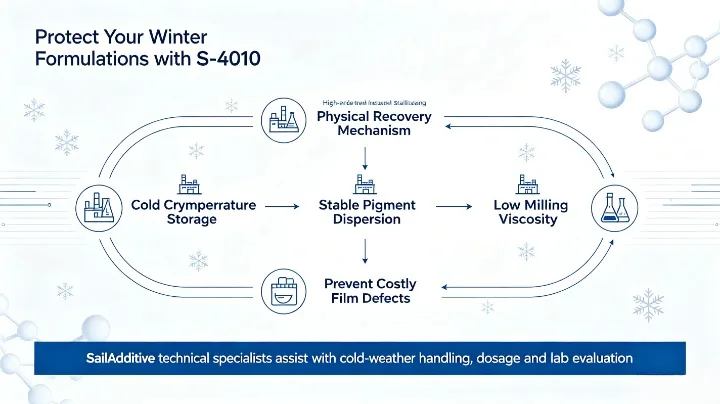
Low-temperature turbidity and cold crystallization do not have to disrupt your paint manufacturing. By understanding the physical recovery mechanism of S-4010 Dispersing Agent, paint manufacturers can handle winter raw materials safely, maintain low milling viscosity, and prevent costly film defects.
The technical specialists at SailAdditive stand ready to assist your team with cold-weather handling advice, dosage calculations, and free laboratory evaluation samples.
Ready to test S-4010 in your winter formulations? Contact SailAdditive today to request your free S-4010 evaluation sample and optimize your coating stability!