Wood and Furniture Coatings: How to Maintain Film Stability Under High-Temperature Processing?

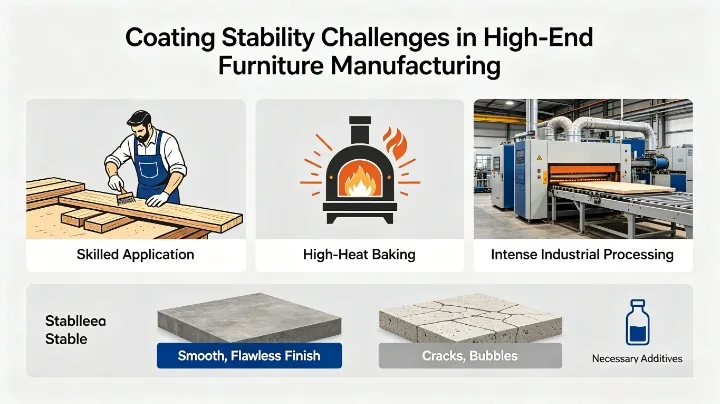
Achieving a flawless finish on high-end furniture or raw wood requires more than just skilled application. Manufacturers often face the challenge of maintaining coating stability when surfaces undergo high-heat baking or intense industrial processing. Without the right additives, heat can trigger surface defects that ruin days of work.
In this guide, we explore how to secure your coating integrity during thermal stress using advanced leveling technology.
The Challenge: Demanding Application Scenarios
Thermal stability is critical for several specialized coating sectors. High-temperature environments are standard in the following areas:
- Wood and Furniture Industry: Modern furniture production often uses heat to accelerate drying and curing cycles.
- Raw Wood Paints: Natural wood substrates can release air or moisture when heated, leading to surface irregularities.
- Baking-Type Metallic Paints: These coatings require consistent heat to align pigments perfectly for a professional metallic sheen.
- Coil and Curtain Coating: Industrial processes like coil coating demand additives that can withstand continuous high-speed and high-heat conditions.
The Technical Solution: S-323 Thermal Stability
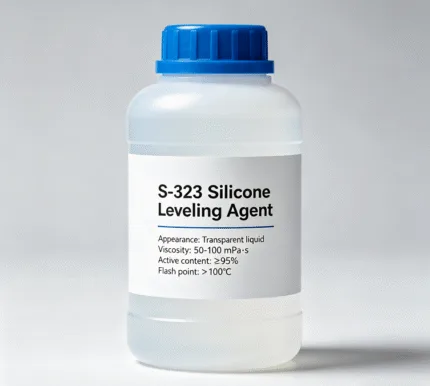
To solve the problem of heat-induced defects, Sail Additive offers S-323, a high-performance silicone leveling agent. This polyether-modified polydimethylsiloxane copolymer is specifically engineered to survive extreme conditions.
The standout technical feature of S-323 is its exceptional thermal stability, which allows it to remain effective at temperatures up to 250°C. Unlike standard leveling agents that may decompose or lose functionality under heat, S-323 maintains its molecular integrity. This ensures the coating remains stable from the moment it enters the oven until the final cure.
Key Benefits: Superior Leveling and Deaeration
S-323 provides more than just heat resistance; it actively manages the physical behavior of the wet film:
- Optimized Flow for Curtain Coating: It slightly reduces surface tension, which stabilizes the flow during curtain coating applications. This creates a consistent, uniform film across the entire substrate.
- Unique Deaeration Effect: Air entrapment is a common enemy in wood coatings. S-323 provides a specialized deaeration effect that prevents foam from stabilizing within the film.
- Matte and Metallic Excellence: In matte systems, S-323 ensures strong orientation of matting agents. For metallic paints, it facilitates the precise alignment of aluminum pigments, resulting in a consistent, high-quality finish.
For professionals seeking global standards, S-323 serves as a reliable and high-performance alternative to the BYK-323 silicone surfactant, offering comparable surface aesthetics for demanding industrial lines.
Technical Data at a Glance
- Exterior: Light yellow to amber transparent liquid.
- Density (25°C): 1.440–1.450.
- Dosis yang Dianjurkan: Only 0.05% to 0.3% of the total formula is required for optimal results.
- Penggabungan: Simply add S-323 during the paint mixing stage to ensure even distribution.
Conclusion: Reliable Protection for High-Heat Coatings
Don’t let high temperatures compromise your furniture or industrial coatings. By integrating S-323 into your formulation, you gain a heat-stable partner that ensures smooth leveling and effective air release.
Ready to upgrade your thermal performance? Visit SailAdditive.com to explore our technical solutions or contact our team to request a sample of S-323 today.