
How to Choose Wetting Additives for Coatings, Inks, and Difficult Substrates

Quick Answer
Choose wetting additives when your main problem involves how a coating or ink spreads across a substrate. Do not confuse this with poor pigment stability or final-surface leveling. If your system pulls back on film, struggles on plastic or metal, or shows poor edge coverage on low-surface-energy surfaces, you should start your search with the Sailadditive® Wetting Agent line.
Formulators often mistake substrate coverage problems for general formulation weaknesses. In reality, many coating and ink systems fail not because the resin itself is wrong, but because the liquid cannot properly spread, anchor, or cover the surface in a stable manner.
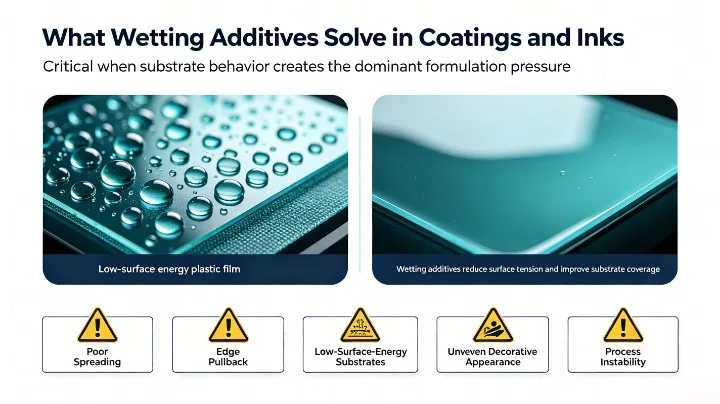
What Wetting Additives Solve in Coatings and Inks
Wetting additives become critical when substrate behavior creates the dominant formulation pressure. Look out for these common warning signs in your lab or production line:
Poor Spreading: The coating or ink beads up instead of forming a clean, uniform film.
Edge Pullback: The material actively retreats from corners, borders, or fine print zones.
Low-Surface-Energy Substrates: Difficult film, plastic, or treated metal surfaces resist uniform coverage.
Uneven Decorative Appearance: The system lays down inconsistently on metal, plastic, or coated stock.
Process Instability: Print and coating results shift wildly when surface tension changes between production batches.
If you recognize any of these issues, you need to introduce wetting additives early in your screening process.
When to Choose Wetting Additives Over Other Additives
Observed Problem
Best First Additive Direction
Why It Belongs Early in R&D
Poor spreading on plastic, film, or metal
Wetting Additives
Substrate coverage is the true bottleneck, not pigment or gloss control.
Edge pullback or uneven border coverage
Wetting Additives
You must correct coverage behavior before tuning the final surface aesthetics.
Weak pigment stability or color drift
Dispersants
The system requires pigment management rather than substrate wetting.
Poor flow or gloss uniformity after good coverage
Leveling Additives
The main issue is surface laydown and film smoothness, not spreading.
Extreme repellency or stubborn defect control
Fluorine Surfactants
Specialized surface-control routes are required when standard tools fail.
The Sailadditive® Wetting Portfolio to Review First
The current Sailadditive® wetting branch features three highly effective organosilicon wetting agents designed for water-based, solvent-based, and radiation-curable coating systems.
Industry Benchmark: These grades offer excellent surface tension reduction and crater prevention, performing on par with premium global standards like BYK Silcowet or Evonik TEGO Twin wetting agents.
1. Sailadditive®
Primary Application: Organosilicon wetting agent for water-based, solvent-based, and coating wetting systems.
Why it belongs early: It fits broad wetting screens where you need a stable, versatile route across multiple formulation environments.
2. Sailadditive®
Primary Application: Organosilicon wetting agent for water-based, solvent-based, and coating wetting systems.
Why it belongs early: It provides an excellent comparative route when you need to evaluate specific substrate responses or process stability against a control sample.
3. Sailadditive®
Primary Application: Organosilicon wetting agent for water-based, solvent-based, and coating wetting systems.
Why it belongs early: It helps establish a highly practical screening option for technical teams testing different substrates and line conditions within the same broad silicone surfactant family.
5 Practical Screening Strategies for Buyers
Define the Substrate First: Plastic films, coated paper, raw metal, and decorative stocks all possess different surface energies. Let the substrate define your first shortlist.
Isolate Spreading from Dispersion: If the liquid physically fails to cover the surface, prioritize wetting agents over dispersant or leveling modifications.
Inspect the Edges Carefully: Never judge success solely by the center of a drawdown panel. Edge coverage and complex geometries always reveal the true capabilities of a wetting agent.
Match Your Formulation Family: While these organosilicon additives work broadly across water-based and solvent-based systems, you must still optimize them for your specific process temperature and curing speed.
Run Short Comparative Tests: Compare Sailadditive® head-to-head first. This targeted approach gives you a clean answer much faster than mixing different additive families together.
FAQ
Q: What is the main reason to use a wetting additive?
A: You use it to lower liquid surface tension, which significantly improves how the coating or ink spreads and covers difficult, low-energy substrates.
Q: Should I start with a wetting additive or a leveling additive?
A: Choose a wetting additive if the product is pooling, crawling, or pulling away from edges. Choose a leveling additive if the product covers the substrate completely but displays orange peel or a wavy texture.
Q: Can wetting additives help both industrial coatings and printing inks?
A: Yes. The Sailadditive® wetting routes excel across both water-based and solvent-based families, making them highly effective for industrial paints, packaging inks, and overprint varnishes.
Q: Why should I compare ?
A: Because they belong to the same high-efficiency organosilicon family, they provide an ideal, structured testing matrix to determine which specific modification handles your unique substrate best.
Need Help Narrowing Your Wetting Shortlist?
If poor spreading, edge pullback, or difficult substrate coverage limits your current coating or ink project, start with the specific wetting challenge itself. Shortlist the most relevant Sailadditive® Wetting Agent route first. This approach ensures a faster, cleaner screening path than treating all additive options as interchangeable catalog items.