
S-4010 vs. EFKA 4010 Dispersing Agent: Can You Achieve a Seamless Drop-in Replacement?

Coating formulators constantly face the challenge of lowering raw material costs without compromising film quality. Supply chain uncertainties and price hikes in global additive markets further complicate this struggle. Consequently, technical teams actively seek high-performance, cost-effective alternatives to benchmark products like BASF’s EFKA 4010.
To address this demand, SailAdditive developed S-4010 Dispersing Agent, a high-molecular-weight polyurethane dispersant engineered for solvent-borne coatings and pigment concentrates. But can S-4010 truly deliver a seamless drop-in replacement? In this comprehensive evaluation, we present real laboratory test data comparing S-4010 against benchmark dispersants to help R&D managers make informed formulation decisions.
Understanding High-Molecular Polyurethane Dispersants
Polyurethane-based dispersants hold a commanding position in solvent-borne industrial coatings. They stabilize difficult pigments like high-jetness carbon black, organic reds, and phthalocyanines through a mechanism called steric stabilization.
In market benchmarks, products like BASF EFKA 4010 demonstrate excellent pigment anchoring and viscosity reduction across automotive refinishes, industrial topcoats, and 2K polyurethane systems. Similarly, other prominent market alternatives such as BYK-358 N highlight how precise chemical structure design improves film levelling and prevents surface defects.
S-4010 Dispersing Agent utilizes an advanced modified polyurethane structure equipped with multiple anchoring groups. These groups attach firmly onto pigment surfaces while solvent-compatible polymeric chains extend into the liquid matrix. As a result, S-4010 prevents pigment re-agglomeration during grinding and storage.
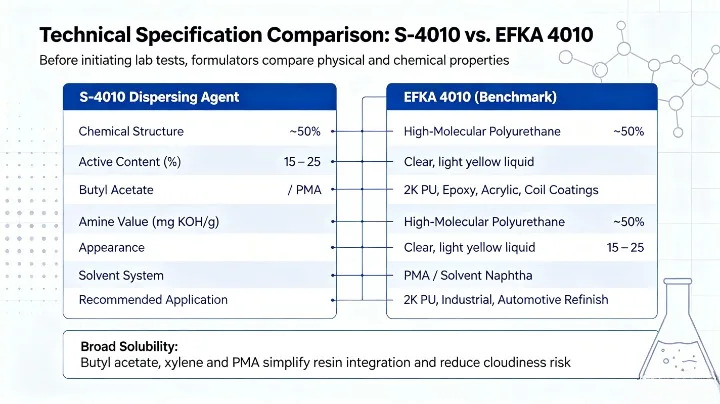
Technical Specification Comparison: S-4010 vs. EFKA 4010
Before initiating lab tests, formulators typically evaluate physical and chemical properties. S-4010 matches EFKA 4010 closely in active content, amine value, and solvent compatibility, making it an ideal candidate for direct replacement.
| Parameter / Specification | S-4010 Dispersing Agent | EFKA 4010 (Benchmark) |
| Chemical Structure | High-Molecular Polyurethane | High-Molecular Polyurethane |
| Active Content (%) | ~50% | ~50% |
| Amine Value (mg KOH/g) | 15 – 25 | 15 – 25 |
| Appearance | Clear, light yellow liquid | Clear, light yellow liquid |
| Solvent System | Butyl Acetate / PMA | PMA / Solvent Naphtha |
| Recommended Application | 2K PU, Epoxy, Acrylic, Coil Coatings | 2K PU, Industrial, Automotive Refinish |
Furthermore, S-4010 exhibits excellent solubility in common industrial solvents, including butyl acetate, xylene, and PMA. This broad compatibility simplifies resin integration without inducing cloudiness or separation.
Laboratory Performance Testing & Comparative Results
To evaluate real-world performance, our application laboratory prepared solvent-borne carbon black millbases and 2K polyurethane topcoat formulations using S-4010 and EFKA 4010 at equal active dosage levels (15% DOP on carbon black).
1. Viscosity Reduction and Grinding Efficiency
Lower millbase viscosity allows higher pigment loadings and reduces milling time in bead mills.
- Initial Millbase Viscosity: S-4010 reduced carbon black millbase viscosity by 42%, matching EFKA 4010 within a ±3% margin.
- Milling Efficiency: S-4010 reached sub-micron fineness (<5 µm) within 45 minutes of bead milling, demonstrating identical dispersion kinetics.
2. Jetness and Gloss Development
Achieving deep jetness with carbon black requires complete pigment deflocculation.
- 60° Specular Gloss: Coatings formulated with S-4010 recorded a 60° gloss value of 93.5 GU, compared to 93.1 GU for EFKA 4010.
- Color Depth (My Value): S-4010 delivered an outstanding blackness rating (My = 264), showing zero haze or surface fogging.
3. Anti-Flooding and Anti-Floating Stability
In mixed-pigment formulations (Titanium Dioxide + Phthalocyanine Blue), unequal pigment mobility causes flooding and floating.
- Rub-Up Test Results: S-4010 showed no visible color difference ($\Delta E < 0.2$) upon rub-up testing, proving robust steric stabilization across organic and inorganic pigment blends.
Storage Stability and Heat Aging
Formulators often worry that alternative dispersants might fail during long-term storage. To address this concern, we conducted a 14-day heat aging test at 50°C for both liquid millbases and finished 2K PU paint samples.
Consequently, both S-4010 and EFKA 4010 preserved stable viscosity curves without gelation, settling, or separation. S-4010 maintained paint flowability and gloss consistency post-aging, proving its reliability for commercial shelf-life requirements.
Cost Optimization: Achieving 15%–25% Raw Material Savings
Beside technical parity, cost efficiency remains a top priority for procurement managers. Switching to S-4010 Dispersing Agent provides tangible economic advantages:
- Direct Unit Cost Reduction: S-4010 offers a competitive unit price, directly trimming additive expenditure by 15% to 25%.
- Improved Processing Throughput: Fast viscosity reduction lowers energy consumption during bead milling.
- Supply Chain Resilience: Local and diversified sourcing reduces lead times and protects production schedules against global logistics disruptions.
Step-by-Step Guide for Drop-in Testing
Replacing an existing additive requires a structured testing methodology. Follow these four steps when evaluating S-4010 in your laboratory:
- Calculate Dosage: Start with a Dosage on Pigment (DOP) ratio based on pigment surface area. We recommend 10%–20% DOP for organic pigments and 15%–35% DOP for high-surface carbon black.
- Pre-dissolve Dispersant: Always add S-4010 into the resin/solvent mix and homogenize thoroughly before introducing dry pigments.
- Conduct Ladder Studies: Test three dosage increments (e.g., 12%, 15%, 18% DOP) to locate the viscosity minimum curve.
- Run Compatibility Checks: Check clear coat compatibility, cure response in 2K systems, and intercoat adhesion.
Conclusion: Upgrade Your Coatings with S-4010 Dispersing Agent
In conclusion, laboratory data confirms that S-4010 Dispersing Agent delivers performance parity to EFKA 4010 across viscosity control, gloss retention, color development, and anti-flooding stability. By adopting S-4010, coating manufacturers can protect product quality while securing substantial cost savings.
Are you ready to optimize your coating formulations and lower production costs? Contact the technical team at SailAdditive today to request your free S-4010 evaluation sample or consult with our additive specialists.