
Cost-Benefit Calculation: How High-Molecular Polyurethane Dispersants Lower Total Milling and Formulation Expenses

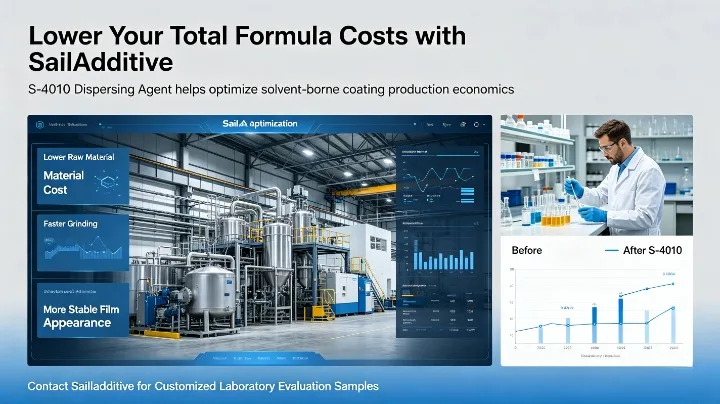
Managing formulation budgets presents a constant challenge for industrial paint manufacturers. Raw material price shifts and rising energy tariffs directly squeeze operational profit margins. Consequently, technical directors and procurement specialists actively seek ways to optimize production costs.
High-performance additives often carry a premium price tag. However, high-molecular-weight polyurethane dispersants deliver systemic value that far outweighs their purchase price. Choosing the right dispersant can lower both direct raw material expenses and indirect processing costs.
To solve this issue, SailAdditive engineered S-4010 Dispersing Agent, a 100% active content modified polyurethane polymer designed for solvent-borne, water-based, and UV coating systems.
In this comprehensive financial breakdown, we analyze the exact math behind additive ROI. Read on to discover how replacing legacy additives with S-4010 can cut your total grinding and formulation costs by 15% to 30%.
Beyond the Unit Price: Calculating Total Cost of Ownership (TCO)
Procurement managers frequently focus solely on the price per kilogram of an additive. Nevertheless, assessing raw material value through unit price alone overlooks major operational costs.
In industrial coating production, total manufacturing expenses depend on three core pillars:
- Raw Material Expenditure: The combined cost of resins, pigments, solvents, and additives.
- Grinding & Energy Efficiency: The electricity and machine hours required to reach targeted fineness.
- Scrap Rates and Quality Rework: The financial losses caused by paint defects like settling, flooding, or gloss loss.
A high-performance dispersant like S-4010 optimizes all three pillars simultaneously. Consequently, formulators achieve lower total production costs per batch.
Industry Benchmarks: S-4010 vs. Market Leaders
Understanding how market alternatives function helps formulators evaluate true financial performance.
The additive market features several established dispersants:
- BASF produces EFKA 4010, a modified polyurethane dispersant widely used in high-end automotive refinishes and coil coatings.
- BYK supplies BYK-161, a high-molecular-weight wetting and dispersing agent designed to deflocculate pigments in solvent-borne systems.
- Evonik offers TEGO Dispers 655, which provides strong viscosity reduction in high-solids industrial topcoats.
While these brands offer strong performance, high pricing inflates total batch expenses. S-4010 Dispersing Agent matches their polymer structure and dispersion power while offering significant price advantages.
Technical Specification Matrix
| Technical Parameter | S-4010 Dispersing Agent PDF | EFKA 4010 (Benchmark) PDF |
| Chemical Structure | Modified Polyurethane Polymer | Modified Polyurethane Polymer |
| Non-Volatile Content | 100% (120°C / 2h) | ~50% (Solvent Cut) |
| Viscosity (25°C, {mm}^2/\{s}) | 1000 – 2000 | 300 – 700 |
| Exterior | Yellow Transparent Liquid | Clear Yellow Liquid |
| Target Pigments | Titanium Dioxide-3, Organics | Inorganic & Organic Pigments |
| Compatible Systems | Solvent-borne, Water-based, UV, Inks | Solvent-borne Industrial |
Note: S-4010 features 100% active non-volatile content. Therefore, formulators achieve greater concentration efficiency per kilogram compared to solvent-diluted options.
Step-by-Step Cost-Benefit Math: 3 Ways S-4010 Saves Money
How exactly does a high-molecular polyurethane dispersant lower your total bill of materials? Let us examine the three financial mechanisms in detail.
[Mechanism 1: Direct Unit Cost] + [Mechanism 2: Higher Pigment Loading] + [Mechanism 3: Shorter Milling Time] = Total Cost Reduction
1. Direct Additive Unit Price Reduction
S-4010 Dispersing Agent supplies 100% active polyurethane chemistry directly from factory production lines.
- Scenario: A paint factory uses 5 tons of dispersant annually for industrial topcoat production.
- S-4010 Cost: 5,000 kg $\9.50/kg
2. Viscosity Reduction and Higher Pigment Loading
Inorganic pigments like titanium dioxide and fillers like calcium carbonate often increase millbase viscosity rapidly. High viscosity forces factories to add extra solvent during grinding, which reduces mill capacity.
S-4010 offers exceptional viscosity-reducing power. Consequently, formulators can increase pigment concentration in the millbase by 5% to 10% without exceeding viscosity limits.
- Higher pigment density means bead mills process more solid pigment per pass.
- Processing more pigment per run lowers the specific solvent consumption per ton of finished paint.
3. Reduced Bead Milling Time and Energy Savings
Agitator bead mills consume substantial electrical power during operation. Furthermore, prolonged milling causes machine wear and heat build-up.
S-4010 significantly enhances dispersion efficiency and wet-grinding speed. It breaks down agglomerates rapidly to reach sub-5-micron fineness.
- Standard Milling Cycle: 60 minutes per batch.
- Optimized Cycle with S-4010: 42 minutes per batch (a 30% reduction in milling time).
- Result: A factory producing 100 batches per month saves 30 machine hours monthly. This cuts mill electricity costs and increases factory throughput by nearly one-third.
Additional Value Drivers: Preventing Quality Defect Costs
Scrapped production batches and customer warranty claims severely damage manufacturer profitability. S-4010 Dispersing Agent acts as an insurance policy against expensive surface flaws.
Eliminating Floating, Flooding, and Mottling
In mixed pigment formulations (such as Phthalo Blue and Titanium Dioxide), unequal particle movement causes floating and mottling. S-4010 provides robust steric stabilization. It anchors securely to pigment surfaces, locking particles into a uniform matrix. This prevents floating defects and eliminates the cost of adding post-fix corrective agents.
Preventing Hard Settling During Storage
Heavy inorganic fillers like calcium carbonate frequently settle at the bottom of paint cans during long warehouse storage. S-4010 features robust anti-settling properties that keep pigments evenly suspended. As a result, product shelf life reaches 24 months, minimizing returned inventory.
Boosting Gloss and Matting Powder Orientation
S-4010 optimizes the spatial distribution of matte powder in low-gloss coatings. In high-gloss topcoats, it boosts surface gloss and clarity. Consequently, paint producers achieve flawless finishes across floor, coil, and automotive applications without purchasing secondary levelling resins.
Practical Dosage & Application Guide
Achieving optimal cost-efficiency requires precise additive dosing. Using too little dispersant causes flocculation, while using too much increases cost unnecessarily.
SailAdditive recommends the following dosage parameters based on total formula weight:
- Standard Coating Formulations: 0.1% to 5.0% of total formula weight.
- UV-Curable & Water-Based Coatings: 0.3% to 1.0% of total formula weight.
- Inorganic Fillers &{TiO}_2: 1.0% to 3.0% on dry pigment weight.
- Organic Pigments & Carbon Black: 10% to 30% on dry pigment weight.
Recommended Incorporation Method
Always add S-4010 Dispersing Agent during the initial paint mixing stage before adding dry pigments. Stir the mixture thoroughly into the resin and solvent phase. This ensures ideal additive distribution before high-shear grinding begins.
Real-World Case Study: Industrial Floor & Coil Coatings
A regional industrial coatings manufacturer sought to reduce production costs across their solvent-borne floor and coil coating product lines.
The Challenge
The customer previously relied on an expensive imported polyurethane dispersant. High raw material costs squished margins, and long milling times created production bottlenecks in their grinding shop.
The Solution
The factory replaced their legacy dispersant with S-4010 Dispersing Agent at an equivalent active level. They incorporated S-4010 during the pre-mixing stage before dispersing titanium dioxide and calcium carbonate fillers.
The Results
- Direct Cost Reduction: Raw material expenditure for dispersants dropped by 23%.
- Milling Efficiency: Millbase grinding time decreased by 25% due to lower viscosity and rapid pigment wetting.
- Coating Quality: Floor coating test panels demonstrated complete anti-settling stability and zero surface mottling.
Storage, Handling, and Supply Chain Security
Securing cost savings requires a stable, long-term supply partner. SailAdditive supports commercial production with flexible supply chain solutions:
- Packaging Options: Supplied in standard 25L drums or 200L plastic/steel barrels.
- Shelf Life: Maintains full performance for 24 months when stored in airtight containers in a cool, dry place.
- Safe Transport: Transports easily as a non-hazardous chemical product.
Lower Your Total Formula Costs with SailAdditive
Slashing formulation expenses does not require compromising on coating performance. By switching to S-4010 Dispersing Agent, industrial paint manufacturers can reduce raw material costs, shorten milling cycles, and prevent film defects across all solvent-borne systems.
The technical specialists at SailAdditive stand ready to calculate your formulation savings and provide customized laboratory evaluation samples.
Are you ready to lower your grinding and formula costs? Contact SailAdditive today to request your free S-4010 testing sample and optimize your factory balance sheet!