
What Are Dispersing Additives?

The Secret to Industrial Coating Stability and Brilliance
In the modern manufacturing of coatings and inks, achieving vibrant colors and long-term stability is a complex challenge. The solution lies in a critical, high-performance additive known as a Dispersing Additive.
What are Dispersing Additives?
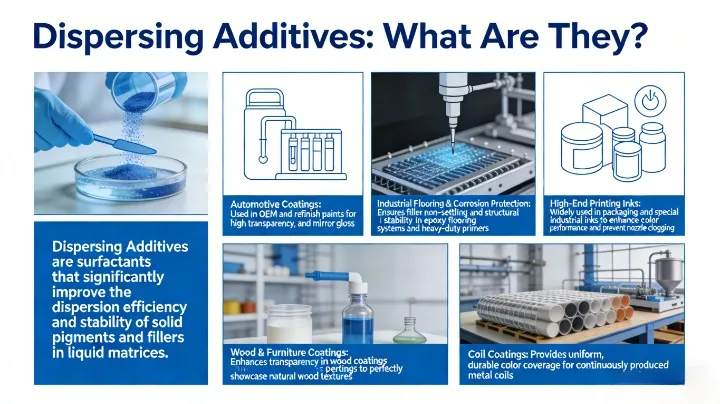
Dispersing additives are specialized surfactants engineered to significantly improve the efficiency of dispersing solid pigments and fillers into a liquid matrix while maintaining their stability. Their primary functions include:
- Ướt: Replacing air and moisture on the pigment surface to allow for better liquid contact.
- De-flocculation: Utilizing advanced steric stabilization (spatial hindrance) to break up pigment clusters and prevent them from re-aggregating.
- Stability: Preventing common surface defects such as settling, sagging, and flooding.
High-quality dispersants, such as those from DongGuan SailAdditive, drastically reduce mill-base viscosity during the grinding process. This not only boosts production efficiency but also enhances surface gloss, color intensity, and transparency.
Core Applications: Products, Processes, and Industrial Fields
Choosing the right dispersing agent is essential for optimizing pigment efficiency across diverse resin systems.
1.Core Systems and Product Categories
Based on the technical standards of DongGuan SailAdditive, dispersants are categorized by their chemical structure and compatibility:
- Solvent-based and Solvent-free Systems: S-110 (a polyphosphate solution) is designed specifically for solvent-based coatings to provide superior anti-settling and anti-sagging properties.
- Modified Polyurethane Technology:
- S-4010: Engineered as a high-efficiency alternative to EFKA 4010, it is optimized for inorganic fillers and pigments like titanium dioxide and calcium carbonate.
- S-9016: A premium agent that enhances fluidity in both water-based and oil-based systems, effectively eliminating haze and color bleeding.
- S-9899: A high-performance polyurethane additive (comparable to EFKA 4061) that utilizes steric stabilization to ensure maximum color brilliance and transparency in solvent-based systems.
2.Key Manufacturing Processes
Dispersing additives are indispensable during several stages of production:
- Pigment Grinding: By lowering the viscosity of the grinding base, these additives reduce grinding time and mechanical energy consumption.
- Paint Mixing and Incorporation: Adding dispersants during the mixing stage ensures optimal distribution and prevents floating or mottling.
- Matte Powder Orientation: Products like S-4010 optimize the orientation of matte powders to achieve a flawless, uniform finish.
3.Broad Industrial Fields
- Automotive Coatings: Used for professional automotive paints where high gloss, color intensity, and structural integrity are critical.
- Industrial Floor Coatings: Essential for epoxy floor systems to prevent pigment settling and ensure stable, high-quality surface treatment.
- Wood and Furniture Coatings: Enhances the transparency and hiding power of coatings used on wood surfaces.
- Inks and Specialized Printing: Applied in high-precision inks to prevent color bleeding and ensure consistent color development.
- Coil and Plastic Coatings: Provides stable, uniform grinds for industrial-scale metal and plastic finishing.
Expert Usage Tips for Optimal Results
For maximum efficiency, dispersing additives should be added during the paint mixing or grinding stage. Recommended dosages generally range from 0.1% to 10% of the total formula, depending on the pigment load and the specific product used