
Defoamer-In-depth professional analysis What It Is, How It Works, and Why It Matters

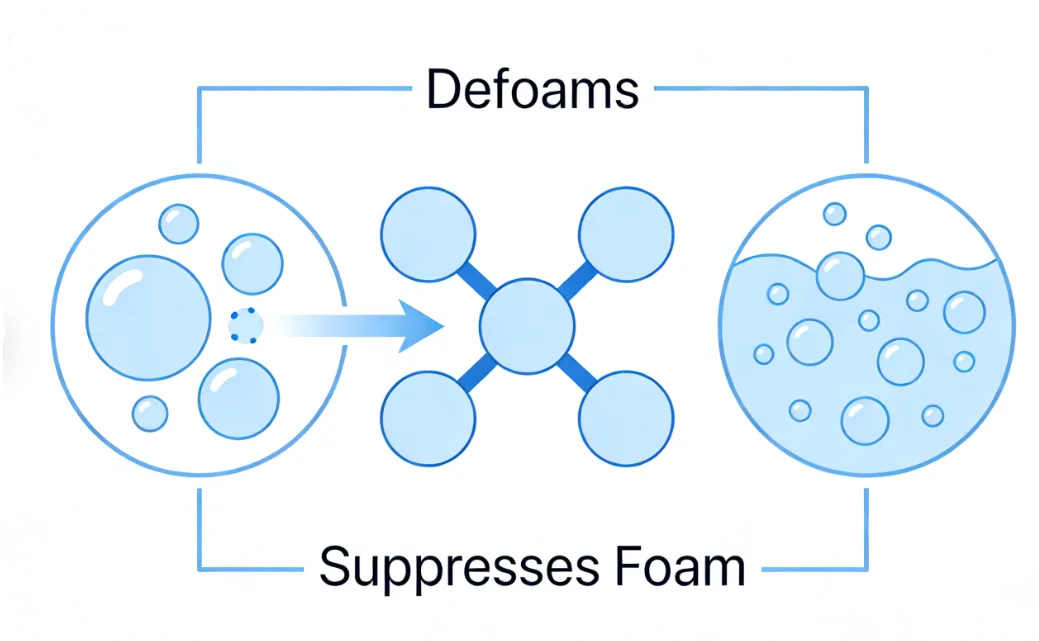
A defoamer is one of those unsung workhorses of modern industry — invisible in the final product but absolutely critical to the process that makes it. Whether you have noticed foam disrupting a wastewater treatment tank, a paint formulation, or a food processing line, the fix almost always involves a defoamer. This article unpacks exactly what a defoamer is, why foam is such a serious problem in industrial settings, and how the right product can protect your process, your equipment, and your bottom line.
By the end, you will understand the chemistry behind foam control, the different types of defoamers available today, and how to select the best option for your specific application. No jargon walls — just clear, practical information for anyone who needs to make better decisions about foam management.
Why Foam Is a Problem Worth Solving
Foam seems harmless — the kind of thing you might associate with bubble baths or cappuccinos. In industrial processes, however, uncontrolled foam is a genuine operational hazard that costs manufacturers time, money, and product quality every single day.
FACT: According to chemical process engineering studies, excess foam can reduce effective reactor and tank capacity by up to 20%, forcing operators to run at lower volumes or risk costly overflows.
The Hidden Costs of Uncontrolled Foam
When foam builds up in a mixing tank, coating line, or fermentation vessel, it does not just look bad. It traps air inside the product, disrupts flow rates, clogs filters, and throws off dosing accuracy. In paper and pulp manufacturing, foam can cause sheet defects and machine shutdowns. In wastewater treatment, it can prevent proper aeration and slow biological processing to a crawl.
The financial impact compounds quickly. Equipment downtime, product waste, energy inefficiency, and labour costs for manual foam removal all add up. Many manufacturers do not realise how much a reliable defoamer could reclaim from those losses until they make the switch.
Why Foam Forms in the First Place
Foam forms when air becomes trapped in a liquid and surface-active agents — known as surfactants — stabilise those air bubbles. Surfactants lower the surface tension of the liquid, creating a film around each bubble that resists breaking. The more turbulent the process (pumping, mixing, agitation), the more foam is generated.
Understanding why foam forms is the first step to controlling it. A well-chosen foam control agent targets those stabilising films directly, making the bubbles collapse before they can accumulate into a problem.
What a Defoamer Actually Does
A defoamer works by disrupting the foam-stabilising film around air bubbles. When it enters the foamy system, it spreads rapidly across the liquid surface and the bubble walls, displacing the surfactants that were holding the structure together. The bubbles then rupture and coalesce, releasing the trapped air.
FACT: The active spreading coefficient of a defoamer must be positive relative to the foaming medium — a principle established in classic surface chemistry that explains why not every compound works in every system.
The Chemistry of Foam Destruction
Most defoamers contain a blend of active ingredients: a hydrophobic carrier (such as a silicone fluid or mineral oil), hydrophobic particles (like silica), and emulsifiers to help the formulation disperse into the target liquid. The hydrophobic particles pierce the foam film; the carrier fluid then spreads and thins the film until it collapses entirely.
This mechanism is fast, efficient, and — when the product is properly matched to the application — requires only very small dosage rates. That is why a defoamer is considered a high-efficiency additive: a tiny amount delivers a large performance return.
Anti-Foam vs. Defoamer: Is There a Difference?
The terms are often used interchangeably, but there is a technical distinction worth knowing. A defoamer is added after foam has already formed, breaking it down reactively. An anti-foam agent is added in advance to prevent foam from forming in the first place. Many commercial products perform both functions, and suppliers frequently use the labels loosely, so it is worth confirming the intended use case with your supplier before purchasing.
Explore our defoamer product range
Types of Defoamers: Key Features to Know
Not all defoamers are created equal. The chemistry, carrier fluid, and particle composition vary significantly across product types, and each has strengths best suited to specific industries and process conditions.
Silicone-Based Defoamers
Silicone defoamers are among the most widely used globally. They are effective at very low concentrations, typically between 0.01% and 0.1% by weight, and perform across a wide range of temperatures and pH levels. They are particularly popular in paints and coatings, adhesives, and industrial cleaning formulations.
The main consideration with silicone defoamers is compatibility. In some coating systems, excessive silicone can cause surface cratering or fish-eye defects. Working with a specialist supplier to select the right silicone grade for your formulation prevents these issues entirely.
Oil-Based Defoamers
Oil-based defoamers use mineral oil, vegetable oil, or white oil as their carrier fluid. They are a cost-effective choice for many water-treatment and paper-manufacturing applications. They are generally easier to formulate and more compatible with a wider range of substrates than silicone alternatives.
FACT: Oil-based defoamers remain the dominant choice in the global paper and pulp industry, where silicone contamination of recycled fibre streams is a known processing concern.
Water-Based (Emulsion) Defoamers
Water-based emulsion defoamers disperse readily into aqueous systems. They are the go-to choice for water-borne coatings, textile processing, and food-grade applications where the carrier oil must remain suspended in a water-continuous phase. They are also easier to handle and dose accurately compared to straight oil-based products.
Powder Defoamers
Powder or solid defoamers are used in dry-mix systems — such as cement, detergent powders, and dry-mortar formulations — where a liquid product would cause handling or shelf-life problems. They activate when the powder is mixed with water during use.
Top Defoamer Categories for Industrial Use
Different sectors have distinct requirements. Here is a practical breakdown of where specific defoamer chemistries deliver the greatest value.
Defoamers for Coatings and Paints
In architectural and industrial coatings, foam control is critical at two stages: during manufacturing (mixing and milling) and during application (brushing, rolling, or spraying). A silicone-free or low-silicone defoamer is often preferred for waterborne coatings to avoid inter-coat adhesion issues. Polymeric defoamers — based on polyether or polyacrylate chemistry — are increasingly popular for their excellent compatibility.
Defoamers for Wastewater Treatment
Wastewater facilities face persistent foam challenges in aeration basins and anaerobic digesters. Here, oil-in-water emulsion defoamers are commonly used because they disperse quickly into large volumes of water. Silicone emulsions are also widely deployed due to their low dosage and effectiveness even in heavily contaminated effluent.
Defoamers for Food and Beverage Processing
Food-grade applications demand defoamers that comply with relevant food safety regulations, such as [EXTLINK: https://www.fda.gov “FDA guidelines for food contact substances”]. Permitted carrier fluids — food-grade white oils, vegetable-based silicones, and polydimethylsiloxane (PDMS) — are used at tightly controlled levels. These products are used in fermentation, sugar processing, edible oil refining, and dairy operations.
How to Choose the Right Defoamer
Selecting the wrong defoamer does not just fail to solve the foam problem — it can introduce new ones, including product defects, process contamination, or regulatory non-compliance. A structured selection approach saves significant trouble.
Match the Chemistry to the System
Start with the continuous phase of your process: is it water-based, solvent-based, or a non-aqueous system? Silicone emulsions work best in aqueous systems. Solvent-borne systems typically require silicone fluids or polymeric defoamers dissolved in a compatible solvent. Matching polarity and solubility between the defoamer and the medium is the most important first step.
Evaluate Performance at Your Process Conditions
Temperature, agitation intensity, pH, and the presence of surfactants in the formulation all affect defoamer performance. Always test under realistic process conditions — not just in a lab shake test — before committing to a product at scale.