
How to Properly Request and Evaluate S-4010 Samples: A Complete Laboratory Dispersion SOP

Evaluating a new high-performance chemical additive requires a systematic, objective testing protocol. Coating formulators, R&D chemists, and laboratory managers frequently request sample quantities of polymeric additives to benchmark performance against legacy products. However, executing an unstructured laboratory trial often yields misleading results. Improper incorporation order, incorrect dosage calculations, or inconsistent grinding times can hide the true technical potential of an additive.
Formulators need a standardized Standard Operating Procedure (SOP) that covers sample request preparation, dosage ladder calculations, millbase grinding parameters, and final film property evaluations.
To streamline your laboratory evaluations and ensure repeatable testing results, SailAdditive developed S-4010 Dispersing Agent, a 100% active content, high-performance modified polyurethane polymer engineered for solvent-borne, water-borne, and UV coating systems.
In this practical testing guide, we outline how to request evaluation samples, share a step-by-step laboratory SOP for evaluating S-4010 Dispersing Agent, and demonstrate how to benchmark its performance against global industry standards.
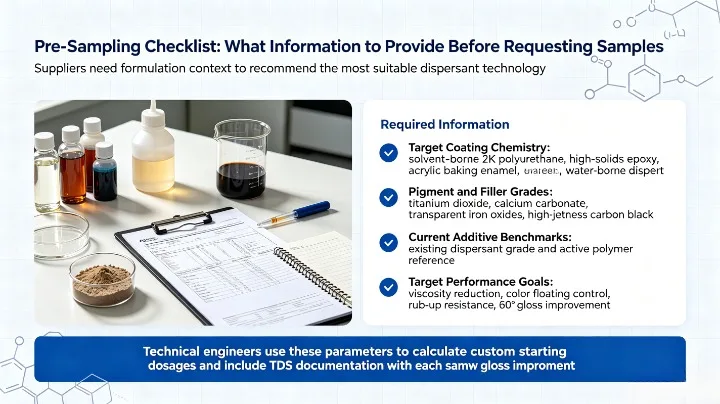
Pre-Sampling Checklist: What Information to Provide Before Requesting Samples
Requesting an additive evaluation sample should involve clear technical communication between your laboratory and the additive supplier.
To ensure SailAdditive ships the exact grade and dosage guidance tailored to your system, provide the following key parameters when submitting your sample request:
- Target Coating Chemistry: Specify whether your system is a solvent-borne 2K polyurethane, high-solids epoxy, acrylic baking enamel, water-borne dispersion, or UV-curable ink.
- Pigment and Filler Grades: Identify specific pigments in your millbase—such as titanium dioxide , calcium carbonate , transparent iron oxides, or high-jetness carbon black.
- Current Additive Benchmarks: Mention your current dispersant grade so technical teams can calculate equivalent active polymer dosages.
- Target Performance Goals: Clarify if your main priority is slashing millbase viscosity, preventing color floating, eliminating rub-up failure, or improving 60° specular gloss.
Providing these details allows SailAdditive technical engineers to calculate custom starting dosages and include detailed technical data sheets (TDS) with your sample shipment.
Market Landscape: S-4010 vs. Leading Industry Alternatives
Evaluating established market additives helps technical teams benchmark polymer efficiency, active non-volatile content, and viscosity reduction against global chemical suppliers.
The industrial coatings market features several prominent polyurethane dispersants:
- BASF manufactures EFKA 4010, a widely recognized modified polyurethane dispersant used in high-performance automotive and industrial coatings.
- BYK produces BYK-161, a high-molecular-weight wetting and dispersing additive engineered to deflocculate organic pigments and carbon black in solvent-borne systems.
- Evonik supplies TEGO Dispers 655, which offers strong viscosity reduction in demanding high-solids solvent-borne formulations.
While these legacy brands deliver high technical performance, S-4010 Dispersing Agent offers a 100% active polyurethane structure with broad system compatibility, providing exceptional formulation flexibility and lower raw material costs.
Technical Data Overview
| Specification / Property | S-4010 Dispersing Agent | EFKA 4010 (Benchmark) |
| Chemical Foundation | Modified Polyurethane Polymer | Modified Polyurethane Polymer |
| Active Non-Volatile Content | 100% (120°C / 2h) | ~50% (Solvent Cut) |
| Viscosity Range (25°C | 1000 – 2000 | 300 – 700 |
| Exterior | Yellow Transparent Liquid | Clear Yellow Liquid |
| Target Pigments | Titanium Dioxide, Organics | Inorganic & Organic Pigments |
| System Compatibility | Solvent-based, Water-based, UV, Inks | Solvent-Borne Industrial Systems |
Step-by-Step SOP: Laboratory Dispersion Evaluation Protocol
Follow this standard 5-step laboratory evaluation protocol when testing S-4010 Dispersing Agent against your current control dispersant:
[Phase 1: Active Dosage Calculation] ➔ [Phase 2: Pre-Mixing Addition] ➔ [Phase 3: High-Shear Bead Grinding] ➔ [Phase 4: Rheology & Fineness Check] ➔ [Phase 5: Film Application & Gloss]
Phase 1: Calculate Active Dosage on Pigment (DOP)
Calculate dispersant addition levels strictly based on Dry Pigment Weight (DOP) rather than total formulation mass.
- Inorganic Pigments & Fillers: Apply 1.0% to 3.0% active DOP.
- Standard Organic Pigments: Apply 10% to 25% active DOP.
- High-Surface Carbon Black: Apply 15% to 30% active DOP.
- The S-4010 Advantage: Because S-4010 delivers 100% active content, active DOP calculations require zero solvent dilution adjustments.
Phase 2: Pre-Mixing Sequence (Pre-Addition Protocol)
Always incorporate S-4010 into the liquid resin and solvent mixture before introducing dry pigment powders.
- Charge carrier solvents and main grinding resins into the stainless steel dispersion beaker.
- Add S-4010 Dispersing Agent directly into the liquid vehicle. Stir at low speed (500 RPM) for 5 to 10 minutes to dissolve the polymer completely.
- Slowly charge dry pigment powders into the liquid under medium agitation (1500 RPM).
Phase 3: Controlled High-Shear Micro-Bead Grinding
Transfer the pre-mixed slurry into a laboratory agitator bead mill or high-speed disperser with glass/zirconia beads:
- Maintain a constant bead-to-millbase weight ratio
- Set cooling water circulation to keep millbase exit temperatures below 45°C.
- Grind for a fixed duration (e.g., 30, 60, and 90 minutes), taking small sampling aliquots at each time interval.
Phase 5: Film Application, Gloss, and Rub-Up Testing
Let down the ground millbase into your main clear resin vehicle. Apply drawdown films onto Leneta cards or glass panels at 100mu{m} wet film thickness:
- Specular Gloss: Measure 20° and 60° specular gloss using a calibrated gloss meter after complete film curing. S-4010 delivers high specular gloss and zero haze.
- Finger Rub-Up Test: Rub a finger across a half-dry film area. Check for color shifts (Delta E < 0.2) to verify anti-floating stability.
Accelerated Thermal Aging and Storage Stability Evaluation
Predicting long-term shelf stability requires subjecting finished paint samples to accelerated thermal stress testing:
- Seal Test Samples: Fill airtight glass jars with 200 mL of freshly tinted paint, leaving minimal headspace.
- Oven Aging: Place sealed jars into a temperature-controlled oven at 50°C for 14 days (equivalent to 12 months of ambient storage).
- Inspect Caking and Viscosity: Remove samples and let them cool to 25°C. Inspect for hard caking, phase separation, or viscosity spikes.
- S-4010 Results: S-4010 maintains soft, easily re-incorporable sediments and stable viscosity across 24 months of storage.
Recommended Formula-Based Dosage Guidelines
If you prefer calculating addition levels based on total formulation weight rather than pigment mass, SailAdditive provides these practical rules of thumb:
- Standard Industrial Coating Formulations: 0.1% to 5.0% of total formulation weight.
- UV-Curable & Water-Based Formulations: 0.3% to 1.0% of total formulation weight.
Packaging, Storage, and Safe Handling Specifications
- Packaging Options: Supplied in standard 25L drums or 200L plastic/steel barrels.
- Storage Conditions: Store in airtight containers for 24 months in a cool, dry place.
- Transportation Safety: Transport S-4010 safely as a non-hazardous chemical product.
Request Your Free S-4010 Evaluation Sample Today
Executing a structured laboratory SOP allows industrial coating manufacturers to verify dispersant efficiency, lower millbase viscosity, and eliminate surface defects with complete scientific confidence. By choosing S-4010 Dispersing Agent, formulators secure 100% active polyurethane chemistry that optimizes pigment dispersion across solvent, water, and UV systems.
The technical specialists at SailAdditive stand ready to assist your lab with custom dosage calculations, testing protocols, and free evaluation samples.
Ready to request your evaluation sample and start your laboratory trials? Contact SailAdditive today to request your free S-4010 evaluation sample and elevate your industrial coating performance!