Solving Gloss Reduction and Haze in Automotive PU Coatings: The Secret to a True Mirror Finish

For automotive research and development (R&D) experts, achieving a perfect topcoat is the ultimate goal. A premium automotive polyurethane (PU) finish must display deep color, rich gloss, and clear reflections. However, even with advanced application technology, a frustrating obstacle often appears during the curing process: micro-haze.
You might look at a freshly dried car panel under direct light and notice a faint, milky cloudiness. This optical defect destroys the coating’s clarity. It reduces the visual depth of the paint and lowers the Distinctness of Image (DOI). If your formulations are losing their competitive edge due to cloudy finishes, you need to look closely at your pigment stabilization chemistry.
This technical guide breaks down why premium finishes develop haze. We will explore how proper deflocculation unlocks elite gloss, and how advanced additives can protect your PU systems from surface defects.
1. Why Premium Automotive Finishes Suffer from Micro-Haze
Micro-haze is a specialized surface defect that directly threatens high-gloss automotive OEM and refinish paints. Unlike macro-defects like orange peel or large craters, micro-haze is an optical problem occurring at a microscopic level. It acts as an invisible killer of surface brilliance.
The root cause of this defect tracks back to pigment flocculation. When raw pigments break down during the grinding phase, they expose immense surface area. If the formulation lacks a sufficiently strong dispersant, these tiny primary particles will immediately attract one another. They form loose cluster networks known as flocculation.
As the polyurethane coating cures, these floating pigment clusters migrate unevenly throughout the film. Some of these micro-clusters settle near or break through the top layer of the wet paint. This migration creates three severe optical problems:
Light Scattering
A perfectly smooth coating surface acts like a mirror, reflecting light rays uniformly in a single direction (specular reflection). When flocculated pigment clusters disturb the surface or sit just beneath it, they create microscopic irregularities. These irregularities scatter the incoming light rays in random directions, creating a visible, cloudy milkiness.
Loss of Deep Jetness
In deep black or dark blue automotive coatings, micro-haze alters the human eye’s perception of color depth. Instead of a rich, bottomless jet-black finish, the scattered light mixes with the true pigment color. This effect makes the coating look dull, faded, or slightly grey.
Reduced Distinctness of Image (DOI)
DOI measures how sharp a reflection appears on a coated surface. Flocculation causes light to diffuse, blur-testing the edges of reflected objects. Instead of a sharp, crisp reflection, the car paint displays a soft, fuzzy image that fails to meet luxury OEM quality control standards.
2. Achieving Mirror-Like Gloss Through Total Pigment Deflocculation
To permanently eliminate micro-haze and capture a mirror-like gloss, your formulation must achieve total pigment deflocculation. This means every individual pigment particle must stay separate and fully stabilized within the polyurethane matrix throughout the entire storage and drying cycle.
Complete deflocculation alters the physical and optical performance of the coating film:
Perfect Specular Reflection
When primary pigment particles are completely separated, they arrange themselves uniformly within the cured resin film. Because they are smaller than the wavelength of visible light, they no longer interfere with light waves. Light passes cleanly through the clear resin matrix or reflects perfectly off the substrate, producing a brilliant, high-gloss surface.
Maximizing Tinting Strength
Deflocculating your pigments unlocks their maximum active surface area. This dramatic expansion in surface exposure optimizes light absorption and scattering efficiency. As a result, you achieve much higher color strength, richer color saturation, and deep color tone using fewer raw pigments.
Exceptional Rheology Control
Flocculated networks trap liquid resin within their structures, which restricts fluid movement and causes the paint’s viscosity to spike uncontrollably. Total deflocculation releases this trapped vehicle, allowing the fluid to flow freely. This improved rheological behavior allows the wet paint layer to self-level rapidly during application, eliminating brush marks and orange peel before the PU cross-links.
3. S-110’s Role in Enhancing Hiding Power and Color Depth
When selecting an additive to eliminate micro-haze in premium automotive topcoats, S-110 Dispersing Additive provides elite performance. S-110 is a high-performance polyphosphate solution specifically engineered to stabilize demanding organic and inorganic pigments in solvent-borne systems.
S-110 functions by anchoring its polar polyphosphate groups tightly onto the pigment surface. These active groups form strong, multi-point chemical bonds that resist displacement during intense grinding phases. Long, solvated polymer tails extend outward from the particle surface into the surrounding polyurethane matrix. This architecture provides excellent steric stabilization (spatial repulsion), preventing particles from clustering together when the paint film flashes off.
Using S-110 in automotive PU coatings yields critical aesthetic and technical benefits:
- Drastic Reduction in Micro-Haze: By keeping particles perfectly separated, S-110 prevents the light scattering that causes cloudiness. This action ensures absolute film clarity and a pure mirror finish.
- Enhanced Transparency in Effect Pigments: In automotive metallic or pearlescent coatings, S-110 promotes the clean dispersion of effect pigments. It ensures that the color clear coat stays transparent, showcasing the true metallic flake reflection without any muddy interference.
- Boosted Hiding Power and Color Depth: Maximizing particle distribution allows S-110 to enhance the paint’s opacity and coverage efficiency. Dark colors, especially jet-blacks and deep blues, achieve a richer look and increased color depth.
4. Global Benchmarks: Meeting the Standards of High-End Finishings
Formulation scientists often look toward recognized global brands when choosing surface additives for high-end automotive applications. For example, Evonik Degussa’s TEGO® Dispers series enjoys a strong international reputation for its ability to control pigment stability and surface quality in professional automotive coatings.
However, modern manufacturing plants face constant challenges from rising raw material costs, rigid corporate pricing structures, and long delivery lead times from multinational suppliers.
SailAdditive’s S-110 provides an exceptional peer-performing alternative. It is tailored specifically to meet or exceed these high global benchmarks while offering excellent cost-efficiency and logistics reliability.
While the TEGO® Dispers range includes various specialized polymeric dispersants for architectural and industrial paints, S-110 offers a highly focused, highly compatible solution for solvent-borne and solvent-free polyurethane matrices. It provides the same dependable deflocculation power and anti-flooding protection as traditional premium lines.
By integrating S-110 into your R&D framework, you achieve international quality standards for color development and DOI. Simultaneously, your procurement team gains a reliable, agile supply partner that helps lower your total cost per batch.
5. Formulating with 100% Non-Volatile Matter for Stable Systems
Modern automotive and industrial coating regulations increasingly demand lower volatile organic compound (VOC) levels. This regulatory shift forces formulators to design high-solids and solvent-free coatings. Under these conditions, the physical parameters of your additives become a critical factor for success.
A major technical advantage of S-110 is its 100% non-volatile matter content. Unlike standard commercial dispersing agents that are diluted with aromatic hydrocarbons, glycol ethers, or acetates, S-110 contains zero carrier solvents. It is delivered as a pure, active polyphosphate polymer.
This 100% solids profile provides three critical engineering benefits for high-performance PU paint systems:
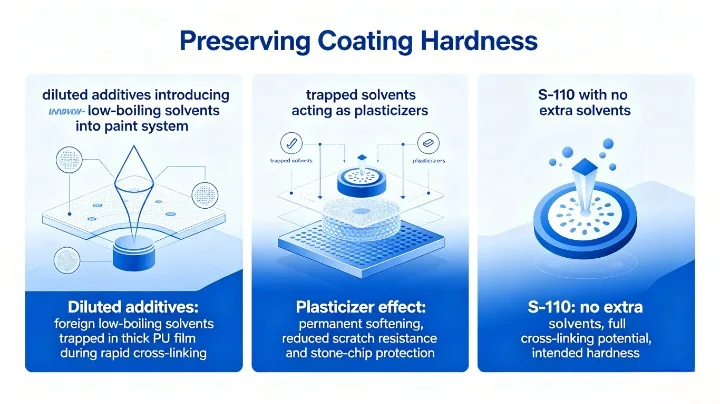
Preserving Coating Hardness
Diluted additives introduce foreign, low-boiling solvents into your paint system. If these solvents become trapped inside a thick PU film during rapid cross-linking, they act as plasticizers. This trapping effect can permanently soften the coating, reducing its scratch resistance and stone-chip protection. S-110 introduces no extra solvents, allowing the polyurethane to reach its full cross-linking potential and intended hardness.
Long-Term Weathering and Gloss Retention
Trapped carrier solvents can slowly migrate out of a cured automotive film over months of exposure to sunlight and outdoor heat. This migration creates micro-voids that encourage moisture penetration, leading to premature chalking, blistering, and gloss reduction. S-110 ensures a dense, chemically stable polymer network that maintains its high-gloss mirror finish over years of environmental exposure.
Simplified VOC Compliance
When you use S-110, you do not need to calculate or account for hidden solvent contributions from your raw material additives. This makes it much easier for your R&D team to hit strict low-VOC targets in high-solids coatings, saving time during product certification processes.
Application Guidelines
To ensure complete stability and maximum gloss, incorporate S-110 during the paint mixing stage before adding raw pigment powders. For general industrial and automotive PU formulations, the recommended dosage is 0.2% to 10% of the total formula weight, depending on your organic-to-inorganic pigment ratio.
Conclusion: Eliminate Haze and Elevate Your Brand
Micro-haze and gloss reduction are expensive problems that can damage your product’s reputation in the premium automotive market. By switching to a high-purity, 100% active polyphosphate dispersant like S-110, you give your polyurethane coatings the advanced steric stabilization they need to achieve ultimate image clarity.
Stop compromising on color depth and surface brilliance. Upgrade your formulation’s fluid dynamics and secure a lasting mirror finish with precision chemistry.
Ready to eliminate micro-haze and optimize your formulation costs? Visit SailAdditive.com to explore our complete raw material catalog, or connect directly with our technical support engineers at 86-13713141735 to request a sample of S-110 today.