
How to Lower Mill-Base Viscosity During Pigment Grinding: The Ultimate Guide to Production Efficiency

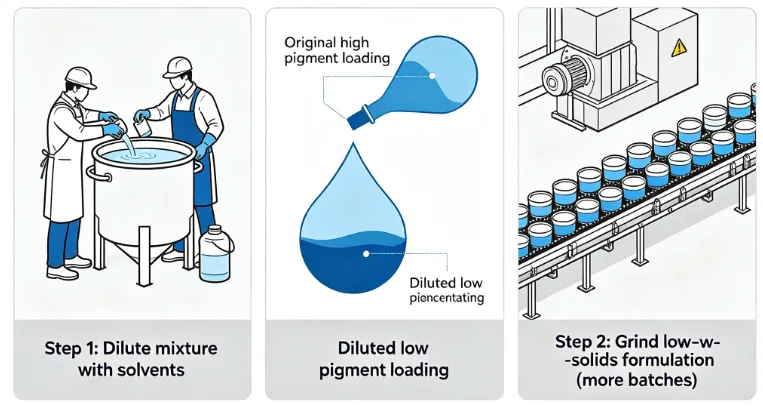
In industrial paint and ink manufacturing, the pigment grinding stage is the most energy-intensive and time-consuming part of the process. Plant managers and formulation chemists constantly work to optimize this step. Their goal is clear: achieve a stable, fine particle dispersion as quickly as possible.
However, a common physical bottleneck often slows down production: high mill-base viscosity.
When a mixture becomes too thick during grinding, efficiency drops sharply. Machinery works harder, processing times double, and costs climb. If you want to maximize your output, learning how to lower mill-base viscosity is essential.
This comprehensive guide explores the financial and mechanical impacts of viscosity during pigment grinding. We will analyze the physics of fluid resistance and introduce advanced rheology control solutions to accelerate your manufacturing pipeline.
1. The Economic Impact of High Viscosity in the Grinding Process
From the perspective of procurement managers and production supervisors, high viscosity is not just a technical inconvenience. It is a direct drain on factory profitability. When a mill base turns into a thick, sluggish paste inside the bead mill, it triggers several costly operational problems.
Wasted Production Capacity
High viscosity severely restricts fluid mobility inside the sand mill or horizontal bead mill. Because the thick liquid flows slowly, the equipment takes much longer to achieve the target particle size. This extended processing time creates a massive bottleneck, reducing the total volume of paint your factory can produce per shift.
Rising Energy Costs
Shearing a high-viscosity fluid requires a tremendous amount of mechanical force. Motors must draw significantly more electrical power to rotate the milling shafts and move the grinding media through the thick paste. In an era of volatile energy prices, this increased electricity consumption directly erodes your gross margins.
Equipment Wear and Temperature Spikes
Thick mill bases generate massive internal friction during high-speed shearing. This friction converts mechanical energy into intense heat, causing the temperature of the mill base to spike. High temperatures can damage heat-sensitive pigments, degrade the resin matrix, and accelerate the wear and tear on expensive milling beads and machine liners.
Ultimately, failing to control viscosity forces your facility to run below its true potential while paying more for maintenance and energy.
2. Mechanics of Reducing Resistance in High-Solid Resin Matrices
To understand how to lower viscosity, you must look at the microscopic forces acting inside high-solids and solvent-free resin matrices.
When you add raw pigment powder to a liquid resin, the particles are not separate. They exist as tightly bound clusters called agglomerates. As the milling media strikes these clusters, it breaks them down into smaller, primary particles.
This reduction in particle size creates a massive increase in total surface area. Suddenly, there is not enough free resin available to wet and cushion the newly exposed particle surfaces.
Without immediate stabilization, the raw particles experience strong Van der Waals forces of attraction. They begin to stick together, forming temporary, loose networks. This internal structure traps liquid within its micro-voids, increasing fluid resistance and causing the mill-base viscosity to skyrocket.
Advanced wetting and dispersing additives break this cycle through precise surface chemistry. These molecules contain highly polar anchoring groups that attach firmly to the pigment surface, combined with organic tails that extend into the surrounding resin matrix.
By wrapping each primary particle in a protective chemical layer, the additive replaces the attractive forces with powerful steric hindrance (spatial repulsion).
Because the particles can no longer attract one another, the internal fluid networks collapse. The pigment particles glide past each other with minimal friction. This mechanical shift dramatically lowers fluid resistance, allowing high-solid and solvent-free resin matrices to remain highly fluid even at maximum pigment loading.
3. Boosting Production Throughput with Active Rheology Control
When searching for an additive that provides active rheology control in solvent-borne systems, S-110 Dispersing Additive delivers exceptional industrial performance. S-110 is a specialized polyphosphate solution designed to maximize grinding efficiency.
By offering absolute pigment deflocculation through spatial hindrance, S-110 acts as a highly effective viscosity reducer. This active rheology control provides three major operational advantages on the factory floor:
- Increased Pigment Loading: Lowering the internal friction of the mill base allows you to pack significantly more pigment into each grinding batch. This high-solids capability means you can produce more concentrated color pastes in fewer production cycles.
- Higher Bead Mill Filling Rates: Sluggish pastes force operators to run mills at reduced speeds to prevent blockages. Because S-110 keeps the fluid highly mobile, you can increase the bead mill filling rate and run the equipment at maximum flow velocity.
- Rapid Heat Dissipation: A thinner fluid transfers heat much more efficiently to the mill’s cooling jacket. S-110 prevents dangerous temperature spikes, protecting your raw materials and extending the working life of your machinery.
4. Peer Performance: How Market Standards Manage Grinding Efficiency
Formulators often look to established global brands when benchmark testing rheology and grinding additives. For instance, Dow Chemical’s TAMOL™ Dispersants are highly regarded in the industry, having spent decades optimizing sand mill efficiency and pigment wetting primarily within water-borne and specialized industrial coating systems.
However, when working with demanding, low-VOC, solvent-borne, or solvent-free industrial matrices, formulators need an additive tailored for high-solids environments. This is where SailAdditive’s S-110 shines as an elite peer performer.
| Performance Factor | Water-Borne Industry Standards | SailAdditive S-110 |
| Primary System Fit | Aqueous / Emulsion Paints | Solvent-Borne / Solvent-Free Epoxy & PU |
| Active Content | Varied (Often Diluted) | 100% Non-Volatile Matter Content |
| Viscosity Range ($25^{\circ}C$) | Low to Medium | 30–80 $mm^2/s$ (Highly Fluid) |
| Core Mechanism | Electrostatic / Polyelectrolyte | Steric / Polyphosphate Anchor |
While aqueous standards excel in their respective fields, S-110 provides unmatched降粘 (viscosity reduction) capabilities in highly viscous solvent systems. S-110 features a 100% active solids profile, meaning it contains zero volatile organic compounds or carrier solvents.
Every drop you add is pure, functional polymer that actively works to lower resistance. This allows procurement and R&D teams to achieve premium rheology control and exceptional color development while maintaining a highly competitive cost-per-kilogram ratio.
5. Step-by-Step Incorporation Tips at the Pre-Mix Stage
To achieve the lowest possible mill-base viscosity, you must introduce your dispersing additive using the correct sequence. Adding the chemical at the wrong stage can result in incomplete pigment coverage and wasted raw materials.
Follow this professional step-by-step procedure during the pre-mix phase to ensure optimal distribution and strong chemical anchoring:
Step 1: Charge the Solvents and Binder
Add your carrier solvents and a portion of your grinding resin into the pre-mix vessel. Stir at low speed to create a completely homogenous liquid phase.
Step 2: Incorporate the S-110 Additive
Add the calculated dose of S-333 or S-110 directly into the liquid resin blend before adding any dry powders. Mix at a moderate speed for 5 to 10 minutes. This step ensures that the polyphosphate anchoring groups are fully dissolved and ready to interact with the incoming pigments.
Step 3: Introduce Dry Pigments and Fillers
Slowly pour your raw pigments and inorganic fillers into the vortex under mechanical agitation. Because S-110 is already present in the liquid, it wets the particle surfaces immediately as they enter the fluid, preventing the formation of hard, dry agglomerates.
Step 4: High-Speed Pre-Dispersion
Increase the mixer speed to create a strong vortex and run for 15 to 20 minutes. This high-shear pre-mix breaks down the largest pigment chunks, allowing S-110 to anchor permanently across the freshly exposed surfaces.
Step 5: Transfer to the Bead Mill
Pump the highly fluid pre-mix into your horizontal bead mill for final grinding. Because you successfully controlled the rheology during the pre-mix stage, the mill base will slide through the grinding chamber with minimal resistance, drastically reducing your total milling time.
Recommended Technical Dosages
To maintain a stable system, always calculate your S-110 dosage based on the total weight of the pigments:
- Inorganic Pigments & Fillers: 1% – 4% of pigment weight.
- Organic Pigments: 10% – 30% of pigment weight.
- Carbon Blacks: 30% – 50% of pigment weight.
- Total Formulation Approach: For general industrial coatings, include 0.2% to 1% of S-110 based on the total formula weight.
Conclusion: Accelerate Your Production Line
High mill-base viscosity is an expensive obstacle, but it is entirely preventable. By implementing active rheology control with a 100% active polyphosphate dispersant like S-110, you eliminate internal friction, lower energy usage, and unlock the true capacity of your milling equipment.
Stop wasting time and money on long, sluggish grinding cycles. Upgrade your fluid dynamics and maximize your factory throughput with precision chemistry.
Ready to optimize your grinding efficiency? Visit SailAdditive.com to explore our complete technical catalog, or contact our application specialists directly at 86-13713141735 to request a sample of S-110 today.