Improving Scratch Resistance: How to Make Your Coatings Last Longer

In the competitive world of industrial finishes, a beautiful surface is only the beginning. The true test of quality is how well that surface stands up to daily wear and tear. If you are wondering how to make paint scratch resistant or looking to improve coating hardness and slip, you need to focus on surface chemistry.
ตอน SailAdditive, we specialize in high-performance solutions that protect your products from the first touch to years of use.
1. The Science of Surface Slip and Friction Reduction
Scratch resistance is directly linked to how objects interact with a surface. When a sharp object hits a high-friction coating, it “catches” and digs into the film, creating a permanent mark. However, if you reduce the surface friction, the object simply glides across without causing damage.
By using specialized additives, formulators can manipulate the molecular structure of the coating’s surface. High-performance polymers migrate to the top layer, creating a microscopic “slip” effect that deflects physical energy. This reduction in friction is the primary defense against abrasions.
2. How S-333 Creates a Protective “Shield” for Furniture
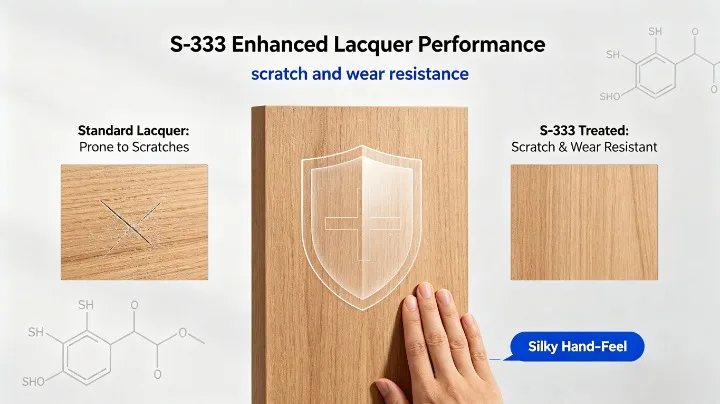
Furniture coatings face constant mechanical stress from sliding plates, keys, and cleaning tools. S-333 is a high-performance polyether-modified polydimethylsiloxane copolymer specifically engineered to protect these delicate surfaces.
When added to your formulation, S-333 significantly reduces the coefficient of friction. This creates a protective “shield” that enhances the silky “hand-feel” of the wood while providing excellent scratch and wear resistance. It transforms a standard lacquer into a premium, durable finish that maintains its beauty under pressure.
3. Reducing the Coefficient of Friction in Industrial Finishes
Industrial finishes often require a balance of aesthetics and extreme durability. S-333 serves as a high-efficiency alternative to industry benchmarks like BYK-333, offering professional-grade slip for diverse systems.
By lowering the surface tension and improving surface slipperiness, S-333 ensures that industrial parts—from automotive components to metal containers—remain defect-free. This technical advantage is critical for maintaining structural integrity in high-performance multi-coat processes.
4. Testing Scratch Resistance: Real-World Lab Results
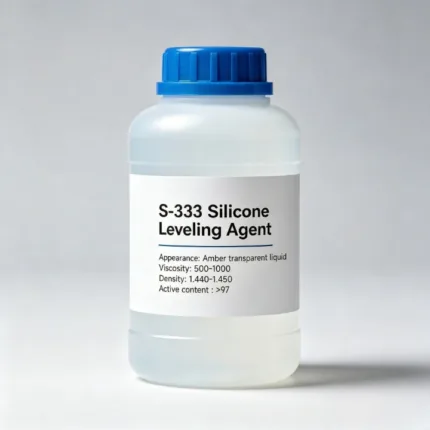
Technical data provides the foundation for trust. According to the S-333 TDS, this additive maintains a consistent density of 1.440-1.450 and a viscosity of 500-1000 $mm^2/s$ at $25^{\circ}C$. These parameters ensure it remains active at the liquid-air interface as the coating dries.
In laboratory settings, coatings treated with S-333 show a measurable decrease in surface friction. This translates to fewer surface defects like shrinkage cavities or fish-eyes. Because S-333 is highly compatible across UV, solvent-based, and aqueous systems, it delivers reliable results regardless of your resin base.
5. Long-Term Durability for High-Traffic Surfaces
For high-traffic environments like flooring, cabinetry, and automotive interiors, durability is non-negotiable. S-333 does more than just stop scratches; it also provides anti-blocking properties. This prevents coated surfaces from sticking together when stacked, which is vital for fast-moving production lines.
With a recommended dosage of only 0.05% to 0.3% for standard formulas, S-333 is a cost-effective way to ensure long-term durability. It preserves the gloss and clarity of your finish while ensuring the surface remains “easy-to-clean” and resistant to daily abrasion.
Conclusion: Elevate Your Surface Protection
Achieving a scratch-resistant finish doesn’t have to be a struggle. By focusing on slip and friction reduction with S-333, you can deliver a product that feels premium and lasts longer.
Ready to protect your finish? Visit SailAdditive.com to explore our technical catalog or contact our team to request a sample of S-333 today.