
Understanding High-Molecular Polyurethane Dispersants: How Active Content and Anchoring Groups Impact Pigment Dispersion

Selecting the right dispersant determines the ultimate performance of high-end industrial coatings. Paint formulators evaluate technical properties—such as active content, amine value, viscosity, and polymer architecture—before introducing any new additive into a commercial formula. These technical metrics directly dictate how effectively the dispersant wets pigments, lowers millbase viscosity, and prevents particle re-agglomeration during storage.
High-molecular-weight polyurethane dispersants stand out as the industry standard for stabilizing difficult pigments. However, understanding how active polymer content and chemical anchoring groups function at the molecular level allows formulators to optimize their coatings effectively.
To solve common formulation challenges, SailAdditive developed S-4010 Dispersing Agent, a 100% active content, modified polyurethane polymer designed for solvent-based, water-based, and UV coating systems.
In this technical breakdown, we examine how active content and anchoring mechanisms influence pigment dispersion, and why S-4010 serves as a powerful, cost-effective tool for paint formulators.
The Molecular Mechanism: How Polyurethane Dispersants Work
Pigment particles in raw powder form tend to cling together through strong van der Waals forces. Without proper chemical stabilization, these agglomerates cause high millbase viscosity, severe flooding, color floating, and loss of gloss.
High-molecular Polyurethane Dispersants stabilize pigments through a two-part molecular structure:
- Pigment-Affinic Anchoring Groups: These chemical heads (such as amines or carboxyls) attach firmly onto the surface of organic pigments or inorganic fillers like titanium dioxide.
- Solvent-Compatible Polymeric Chains: These long-chain tails extend outwards into the resin matrix. They create a physical buffer around each particle—a mechanism called steric stabilization.
Consequently, steric stabilization prevents pigment particles from colliding and re-agglomerating. This steric barrier ensures long-term storage stability and maintains a smooth, uniform grind.
Peer Benchmarks: S-4010 vs. Market Alternatives
Evaluating established market additives helps technical teams benchmark polymer efficacy and formulation fit.
The industrial coatings market features several prominent polyurethane additives:
- BASF manufactures EFKA 4010, a classic modified polyurethane dispersant used in high-performance automotive and industrial coatings.
- BYK produces BYK-161, a high-molecular wetting and dispersing additive engineered to deflocculate organic pigments and carbon black.
- Evonik supplies TEGO Dispers 655, which excels at viscosity reduction in demanding high-solids solvent-borne formulations.
While these legacy brands offer reliable performance, S-4010 Dispersing Agent delivers comparable polyurethane chemistry at 100% active concentration, offering exceptional flexibility and cost savings for modern paint labs.
Technical Data Overview
| Specification / Property | S-4010 Dispersing Agent PDF | EFKA 4010 (Benchmark) PDF |
| Chemical Structure | Modified Polyurethane Polymer | Modified Polyurethane Polymer |
| Non-Volatile Matter Content | 100% (120°C / 2h) | ~50% (Solvent Cut) |
| Viscosity (25°C, $\text{mm}^2/\text{s}$) | 1000 – 2000 | 300 – 700 |
| Exterior | Yellow Transparent Liquid | Clear Yellow Liquid |
| Target Pigments | Titanium Dioxide, _3, Organics | Inorganic & Organic Pigments |
| System Compatibility | Solvent-based, Water-based, UV, Inks | Solvent-borne Industrial |
The Role of Active Content: Why 100% Non-Volatile Content Matters
Many commercial dispersants arrive pre-diluted in organic solvents like xylene or PMA. While solvent cuts reduce raw liquid viscosity, supplying a 100% active content polymer—like S-4010 Dispersing Agent—offers distinct formulation advantages:
1. Complete Solvent Flexibility
Pre-diluted additives force formulators to introduce specific carrier solvents into their systems. In contrast, S-4010 contains 100% active non-volatile matter. Formulators can choose their preferred solvent matrix—whether ester, ketone, aromatic, or water-borne—without carrier solvent interference.
2. Lower Transportation and Storage Costs
Shipping solvent-diluted additives means paying to transport carrier solvents across global supply chains. Because S-4010 delivers 100% active polyurethane polymer, factories purchase less fluid volume per batch. This efficiency lowers freight fees and saves storage space in your warehouse.
3. High Efficiency in Low-VOC Formulations
Modern environmental regulations strictly limit volatile organic compounds (VOCs). Using a 100% active polyurethane dispersant allows technical teams to maximize active polymer dosage without exceeding tight VOC allowances.
How Anchoring Groups Impact Dispersion Efficiency and Viscosity
The strength and density of a dispersant’s anchoring groups directly control how well it stabilizes pigments in high-shear milling.
[Strong Anchoring Attachment] ➔ [Complete Particle Coverage] ➔ [Dramatic Viscosity Drop] ➔ [Flawless Gloss Development]
1. Rapid Viscosity Reduction
When pigments mix into a resin solution, uncovered particles create a stiff, high-viscosity paste. S-4010 Dispersing Agent rapidly wets pigment surfaces, lowering millbase viscosity significantly. This dramatic viscosity drop allows formulators to increase pigment solids in the bead mill, shorten grinding cycles, and cut energy consumption.
2. Targeted Performance for Inorganic Fillers and Titanium Dioxide
Inorganic pigments like titanium dioxide and calcium carbonate) carry high surface energies. S-4010 features specialized modified polyurethane anchoring sites specifically optimized for inorganic surfaces. It ensures a stable, uniform grind, preventing settling even in low-viscosity floor and coil coatings.
3. Prevention of Color Floating, Flooding, and Mottling
When a coating contains a blend of light inorganic pigments and dense organic pigments, particles often separate during film drying. S-4010 locks different pigment types into a cohesive, non-flocculating matrix. Consequently, it effectively prevents floating, flooding, and mottling in demanding automotive, plastic, and industrial finishes.
4. Optimized Matte Powder Orientation and Boosted Gloss
Surface appearance defines coating quality. In clear coats and high-gloss topcoats, S-4010 boosts surface gloss and clarity. Conversely, in low-gloss or satin coatings, it optimizes the spatial orientation of silica matting powders, producing consistent, haze-free finishes.
Dosage and Incorporation Best Practices
Achieving the ideal balance between active content and pigment surface area requires precise dosing. SailAdditive recommends the following application guidelines:
- Standard Coating Systems: 0.1% to 5.0% of the total formulation weight.
- UV & Water-Based Formulations: 0.3% to 1.0% of the total formulation weight.
- Titanium Dioxide and Fillers: 1.0% to 3.0% calculated on dry pigment weight.
- Organic Pigments and Carbon Black: 10% to 30% calculated on dry pigment weight.
Correct Incorporation Sequence
Always incorporate S-4010 Dispersing Agent during the paint mixing stage before adding dry pigment powders. Stir the mixture thoroughly to dissolve S-4010 evenly throughout the liquid resin phase. This pre-mixing step guarantees optimal additive distribution before high-shear grinding begins.
Versatile Industrial Application Scenarios
Because S-4010 functions as a universal dispersant, technical teams can deploy it across diverse coating sectors:
- Automotive Coatings: Enhances color brilliance, jetness, and gloss in OEM and refinish coatings.
- Рулонные покрытия: Maintains film flexibility and high gloss during high-temperature baking cycles.
- Floor Coatings: Prevents heavy filler settling and eliminates surface mottling.
- Wood and Plastic Coatings: Improves transparency, matting powder distribution, and color clarity.
Packaging, Shelf Life, and Safe Handling
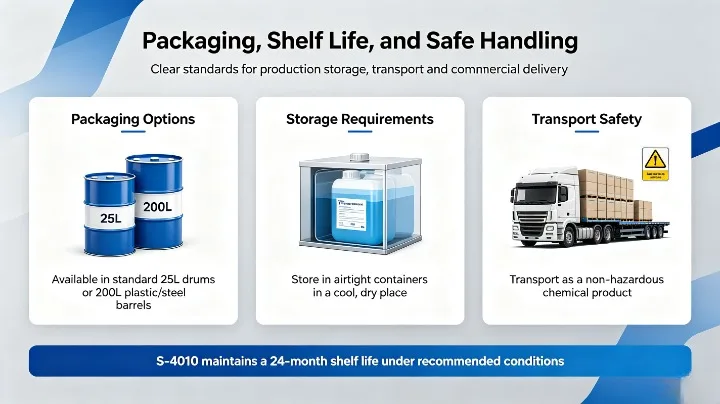
SailAdditive supports commercial production with convenient packaging and clear handling standards:
- Packaging Options: Available in standard 25L drums or 200L plastic/steel barrels.
- Storage Requirements: Store in airtight containers in a cool, dry place. S-4010 maintains a 24-month shelf life under recommended conditions.
- Transport Safety: Transport S-4010 safely as a non-hazardous chemical product.
Elevate Your Coating Formulations with S-4010
Mastering the balance between active content and polymer anchoring allows paint manufacturers to create superior coatings at lower costs. By adopting S-4010 Dispersing Agent, formulators secure rapid pigment wetting, lower millbase viscosity, and complete film defect prevention across solvent, water, and UV systems.
The technical specialists at SailAdditive stand ready to assist your team with dosage calculations, ladder trials, and free laboratory evaluation samples.
Ready to optimize your pigment dispersion and lower formulation costs? Contact SailAdditive today to request your free S-4010 sample package and start your laboratory testing!