
How to Choose Additives for Flow, Wetting, Dispersion, and Surface Performance

Quick Answer
Coating and ink additives should be chosen by the formulation problem they need to solve, not by product name alone.
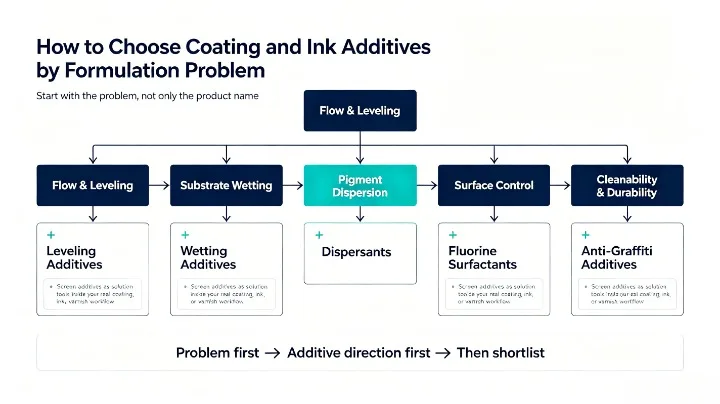
In practical buying terms, the main decision path usually starts with one of five questions: Do you need better flow and leveling, better substrate wetting, more stable pigment dispersion, tighter surface control, or stronger cleanability and anti-graffiti performance? That is the useful role of the Sailadditive Coating and Ink Additives line.
Instead of treating additives as a flat, confusing raw-material list, buyers should screen them as solution tools inside a real coating, ink, or varnish workflow. A UV ink project with pigment instability should not start from the same shortlist as a high-gloss coating project with poor leveling, and neither should use the same first additive review as a difficult plastic-film wetting problem.
What Coating and Ink Additives Actually Solve
Most additive selection problems come from one of the following five formulation pressures:
Flow and Leveling: The coating or ink does not lay down evenly, leaves brush marks/orange peel, or shows gloss inconsistency.
Substrate Wetting: The liquid does not spread well on film, plastic, metal, or other low-surface-energy substrates.
Pigment Dispersion & Color Stability: The system struggles with color development, floating, flooding, storage stability, or grind consistency.
Surface Control: The system needs tighter behavior around crater resistance, repellency, slip, stain resistance, or special surface response.
Cleanability & Durability: Decorative or industrial surfaces need better resistance to contamination, marking, or difficult cleaning environments.
⚠️ Buyer’s Note: If you are choosing additives without first deciding which of those problems matters most, your shortlist usually becomes noisy, chaotic, and expensive.
How to Choose Additives by Formulation Problem
Formulation Problem
First Additive Direction to Review
Why It Belongs Early in R&D
Poor flow, uneven gloss, or surface texture
Leveling Additives
They help evaluate surface uniformity, flow behavior, and appearance control first.
Poor spreading on plastic, film, or metal
Wetting Additives
They belong early when substrate coverage and edge wetting are the real bottlenecks.
Pigment instability or color-strength inconsistency
Dispersants
They are the most direct route when pigment behavior is driving storage or print-performance risk.
Extreme surface tuning or difficult defect control
Fluorine Surfactants
They fit more specialized surface-control work where standard routes are not enough.
Need for better cleanability or anti-graffiti behavior
Anti-Graffiti Additives
They belong when final surface-use conditions matter as much as basic application performance.
Deep Dive: The 5 Selection Paths
1. When to Start with Leveling Additives
Leveling additives deserve early review when the main issue is not adhesion or pigment stability, but appearance and film laydown. This typically includes high-gloss systems, decorative coatings, premium packaging varnishes, and other formulations where surface texture is commercially visible.
The current Sailadditive line already includes a dedicated leveling agent branch, featuring premium grades such as Sailadditive. This is the right first route when the job is to improve flow-out, gloss consistency, or surface smoothness rather than to repair pigment wetting.
2. When to Start with Wetting Additives
Wetting additives move to the front when the real problem is substrate coverage. If the system pulls back on film, struggles on low-surface-energy material, or shows uneven edge coverage on metal or plastic, a wetting route should usually be reviewed before changing broader resin or pigment choices.
Sailadditive separates this into a dedicated wetting agent branch. Buyers working across coatings and inks on plastic films, flexible packaging structures, or difficult decorative surfaces should always keep this route high on their shortlist.
3. When to Start with Dispersants
Dispersants are the stronger first move when the formulation problem is driven by pigment behavior. Typical signs include unstable color development, grind inconsistency, floating or flooding, storage drift (viscosity or color shift), or poor pigment distribution in higher-loaded systems.
The Sailadditive structure includes a highly robust dispersant branch with solutions like Sailadditive. For pigmented coatings and inks—especially where repeatability matters more than just first-pass appearance—this is often the most commercially useful first screening direction.
4. When Fluorine Surfactants Belong in the Shortlist
Fluorine surfactants are a more specialized route, but they become crucial when the standard silicone or acrylic additive toolbox is not enough. That can happen in systems with persistent surface defects, special oil/water repellency needs, extreme wetting demands, or unusual substrate/surface behavior.
Sailadditive® Fluorine Surfactants (such as Sailadditive) are engineered specifically for these extreme environments. These should usually be treated as a targeted surface-performance route, not the default first answer for every basic coating or ink issue.
5. When Anti-Graffiti Additives are the Better Fit
Anti-graffiti additives belong earlier when the buyer’s target is not only application performance, but also how the finished surface behaves in use. Decorative panels, infrastructure coatings, exposed industrial surfaces, and public-facing systems may need stronger cleanability or resistance to permanent markers and spray paint.
Sailadditive® features a dedicated anti-graffiti additive branch, including advanced products like Sailadditive. This route is narrower but commercially vital when the project’s success depends entirely on long-term surface maintenance and easy stain removal.
5 Selection Strategies for Coating and Ink Buyers
Start with the dominant failure mode: Do not begin with a long, mixed list of samples. Decide whether your primary bottleneck is flow, wetting, dispersion, or final-surface behavior.
Separate appearance problems from pigment problems: A coating that levels poorly and an ink that disperses poorly may both look bad in a drawdown, but they do not belong to the same first additive shortlist.
Keep substrate difficulty visible: Plastic films, metal surfaces, paper structures, and decorative panels do not all reward the same additive logic or surface tension values.
Keep end-use conditions in scope: For many premium projects, cleanability, stain resistance, surface slip, or visible gloss retention matter just as much as basic application success.
Use a short first screening set: Testing one representative product family per formulation problem usually gives a much cleaner answer than mixing five different additive types in the first round.
FAQ
Q: What is the first additive type I should test in a high-gloss coating?
A: If the main issue is flow-out, gloss consistency, or visible surface smoothness, start with a leveling additive route from Sailadditive first.
Q: What if my ink problem is mainly pigment stability?
A: Start with dispersants before treating it as a flow or leveling problem. Pigment wetting and stabilization need their own distinct screening path.
Q: When should I look at fluorine surfactants?
A: When standard silicone or acrylic additive routes do not solve severe wetting, stubborn cratering, or special surface-repellency problems, Sailadditive Fluorine Surfactants deserve a targeted review.
Q: Are anti-graffiti additives only for outdoor decorative surfaces?
A: No, but they are most valuable whenever the finished coating is judged by how easy it is to clean and how well it resists marking, scratching, and tagging in real-world use.
Need help narrowing down your additive shortlist?
If your coating, ink, or varnish project is limited by flow, substrate wetting, pigment behavior, or final-surface performance, start with the dominant formulation problem and use that to choose the Sailadditive branch first. That creates a much faster, cleaner, and more cost-effective R&D path than treating additives like a flat catalog list.